Cutting damages onion cells. Substances can then meet and react with the help of enzymes. A volatile irritant forms and can travel through the air to the eyes. The eyes respond by making extra tears.
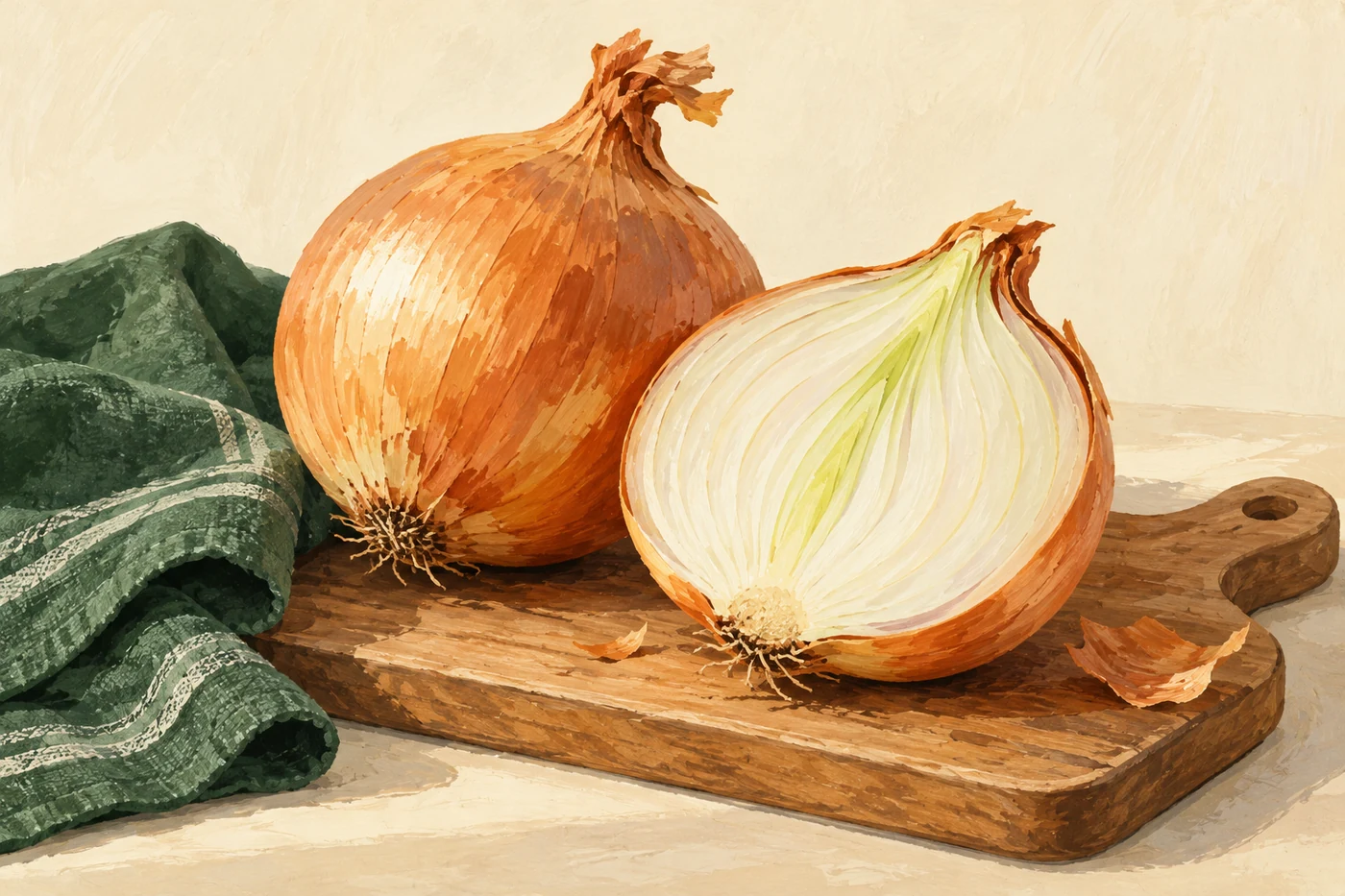
The cover is an illustration. Both diagrams are simplified models: their colours and shapes represent processes we cannot see with the naked eye.
An onion contains tiny cells
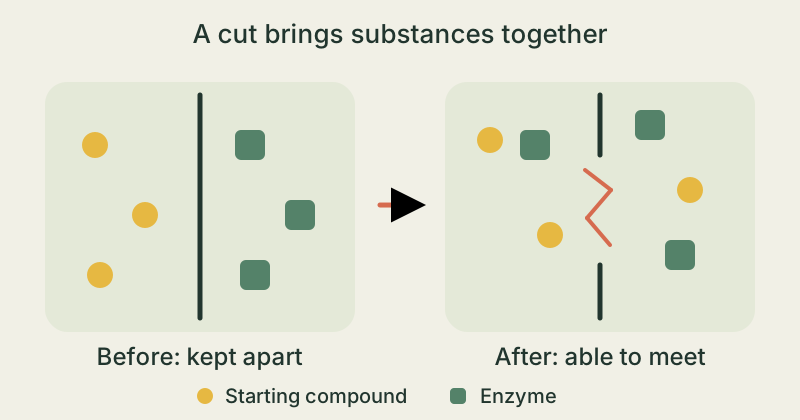
Each visible layer contains many tiny cells. In undamaged cells, certain starting substances and enzymes are kept apart. A cut breaks these barriers. The ingredients for a reaction can now meet.
Enzymes help things change
An enzyme is a protein that speeds up a chemical reaction. First, alliinase helps transform sulfur-containing starting compounds. A second enzyme, lachrymatory factor synthase, converts a short-lived intermediate into the irritant syn-propanethial-S-oxide. You do not need to remember that long name.
Through the air to the eye
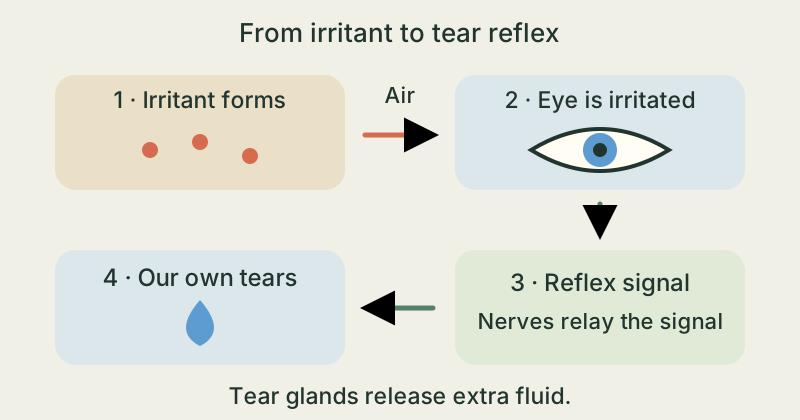
This tear factor is volatile: it can readily enter the air. If it reaches the eye's surface, it irritates sensory nerves there. A reflex activates the tear glands. Extra tears help wash the irritant away. Nobody needs to feel sad for this to happen.
What changes during cooking?
Sufficient heating stops the enzymes involved from working, while volatile irritants can escape. Fully cooked onions therefore usually cause much less of this response. Simply putting a raw onion next to the cooker does not instantly remove its ability to produce the irritant.
Discover the layers during ordinary cooking
- When onions are already being prepared for a meal, ask an adult to show you a whole onion and one they have already halved. Leave the cutting to them and keep your face away.
- Sketch the visible layers on the cut surface. Compare them with diagram 1: the cells drawn there are a model and much smaller than the layers you can see.
- Put four ideas in order on paper: cell damage, reaction, airborne irritant, tear reflex. Use diagram 2 to explain the sequence. You do not need to make your eyes water.
Observe with an adult only during food preparation that was already planned. Do not deliberately sniff onions, splash juice or touch your eyes. Move away if irritation starts; do not continue the activity.
The takeaway
Damaged cells allow enzyme reactions to happen. A volatile irritant produced by these reactions can reach the eyes and trigger a protective tear reflex.
What connects a cut onion with watering eyes?
Sources & further reading
American Chemical Society · The nitty-gritty behind how onions make you cry (2017) ↗Washington State University · Ask Dr. Universe: Why do onions make us cry? ↗McGill University · Onion chemistry and cooking ↗Our stories explain the main idea in our own words. Pictures and models simplify reality and are not drawn to scale.