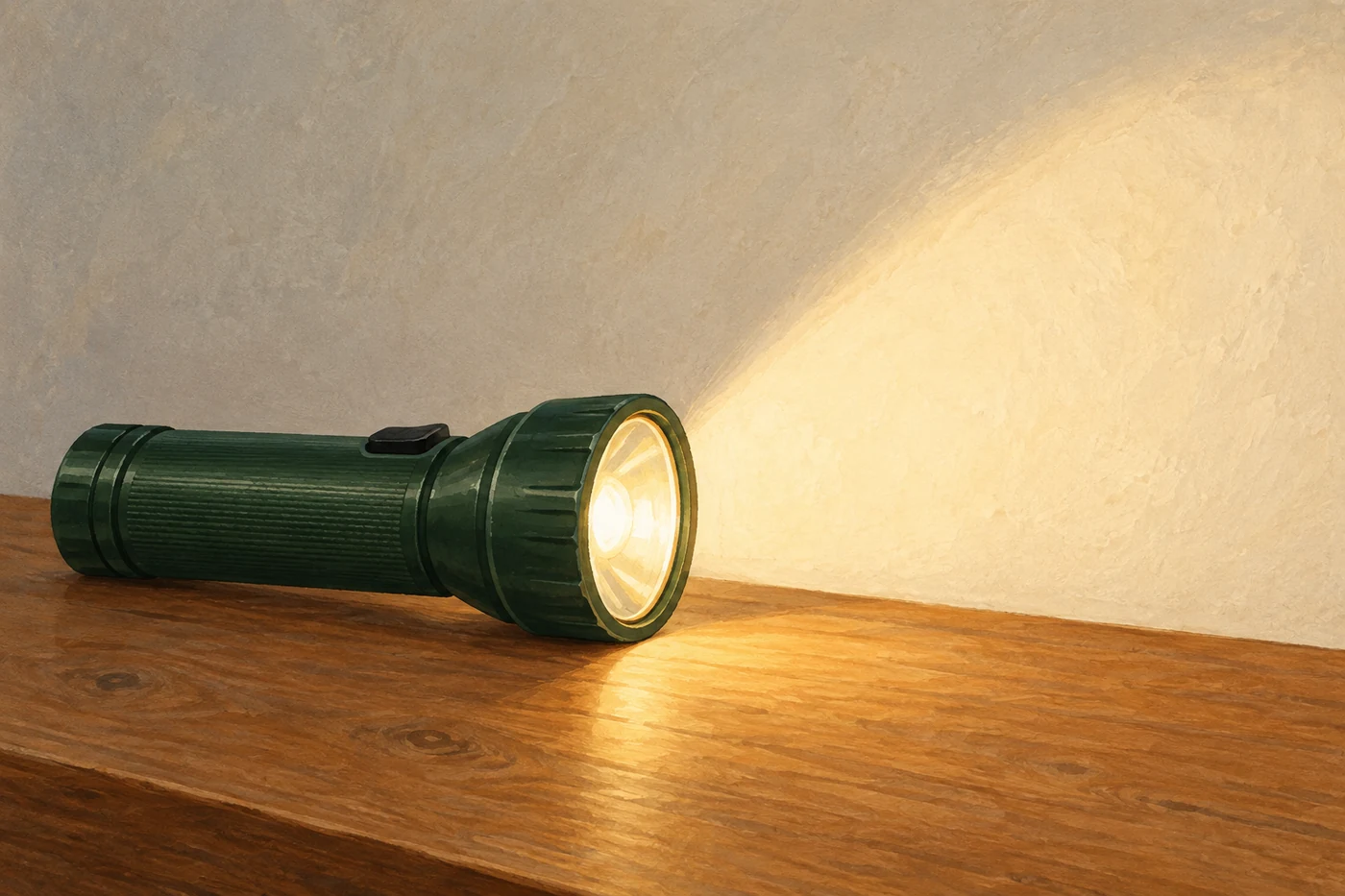
A battery-powered lamp needs an unbroken conducting path from one battery terminal, through the lamp, to the other terminal. The path inside the battery completes the circuit too. When this circuit is closed, with a suitable working battery, current can flow. Breaking the path at the switch turns the simple lamp off.
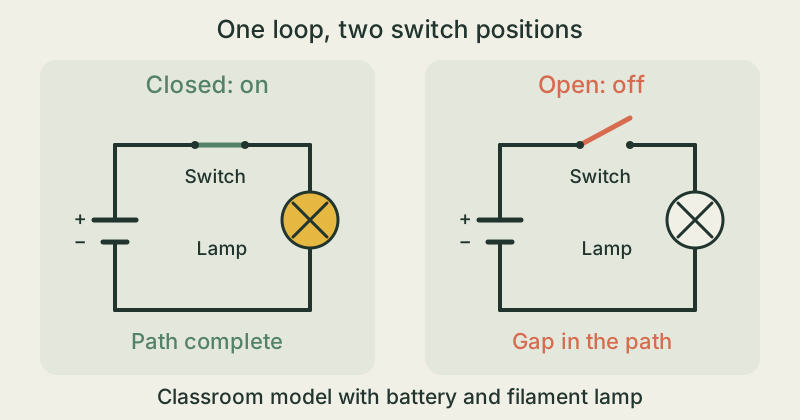
The cover is an illustration. Diagram 1 shows a simplified classroom model with a battery, switch and small filament lamp. A real flashlight may contain extra components. Its housing stays closed during our observation.
A path there and back
Think of the circuit as a continuous loop with the lamp on that path. Connecting just one of the lamp's terminals to the battery is not enough in this simple model.
The loop need not look round: a rectangle can represent a closed circuit too. What matters is the connections. Diagram 1 compares the same arrangement with the switch closed and open.
The switch makes a gap
A simple switch joins two contacts or separates them. Switching on completes the conducting path; switching off creates a gap. In our model, no sustained current then flows through the lamp.
Here, 'closed' means connected and 'open' means broken. This may sound surprising at first: it is the closed switch that lets the lamp shine.
The battery supplies energy
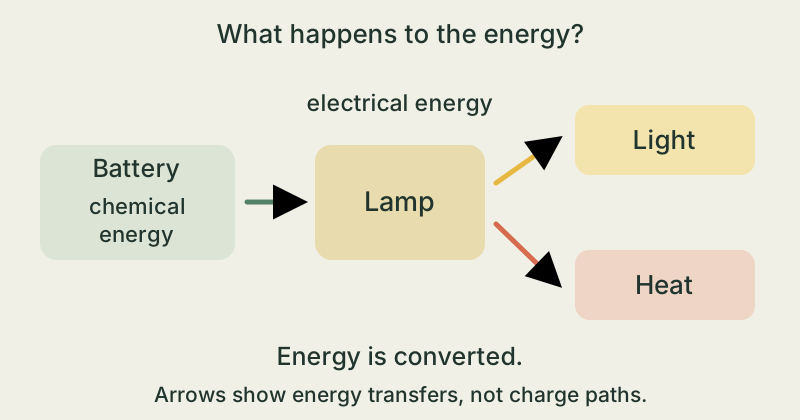
There is an electrical voltage between the battery's two terminals. Chemical reactions in the battery supply energy. In the closed circuit, energy can be transferred to the lamp.
The lamp converts electrical energy into light and heat. Diagram 2 shows this energy conversion; its arrows do not trace individual electrons. A lit lamp can become hot.
Current is not a store of light
Electric current is the directed movement of electric charge. A lamp does not use up charge like fuel. It converts energy. A battery is therefore not a container of ready-made light.
A closed path alone does not guarantee light: the battery and lamp must be suitable for each other and working. Looking at a dark flashlight alone cannot tell you whether the switch, battery or another part is responsible.
Observe a flashlight with its housing closed
- With an adult, choose an undamaged, working flashlight powered by AA or AAA batteries. Leave its battery compartment closed. Point it at a clear wall, never at anyone's eyes.
- Predict what will happen when you use the switch. Turn it briefly on and off again. Record only what you see: a light patch appearing or disappearing. Do not touch the lens.
- Use diagram 1 to draw two models: switch closed and switch open. Mark the gap. Separate your visible observation from its explanation: you did not directly see the current or the contacts inside.
Observe with an adult. Use only the complete flashlight with its housing closed. Use no wall sockets, exposed wires, loose batteries or button cells; do not dismantle or short-circuit anything. Stop if it is damaged or unusually warm. Do not look into the beam.
The takeaway
In a simple circuit, the lamp needs a complete conducting path and a suitable energy source. The switch can complete or break the path. The battery supplies energy; the lamp converts it into light and heat.
What does the switch do in the simple circuit when the lamp is switched on?
Sources & further reading
OpenStax · Physics: Ohm’s law and electric current ↗OpenStax · University Physics Volume 2: Electromotive Force ↗U.S. Energy Information Administration · Open & Closed Circuits (PDF) ↗Our stories explain the main idea in our own words. Pictures and models simplify reality and are not drawn to scale.