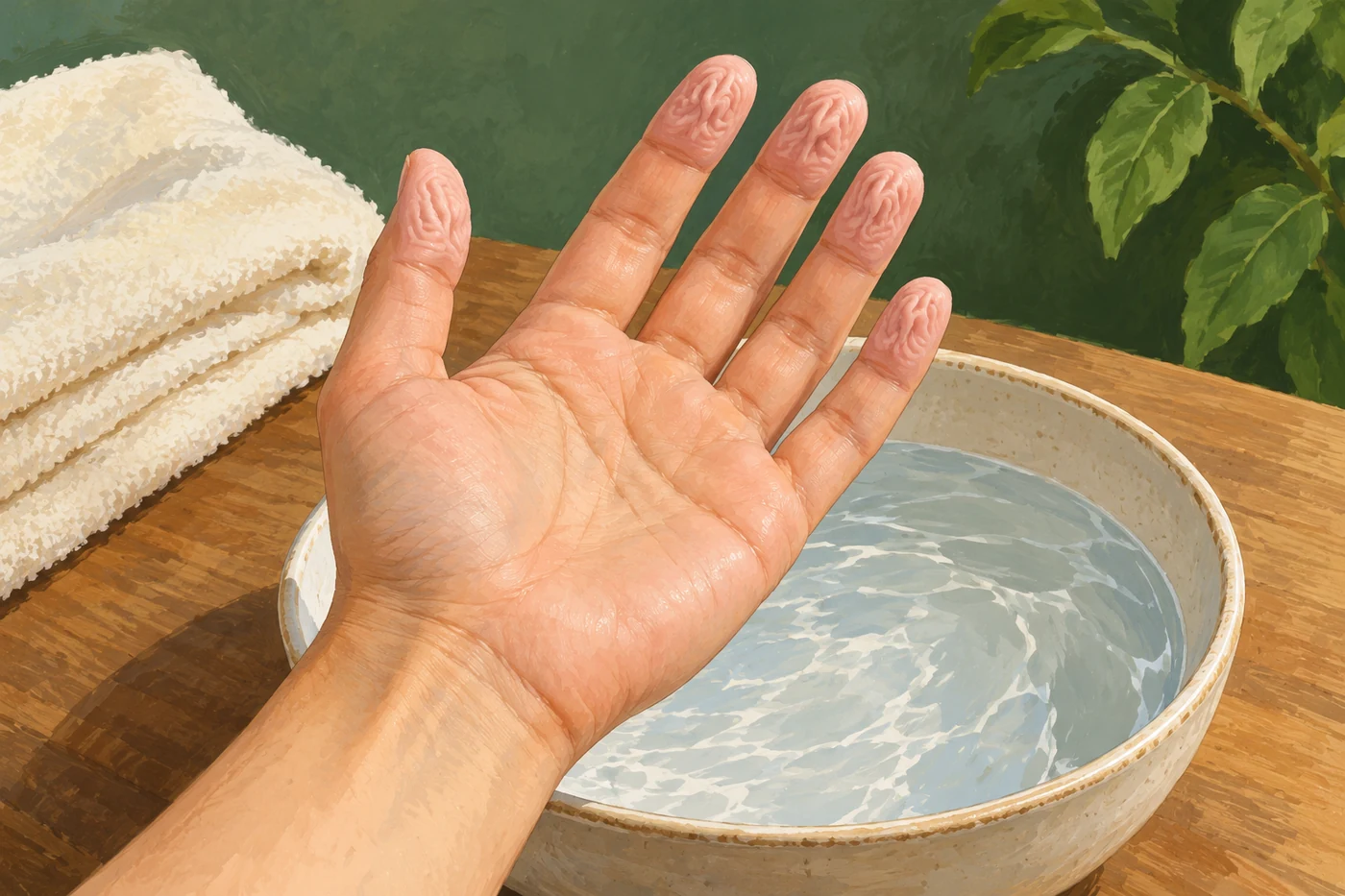
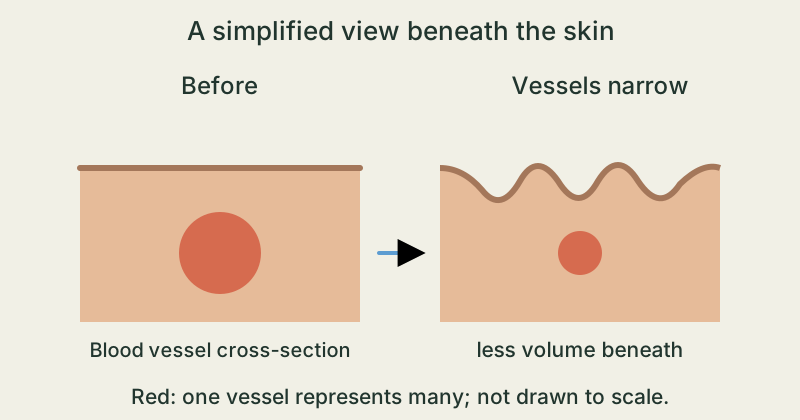
The involuntary nervous system helps produce the familiar water wrinkles. Small blood vessels in the fingertip narrow. This reduces the volume beneath the skin, allowing the surface to fold. The effect is particularly noticeable on the soft pads of our fingertips.
The cover is an illustration. Our diagrams are simplified models, not medical images or drawings to scale. We are discussing the temporary folds that follow prolonged everyday contact with water.
A response without a conscious command
You do not have to tell your fingers to wrinkle. The autonomic nervous system controls many processes without a conscious decision. Its sympathetic branch helps control this response to water.
Researchers are still investigating how water contact starts the full chain of events. The involvement of nerves and blood vessels is an important part of the explanation.
Something changes beneath the surface
A fingertip contains many small blood vessels. When they narrow, their blood content changes and the volume of the soft tissue beneath the skin decreases.
The overlying skin is pulled inwards and forms furrows. Diagram 2 gives a very simplified picture of this connection. Looking at your finger does not let you see the blood vessels themselves.
Large folds and fine fingerprints
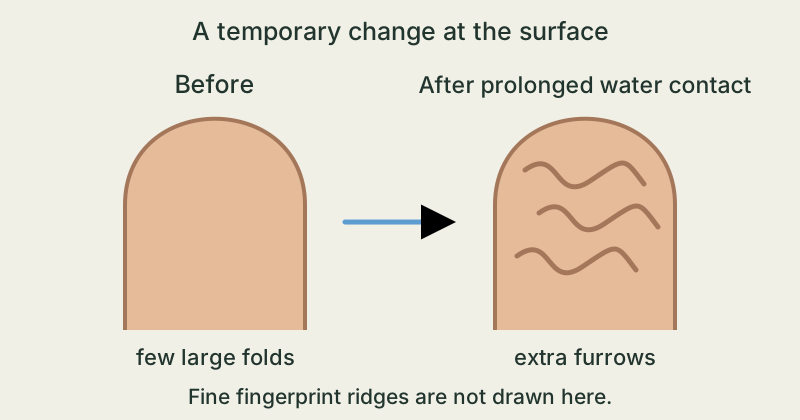
The fine lines of a fingerprint are already there before a bath. The extra, larger water wrinkles change the fingertip's surface relief. Diagram 1 shows only this broad change.
Research presented in 2025 compared photographs after repeated soaking. The researchers found recurring wrinkle patterns. This fits with blood vessels remaining in much the same arrangement inside the finger.
Do the folds help us grip?
One proposed benefit is that wrinkles might help us handle wet objects. A 2021 study found an advantage in how efficiently participants adjusted their grip force.
A separate 2014 study found no advantage for dexterity or touch sensitivity in its tasks. The experiments measured different abilities. Saying 'water wrinkles always improve grip' would therefore be too broad. A possible benefit and the mechanism that produces the folds are different research questions.
Look closely during your next ordinary bath
- Before a bath you were already planning to take, look at one fingertip pad. Sketch its visible skin lines. An adult can help you compare them. Keep your usual bathing time and water temperature unchanged for this observation.
- After the ordinary bath, look at the same fingertip again. Are there extra, larger folds? Add them to your drawing. Record it if you see little change too. Do not stay in the water longer to force a particular result.
- Gently dry your hands and look again later. Compare your three sketches with diagram 1. You are observing the surface, without measuring nerve activity or blood flow. This everyday observation cannot be used as a health test.
Observe only during normal everyday activities; skip this if your skin is irritated or injured. Do not use extra-long soaking, additives, ice or hot water to speed things up. Do not try grip experiments with heavy, breakable or slippery objects.
The takeaway
The autonomic nervous system and narrowing blood vessels help produce typical water wrinkles. Reduced volume beneath the skin lets the surface form furrows. Whether and when wrinkles assist grip is a separate research question.
Which change helps produce water wrinkles in the model described?
Sources & further reading
Binghamton University · Research on water-induced fingertip wrinkles (2025) ↗Davis · Water-immersion finger-wrinkling and grip efficiency · PLOS ONE (2021) ↗Haseleu et al. · Water-induced finger wrinkles and dexterity · PLOS ONE (2014) ↗Our stories explain the main idea in our own words. Pictures and models simplify reality and are not drawn to scale.