No. Crumpling leaves the paper's mass unchanged. Its compact shape usually presents a smaller frontal area to the air than a broadside falling sheet. At the same falling speed, it therefore usually experiences less air resistance. The ball often reaches the floor first.
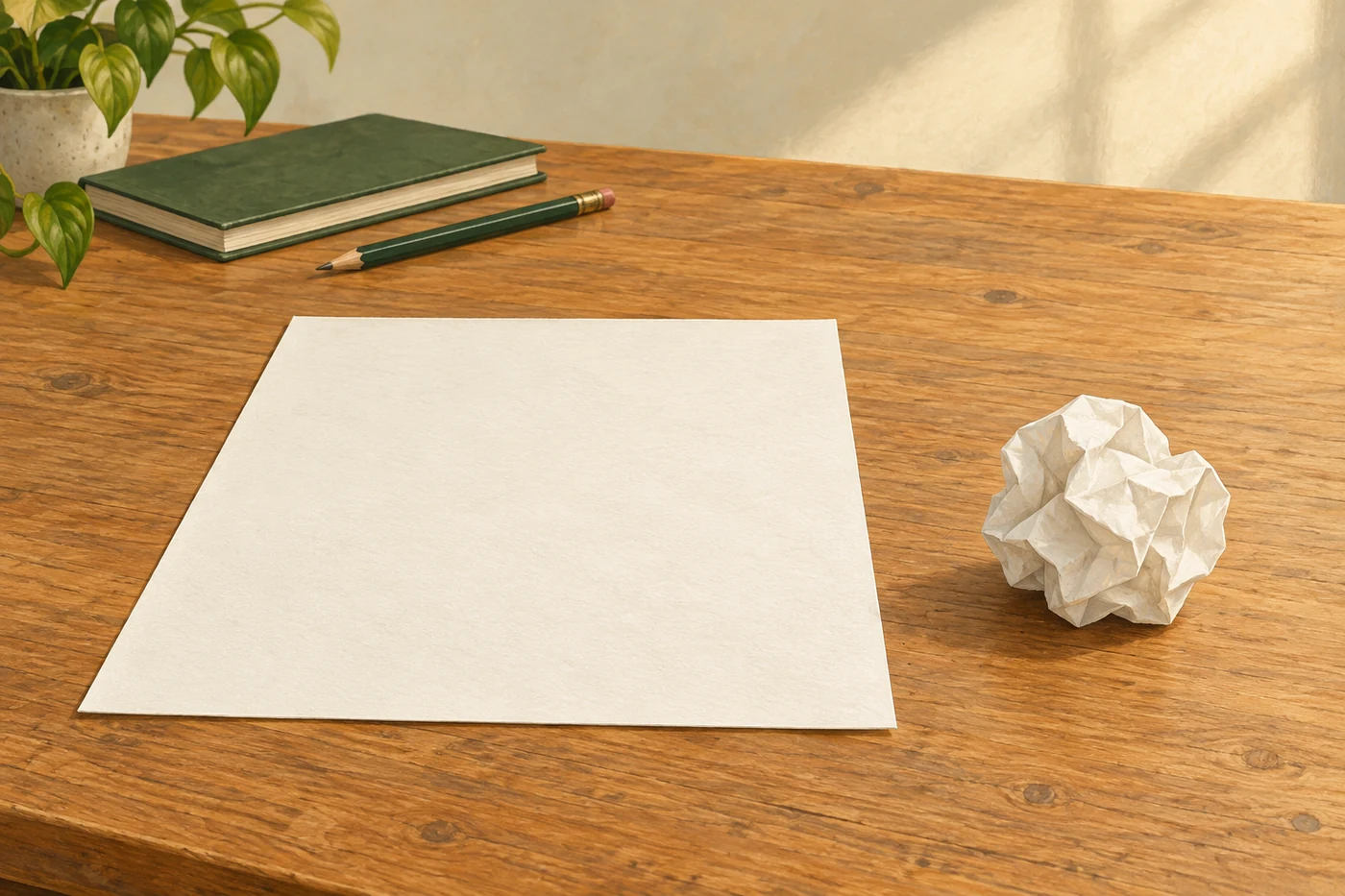
Two identical sheets can fall very differently. One stays flat while the other is crumpled into a ball. Their difference shows that air plays a part in falling too. The cover illustrates the shapes; it is not a measured experimental result.
Crumpling adds no paper
If you neither add material nor tear any away, a crumpled sheet contains the same amount of paper. Its mass stays the same. In the same place, its weight is therefore practically unchanged too.
Earth pulls both shapes downwards. The ball does not fall faster because crumpling has strengthened gravity.
Air pushes against the motion
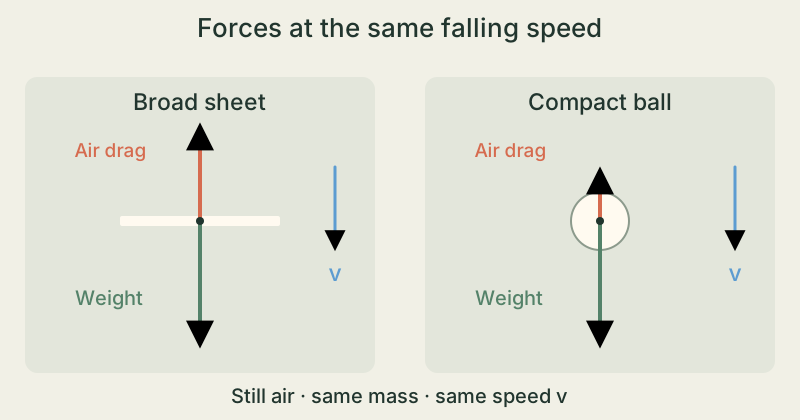
As paper falls, air must move around it. A force acts against its motion through the air: air resistance, or drag. During a vertical fall through still air, this force points upwards.
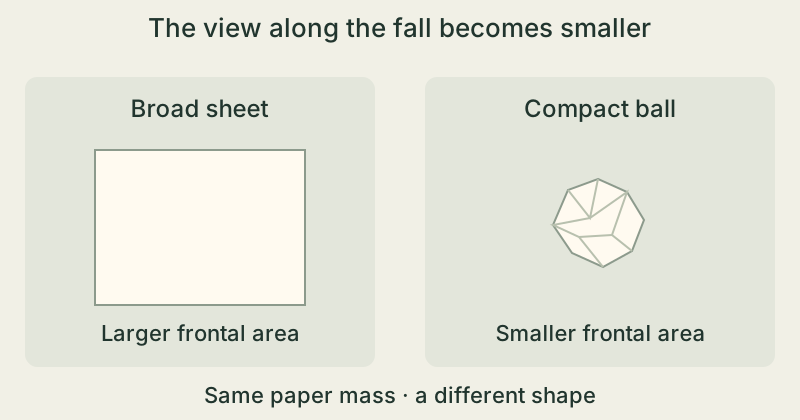
Shape and orientation matter. A horizontal sheet presents its broad side to the air. A compact ball has a much smaller frontal area: the view looking along its direction of fall. The paper's actual surface has not been cut away.
Compare them at the same speed
Air resistance also depends on speed relative to the air. At the same speed, air usually pushes harder against the broad sheet than against the compact shape shown. This offsets more of the downward force.
The sheet then gains falling speed less quickly. A resisting force does not mean it immediately slows down: while the total force still points downwards, it can keep speeding up.
A sheet can tilt too
Real paper turns, flutters and changes its frontal area. Draughts and how you release it also affect its path. The paper ball therefore usually arrives first, but every attempt need not look identical.
Without air resistance, both shapes would accelerate equally and arrive together if released from the same height without a push. Our room, however, contains air.
Compare two paper shapes from the same start
- With an adult, take two equal-sized sheets of the same kind of paper. Crumple one into a compact ball without adding or removing material. Leave the other flat. Clear a patch of floor indoors and avoid draughts.
- The adult holds both shapes side by side at about waist height, no more than one metre above the floor. Keep the flat sheet's broad face horizontal. Release both as nearly together as possible, without pushing. Watch which lands first and whether the sheet flutters.
- Repeat three times, swapping left and right. Record each landing order, including unclear results. Different release times and turning remain sources of error; this simple comparison does not measure an exact drag force.
Use lightweight paper only. Keep your feet on the floor and do not climb on chairs or tables. Never drop anything from windows, stairs or balconies. Add no heavy objects, clips or other materials. Pick up the paper afterwards.
The takeaway
Crumpling leaves mass unchanged. Shape, frontal area and speed help determine how air resists falling paper. Less air resistance at the same speed can let the compact ball reach the floor sooner.
Why does a compact paper ball often reach the floor before a broad sheet?
Sources & further reading
Yale Physics · Falling Bodies Air Resistance ↗NASA Glenn · What is Drag? ↗NASA Glenn · Size Effects on Drag ↗Japan Society of Mechanical Engineers · Falling Slowly, Falling Quickly ↗Our stories explain the main idea in our own words. Pictures and models simplify reality and are not drawn to scale.