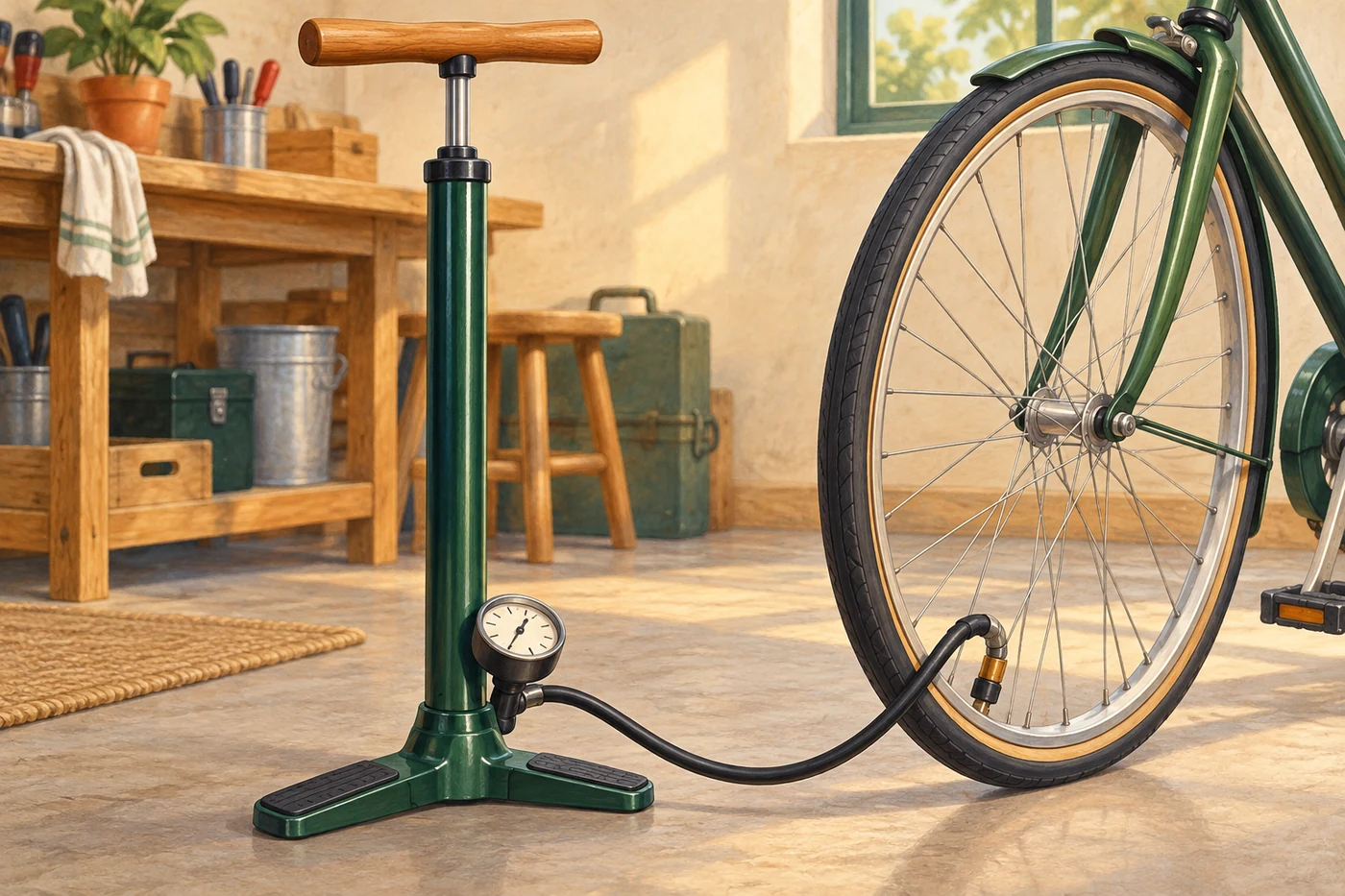
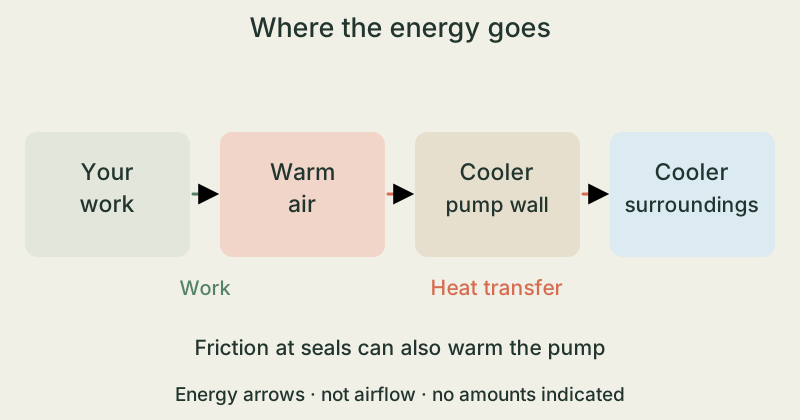
Pumping compresses air and transfers energy to it. During rapid compression, its temperature can rise. Warm air then transfers energy to the pump. Friction can contribute to the warming too.
After inflating a bicycle tyre, you may notice that the pump is warmer. It needs no flame. Moving the handle supplies energy. The cover is an illustration, not a measured experimental result.
A piston pushes on the air
The handle moves a piston inside the pump. The compression stroke reduces the space available to the air. Pushing it into a smaller volume means working against its pressure. In physics, this transfer of energy is called work.
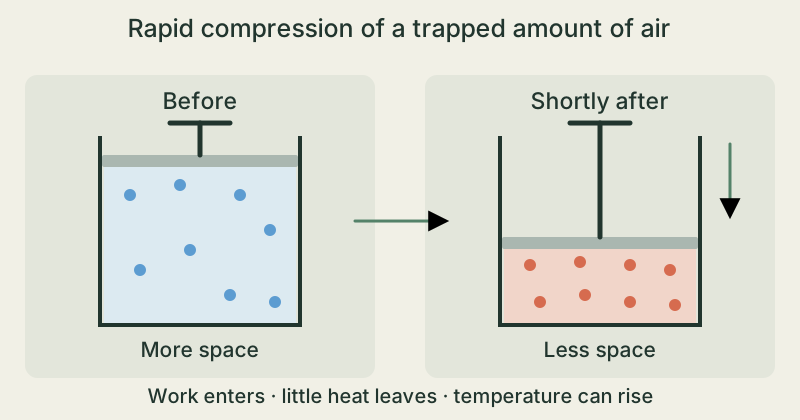
Pressure inside the pump rises. Once it is high enough, air flows through the outlet valve into the tyre. Our first drawing considers only a trapped amount of air as it is compressed.
A quick push leaves little time to cool
Compression supplies energy to the air. If little of it can leave as heat during that short time, the air's internal energy increases. Its temperature can rise too.
Air particles are always moving. At a higher temperature their average energy of motion is greater. The particles themselves do not grow. The particle drawing is a very simplified model.
How the barrel gets warmer
Warmed air transfers energy to the cooler pump wall. After several strokes, the outside can be warmer as well. The air and the barrel need not have the same temperature.
Moving seals also produce friction. Warming depends on the pump's construction, pumping speed and heat transfer, among other things. A warm barrel alone does not reveal each contribution.
High pressure does not always mean hot
During a pause, the warm pump can transfer energy to its cooler surroundings. During very slow compression with good heat transfer, air can stay at nearly the same temperature even while its pressure rises.
Compression, temperature and heat transfer belong together. Energy is not created from nothing: your work supplies it, and some later reaches the surroundings.
Observe normal tyre inflation
- Join an adult when a bicycle tyre needs air anyway. The adult checks its correct pressure and the instructions. Use a floor pump with a pressure gauge and an external contact thermometer. Skip pumping if the tyre is already correctly inflated.
- Record the temperature on the outside of the lower pump barrel before starting. The adult inflates the tyre normally to the intended pressure while you count strokes. They then measure the same spot again without opening the pump.
- Record a third reading after a two-minute pause. Can you see a difference, or is it small? Record that too. The outside temperature is not the temperature of air inside the cylinder, and it cannot separate compression from friction.
The adult operates the pump and thermometer and follows the permitted pressures for the tyre, rim and pump. Do not keep pumping just to produce warmth. Never block the outlet or hose, dismantle the pump or direct air at people. Stop and allow it to cool if the surface gets hot or resistance seems unusual.
The takeaway
Your work during compression can warm the air. It transfers energy to the pump wall, and friction can also contribute. Heat transfer affects how much warming remains.
Why can air get warmer during rapid compression?
Sources & further reading
University of Reading / Open University · Internal energy, heat and energy transfer ↗NASA Glenn · Isentropic Compression ↗OpenStax · University Physics: Thermodynamic Processes ↗University of Colorado Boulder · Adiabatic Expansion and Gas Law Physics ↗Our stories explain the main idea in our own words. Pictures and models simplify reality and are not drawn to scale.