The cones in your retina need enough light for clear colour vision. As light fades, the more light-sensitive rods contribute more to seeing. Rods alone cannot provide colour comparisons. Colours therefore become harder to tell apart.
Colourful objects often look less colourful in the evening. Their surfaces do not simply lose their colour. How our visual system handles low light matters too. The cover is an illustration, not a precise reproduction of your perception.
Light becomes signals
Light from an object passes through the pupil and lens to the retina at the back of your eye. Light-sensitive cells respond there. Their signals are processed and travel through the optic nerve to the brain.
Two important cell types are called cones and rods. They help us in different lighting conditions.
Cones help compare colours
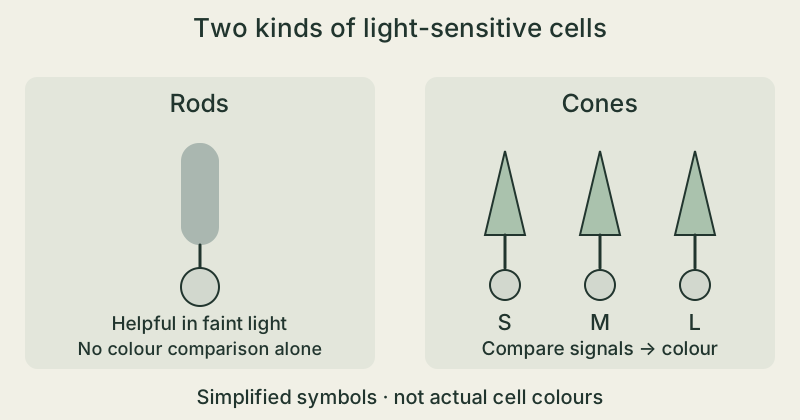
Most people have three types of cones. They respond differently to short, medium and long light wavelengths. Their sensitivity ranges overlap: one cone type is not a detector for just one single colour.
The visual system compares signals from different cones. This lets us distinguish many colours. In very low light, this system provides less useful colour information.
Rods work with less light
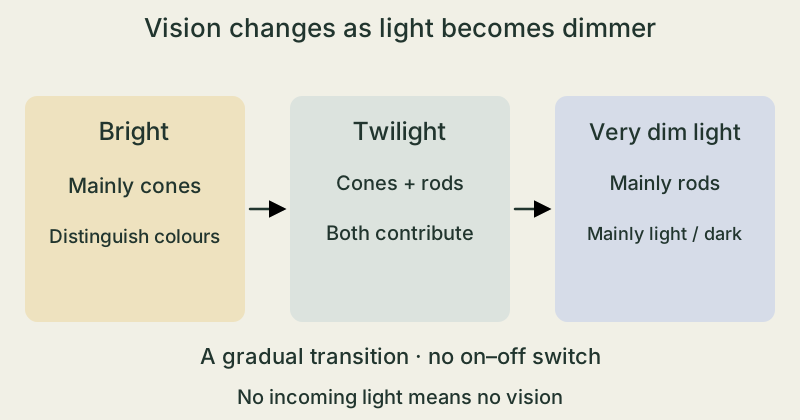
Rods are more sensitive to faint light than cones. They help us detect differences in brightness and outlines in low light. On their own, however, rods cannot distinguish colours.
At dusk, both cell types usually still contribute. There is no sudden switch that turns off every colour. In very faint light, when rods dominate, we mainly get an impression of light and dark.
Adjusting takes time and still needs light
After moving from a bright room into a dimmer one, you often begin to see more after a while. Your pupils can widen, and your visual system adjusts its sensitivity too. This is called dark adaptation.
That does not automatically restore every colour. In complete darkness with no incoming light, we cannot see. Appearance also depends on the light falling on an object and on the observer.
Compare colour cards in one room
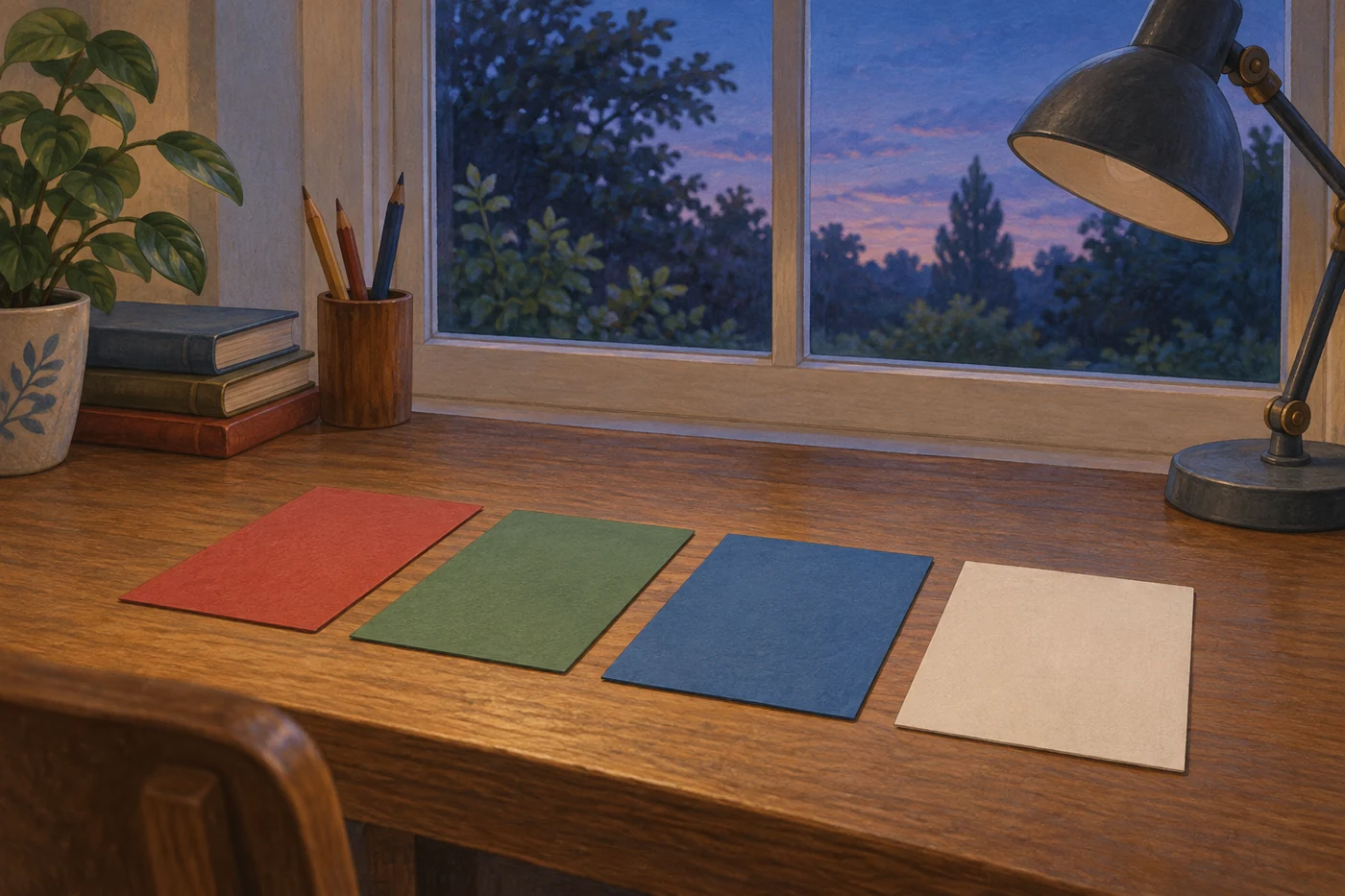
- With an adult, place red, green, blue and white paper cards on a table. Stay seated and look at them under normal room lighting. Note which colours you can distinguish easily, keeping the cards in their positions.
- The adult lowers the room lighting a little, for example by switching off one of several lamps. Keep enough light for safe vision. Leave the cards in place. Look immediately and again after a few minutes: are their colours, or just their outlines, still clear?
- Restore the normal lighting and compare your notes. A small difference or no difference is a result too. Lamp colour, remaining light, paper and memory all affect this comparison; it does not measure individual visual cells and is not an eye test.
An adult operates the room lighting. Stay seated at a clear table and keep enough light to orient yourselves safely. Never cover lamps, use candles, lasers or bright torches, or stare at the sun or light sources. Restore normal lighting and stop if observing feels uncomfortable.
The takeaway
Cones let us compare colours when there is enough light. In dim light, rods help more, but rods alone cannot distinguish colours. Dark adaptation makes faint light more useful; it cannot replace it.
Why can colours become harder to recognise in very low light?
Sources & further reading
National Eye Institute · How the Eyes Work ↗Arizona State University · Rods and Cones ↗OpenStax · Introduction to Behavioral Neuroscience: The Retina ↗OpenStax · Psychology 2e: Vision ↗Our stories explain the main idea in our own words. Pictures and models simplify reality and are not drawn to scale.