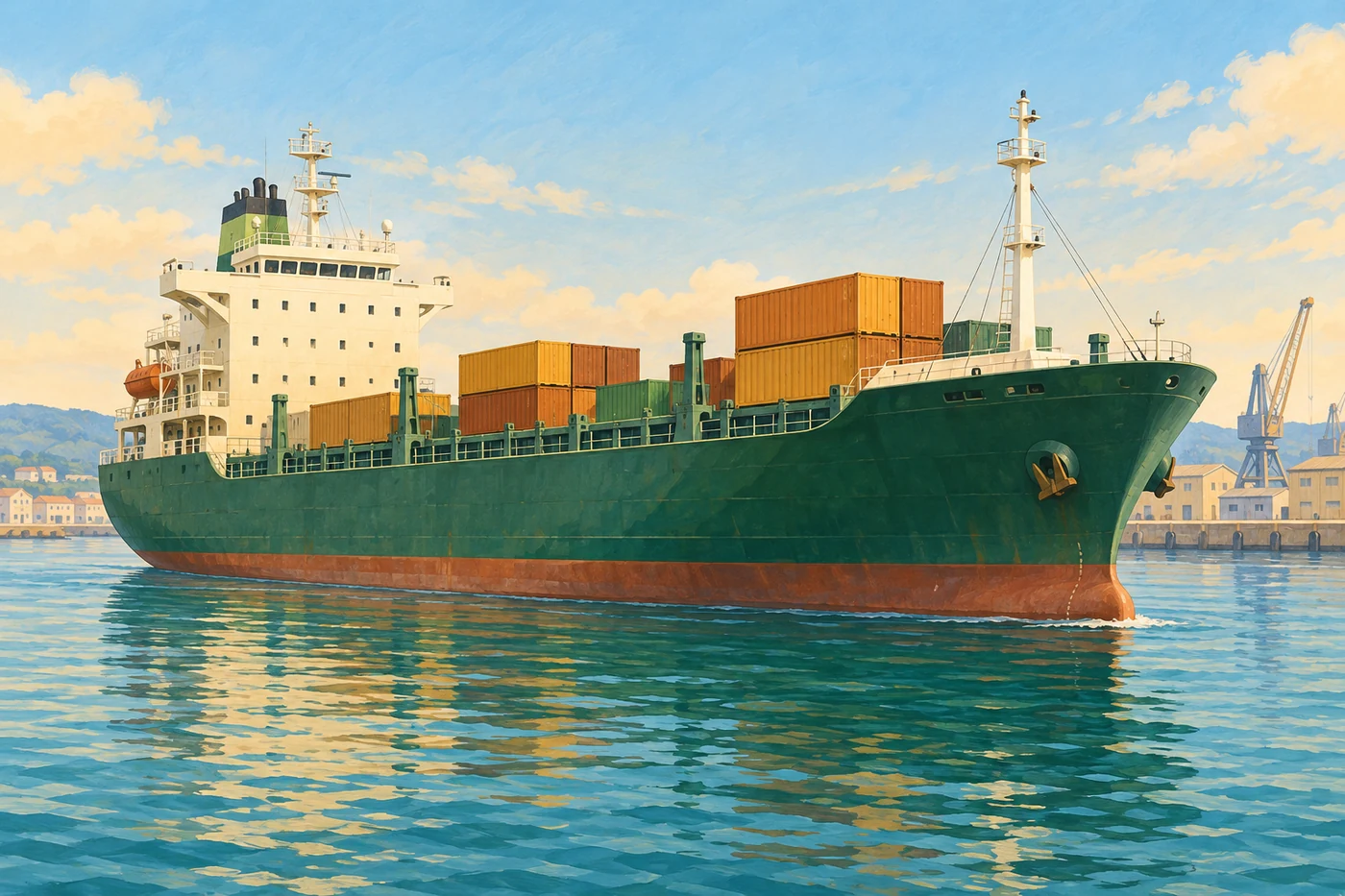
The hollow hull keeps water out and displaces a large amount of it. The water pushes the ship upward: this is buoyancy. When it floats at rest, buoyancy supports the weight of the ship and its cargo.
A cargo ship carries heavy crates too. Its metal has not acquired a new property. We need to consider the whole ship. The cover is an illustration, not an experimental measurement.
Water pushes back
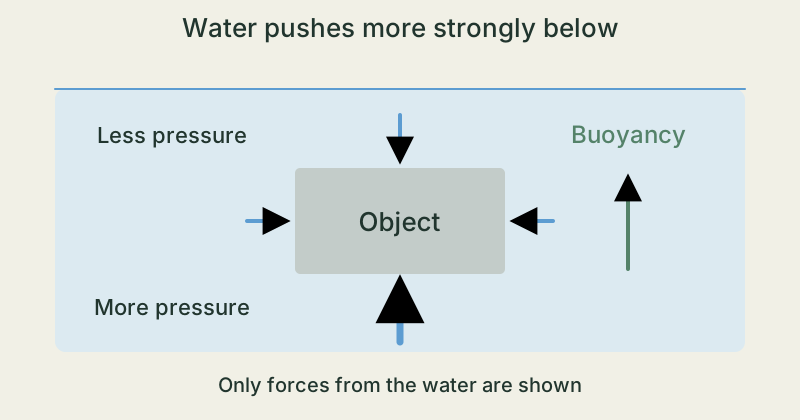
Water pushes on submerged surfaces. Pressure increases with depth. The overall result is an upward force, called buoyancy.
Even a sinking steel block experiences buoyancy. In that case, it is simply too small to support the block's weight.
Space for air instead of water
The hull surrounds a large space filled with air. While water stays out, the ship can push a large volume of water aside.
Taken together, the metal and air space have a low average density. Density describes how much mass occupies a given volume.
Displaced water and weight
Archimedes' principle says that the buoyant force equals the weight of the displaced water.
For a ship floating at rest, buoyancy balances its weight. Air in the hull keeps space free; the supporting force comes from the water.
Cargo makes the hull sit lower
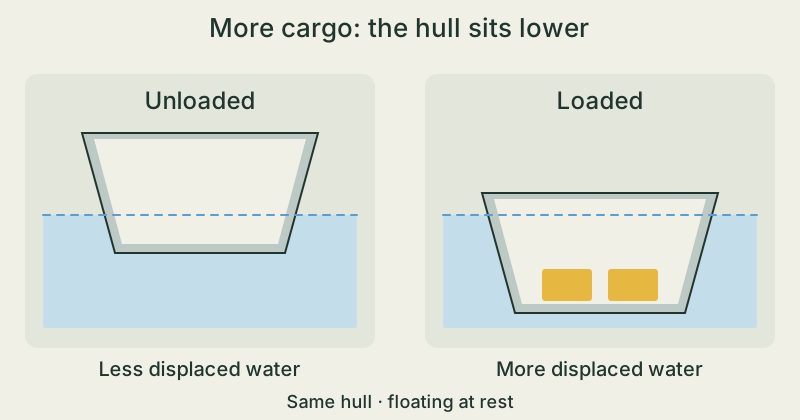
Extra cargo adds weight. The ship sits lower and displaces more water until the forces balance again.
There are limits: overloading or tipping can let water over the rim. Holes also put the dry interior at risk.
Carefully load a foil boat
- With an adult, put a shallow plastic dish on a towel and add a few centimetres of water. Shape aluminium foil into a small open boat with a flat bottom, folded edges and a high rim.
- Place the boat on the water. It must float freely, without touching the bottom or sides of the dish. Draw a side view showing the waterline on its hull.
- The adult adds identical coins one at a time, spreading them evenly. Watch the waterline after each coin. Stop before water enters over the rim. Draw the loaded hull: does it sit lower?
Work with an adult using only a shallow dish on a table. Fold foil edges inward; keep coins away from mouths and small children. Wipe spills immediately and empty the dish afterwards. Do not try this at a real body of water.
The takeaway
A hollow hull can displace enough water for buoyancy to support its weight. More cargo means more displaced water and a hull sitting lower.
What is true of a ship floating at rest?
Sources & further reading
NOAA · Build a boat ↗NASA Glenn · Buoyancy: Archimedes Principle ↗OpenStax · University Physics: Archimedes’ Principle and Buoyancy ↗Idaho State University · Aluminum Foil Boats ↗Our stories explain the main idea in our own words. Pictures and models simplify reality and are not drawn to scale.