Soap contains cleaning particles called surfactants. Their heads interact well with water and their long tails with grease. This helps loosen grease from a surface and disperse it in water. Rinsing then carries it away.
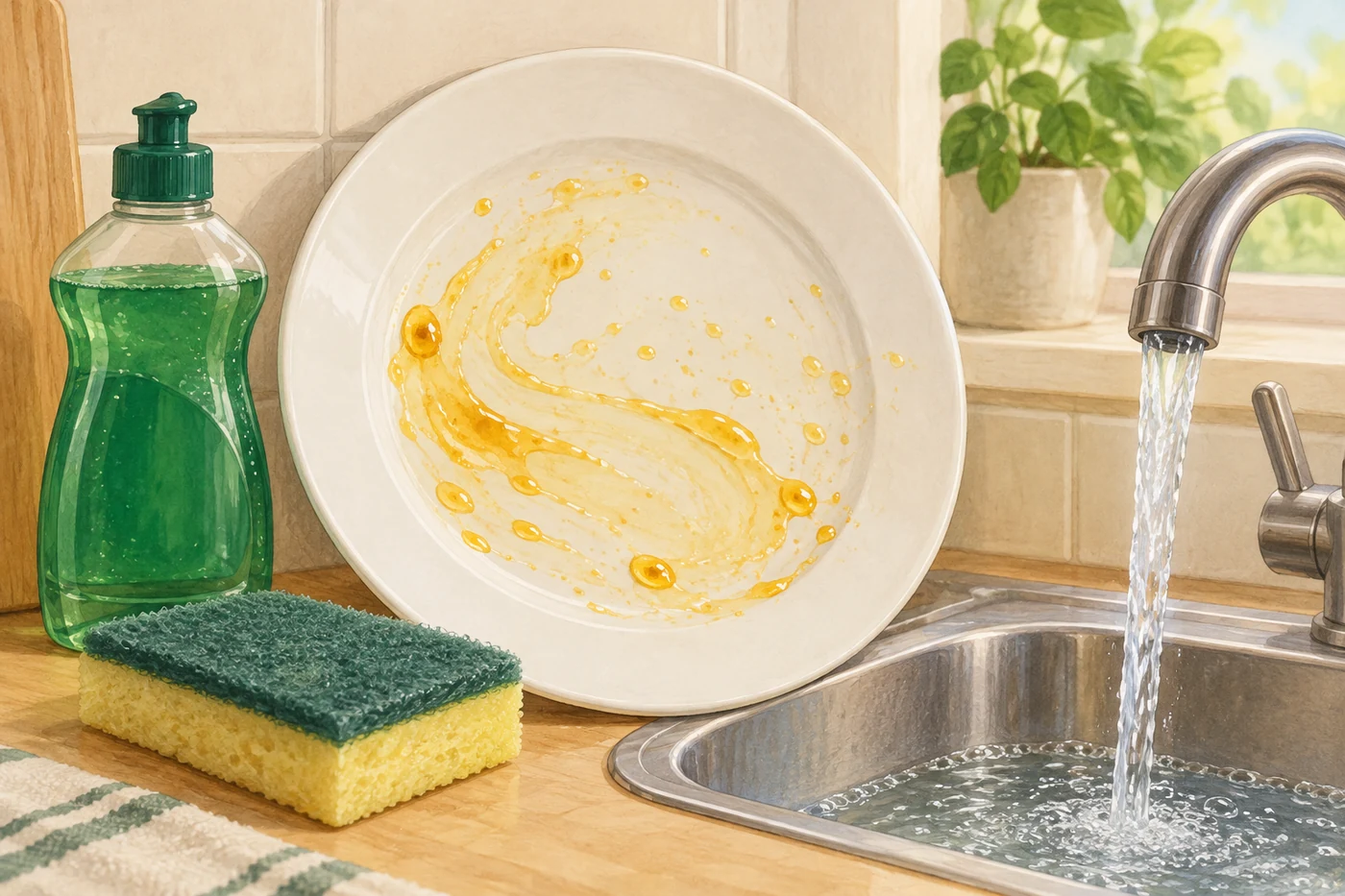
An oily plate often stays greasy when washed with water alone. A little washing-up liquid helps. Let's look at what its tiny cleaning particles do. The cover is an illustration, not a measured experimental result.
Water and oil tend to stay separate
Cooking oil barely dissolves in water. Their molecules have different structures, so they mix poorly. After stirring, many small oil droplets join up again into larger drops or a layer.
Cooking oil floating on top is a different property: it is less dense than water. Floating and dissolving are two separate questions.
One particle with two useful ends
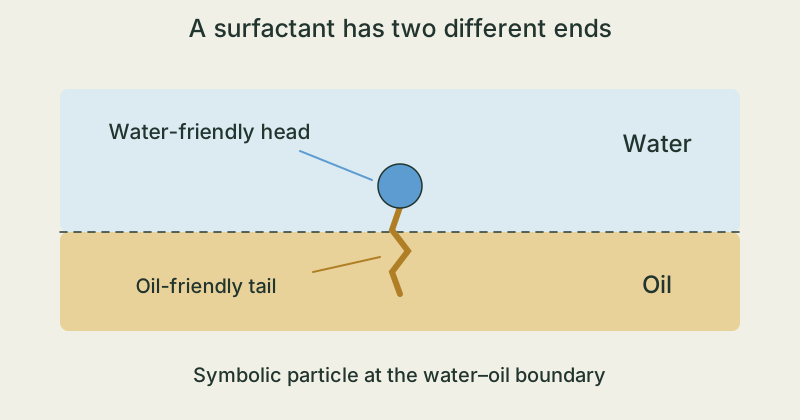
A surfactant has a water-friendly head and an oil-friendly tail. At the boundary between water and oil, the tail can extend into the oil while the head stays in the water.
Washing-up liquid also contains surfactants. They are usually different substances from traditional soap, but have the same useful combination. Water-friendly and oil-friendly describe interactions, not feelings.
Tiny helpers around grease
Movement and rubbing help loosen grease and break it into smaller drops. Surfactants collect at the droplets' surfaces and make it harder for them to merge straight away. Oil droplets dispersed in water form an emulsion.
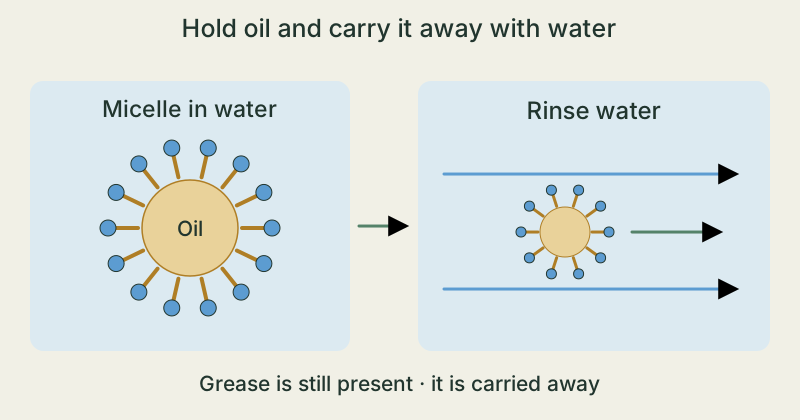
Surfactants can also form tiny groups called micelles. Their tails gather inside, with heads facing the water outside. These groups can hold oil components in their interiors. They are far smaller than visible foam bubbles.
Rinsing carries grease away
Rinse water carries loosened grease off the plate. The grease is still there; it has been dispersed and carried away. That is why rinsing is part of washing.
Our cup activity only observes how cooking oil disperses. It cannot show individual molecules or micelles, and it does not test for germs. Amounts, stirring and the washing-up liquid used affect the result.
Watch oil droplets in two cups
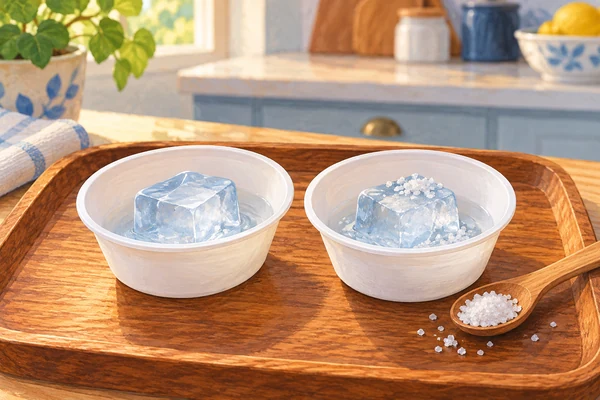
- With an adult, put two identical clear plastic cups on a tray. Add 50 ml of room-temperature water and three drops of cooking oil to each. Draw the oil patches as seen from above.
- The adult adds one small drop of ordinary hand dishwashing liquid to just one cup. Stir each cup slowly ten times, using separate spoons and roughly the same speed. Do not shake or whisk up foam.
- Compare straight away and after two minutes: can you see large patches, smaller drops or cloudy liquid? Draw both cups again and record a small difference too. Dispersed droplets can make liquid cloudy; this does not prove that the oil has disappeared.
Work with an adult, wear splash goggles and follow the product label. Use small amounts of cooking oil and ordinary hand dishwashing liquid, with no dishwasher tablets or other cleaners. Do not taste anything; keep splashes away from eyes and mouth. Oil makes surfaces slippery, so wipe spills immediately. The adult wipes up visible oil residue with paper and puts it in household rubbish, then rinses the cups. Wash your hands afterwards.
The takeaway
Surfactants have one end that interacts well with water and another that interacts well with grease. They help loosen and disperse grease. Rinse water then carries it away.
What helps soap wash grease away with water?
Sources & further reading
American Chemical Society · Can Liquids Dissolve in Water? ↗OpenStax · Organic Chemistry: Soap ↗OpenStax · Chemistry 2e: Colloids, Soaps and Detergents ↗American Chemical Society · Cleaning Up Oil Spills with Chemistry (PDF) ↗Our stories explain the main idea in our own words. Pictures and models simplify reality and are not drawn to scale.