Rapid twinkling happens mainly in Earth's atmosphere. Moving air bends starlight in slightly different ways. Your eye receives a little more light at one moment and less at another, making the star look unsteady.
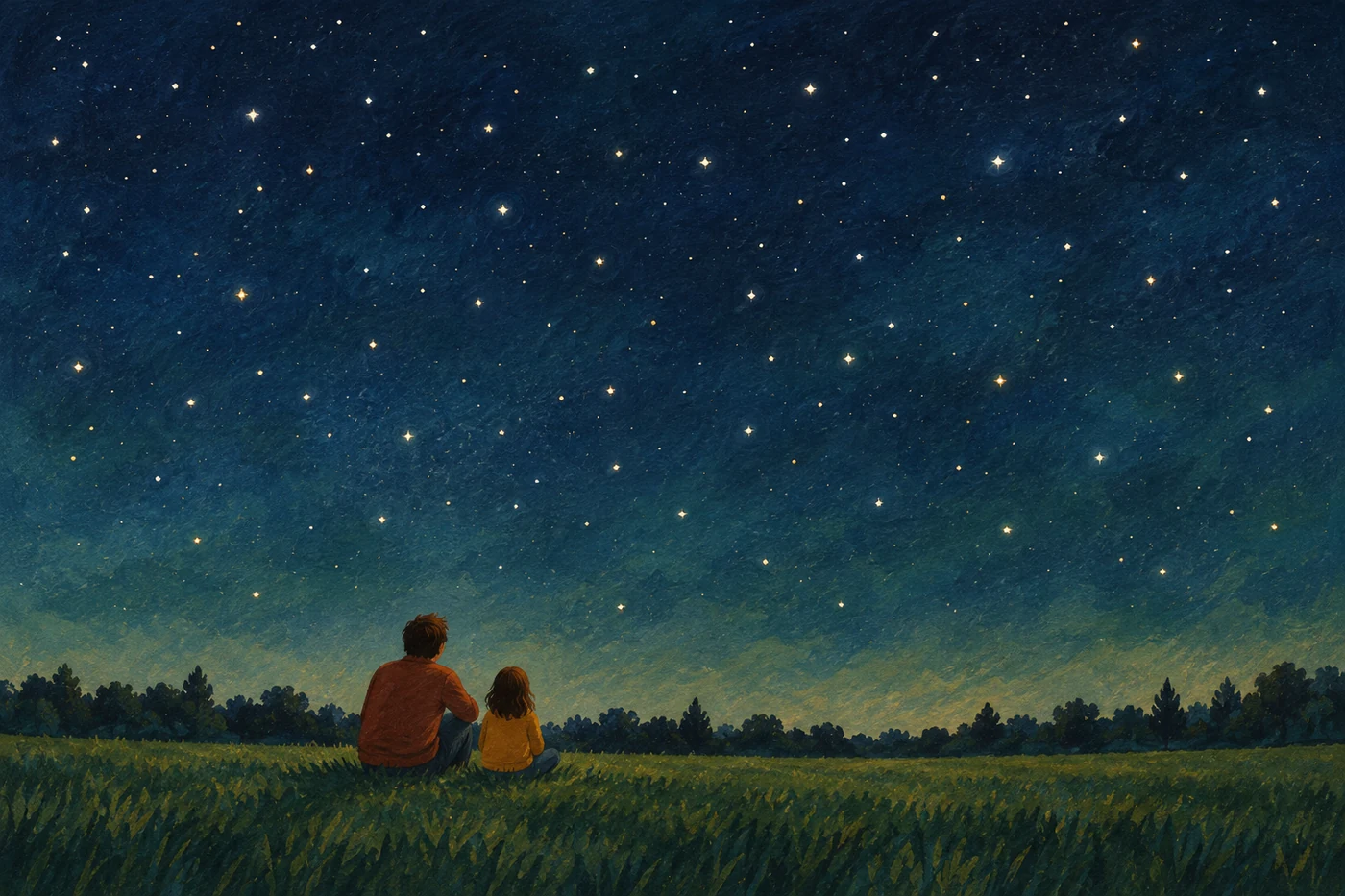
The cover is an illustration, not a sky photograph or star chart. It shows no measured brightness values or particular night.
Light travels through moving air
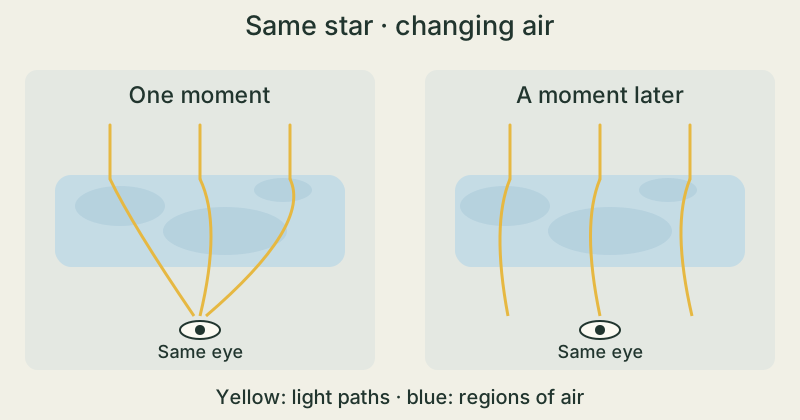
Starlight reaches us through Earth's blanket of air. Within it, regions with different temperatures and densities move and mix.
These regions refract light differently, changing its direction slightly. As the air shifts, the light's path changes too.
A distant star looks like a point
Stars are huge but extremely far away. This makes them look almost like points in the sky.
Air can focus or spread their light slightly. The brightness fluctuates rapidly, and the apparent position can jitter too. Above Earth's atmosphere, this atmospheric twinkling is absent.
A low star has more air in the way
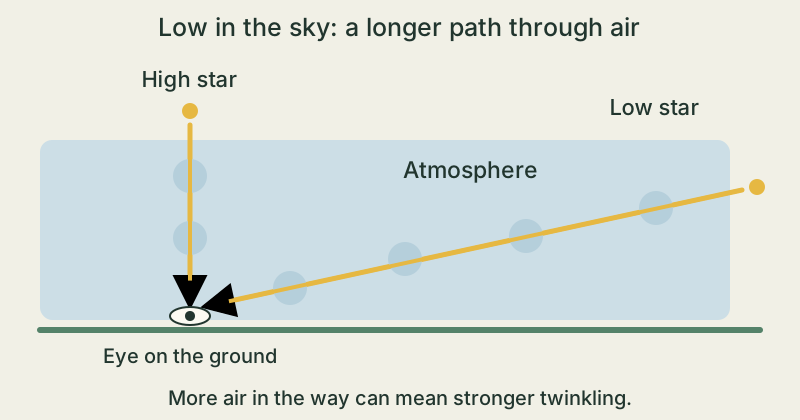
Near the horizon, light travels through more atmosphere than light from a star high in the sky.
Low stars therefore often twinkle more. How clear the difference is also depends on conditions in the air. One comparison may not reveal a clear pattern.
Why do planets often look steadier?
Planets appear as tiny disks, even when our eyes see them as points. Their light comes from many neighbouring parts of the disk.
Fluctuations from these parts partly average out, so planets usually twinkle less. Twinkling alone is not a reliable test for identifying a point of light as a star or planet.
Compare high and low stars
- With an adult, choose a safe, level place after sunset with a clear view. Stay in one spot away from roads, edges and open water. Use only your eyes. If clouds or bright lights spoil the view, postpone the observation.
- Use a star chart to choose two confidently identified stars: one higher in the sky and one lower, clearly above the horizon. Watch each for about 20 seconds and record “hardly any”, “some” or “strong twinkling”. Alternate between them three times and note the time.
- Compare your notes: does the lower star show stronger twinkling more often? Also record clouds, visibility and distracting lights. Try again on another clear evening. An unclear result is fine; you are measuring neither air movement nor precise stellar brightness.
Observe with an adult and wear enough warm clothing. Do not climb onto windowsills, roofs or railings. Do not use binoculars, telescopes or lasers. Never look at the Sun; stay indoors if the weather or location is unsafe.
The takeaway
Twinkling tells us a lot about the air between a star and our eyes. Changing refraction alters the light that arrives. Stars near the horizon often twinkle more, but one glance does not establish a pattern.
Where does the rapid twinkling we see from the ground mainly arise?
Sources & further reading
NASA / Goddard · StarChild: Why Do Stars Twinkle? ↗Optical Society of America / Florida State University · Why Do the Stars Twinkle? ↗University of Wisconsin–Madison · Why Do Stars Appear to Twinkle? ↗Our stories explain the main idea in our own words. Pictures and models simplify reality and are not drawn to scale.