In sufficiently concentrated salt water, many potato cells lose water through their membranes. Their internal pressure drops, making the tissue less firm. This movement of water across a partially permeable membrane is called osmosis.
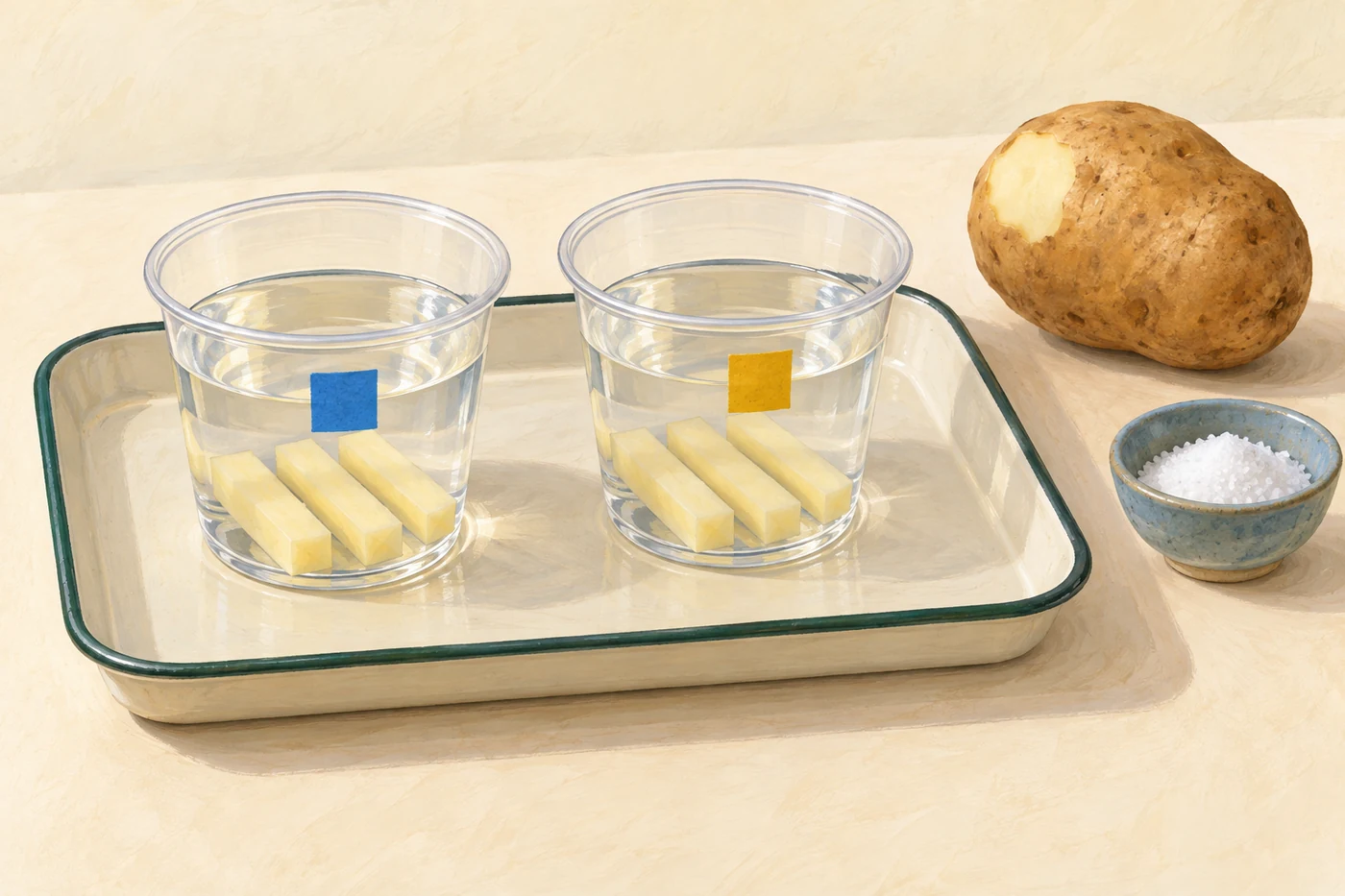
The cover illustration shows the setup before an observation, not a measured result. We compare raw pieces at room temperature without cooking them.
A potato is made of cells
A potato's tiny building blocks contain plenty of water with dissolved substances, including sugars and minerals. A firm cell wall surrounds each plant cell.
Just inside the wall is a thin cell membrane. Water can cross it; other substances pass through to different degrees. The cell wall and membrane are separate structures.
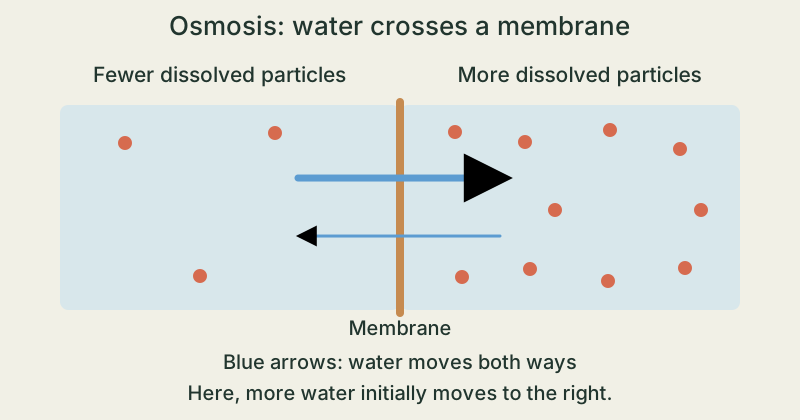
Water moves both ways
Water molecules are constantly moving, including across membranes. With osmosis, the balance matters: does more water move in or out overall?
In strong salt water, potato cells can lose more water than they take in. Dissolved particles outside change the conditions for water exchange. The potato is not making a decision.
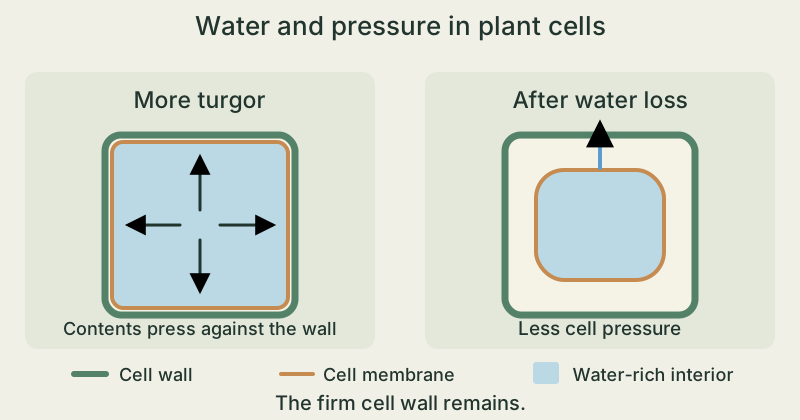
Less water means less cell pressure
Inside a well-watered plant cell, the contents press against the cell wall. This internal pressure is called turgor. It helps make the tissue firm.
When the cell loses water, that pressure falls. With substantial water loss, the membrane can pull away from the wall. The cell wall itself does not disappear.
Keep the comparison fair
In water with no added salt, cells can take up water and remain firm or become firmer. The pressure that builds inside limits further uptake; cells do not fill endlessly.
The size of the change also depends on the thickness, potato and soaking time. Flexibility only gives a clue about changes in the tissue. It does not measure the turgor of individual cells.
Compare two water baths
- Have an adult cut six matching peeled sticks from the same raw potato, roughly 5 cm long and 5 mm thick and wide. Photograph them beside a ruler and gently check their flexibility. Label two matching plastic cups “Water” and “Salt”. Put 200 ml of water from the same source at room temperature in each; dissolve 10 g of ordinary table salt completely in the salt cup only.
- Put three sticks in each cup, fully below the liquid. Place both cups on a tray in the same spot, away from sunshine or heating. Wait 60 minutes and record the time. Keep potato, size, water volume and temperature as similar as possible; only the added salt differs.
- Remove all the pieces and blot each equally gently. Compare them with the starting photographs and bend them slightly without breaking them. For all three pieces from each bath, record whether they feel firmer, similar or more flexible. Little difference is a result too. Another trial with freshly cut sticks can help check whether the pattern repeats.
Only an adult should use the knife. Do the observation together, keep the cups stable and wipe up spills. Do not eat the experimental pieces or drink the liquids; discard them afterwards, clean the work surface and wash your hands. Do not use hot water or any other additives.
The takeaway
Strong salt water can draw water out of raw potato cells. Osmosis changes their water content; as turgor falls, the tissue bends more easily. A fair comparison uses matching pieces and similar conditions.
Why might a raw potato stick bend more easily after soaking in strong salt water?
Sources & further reading
Vanderbilt University · Osmosis with Potato Slices (PDF, S. 3–5) ↗OpenStax / Rice University · Passive Transport: Osmosis and Tonicity ↗University of Florida / IFAS · Water Potential ↗Science & Plants for Schools · Investigating Osmosis with Potato Tissue ↗Our stories explain the main idea in our own words. Pictures and models simplify reality and are not drawn to scale.