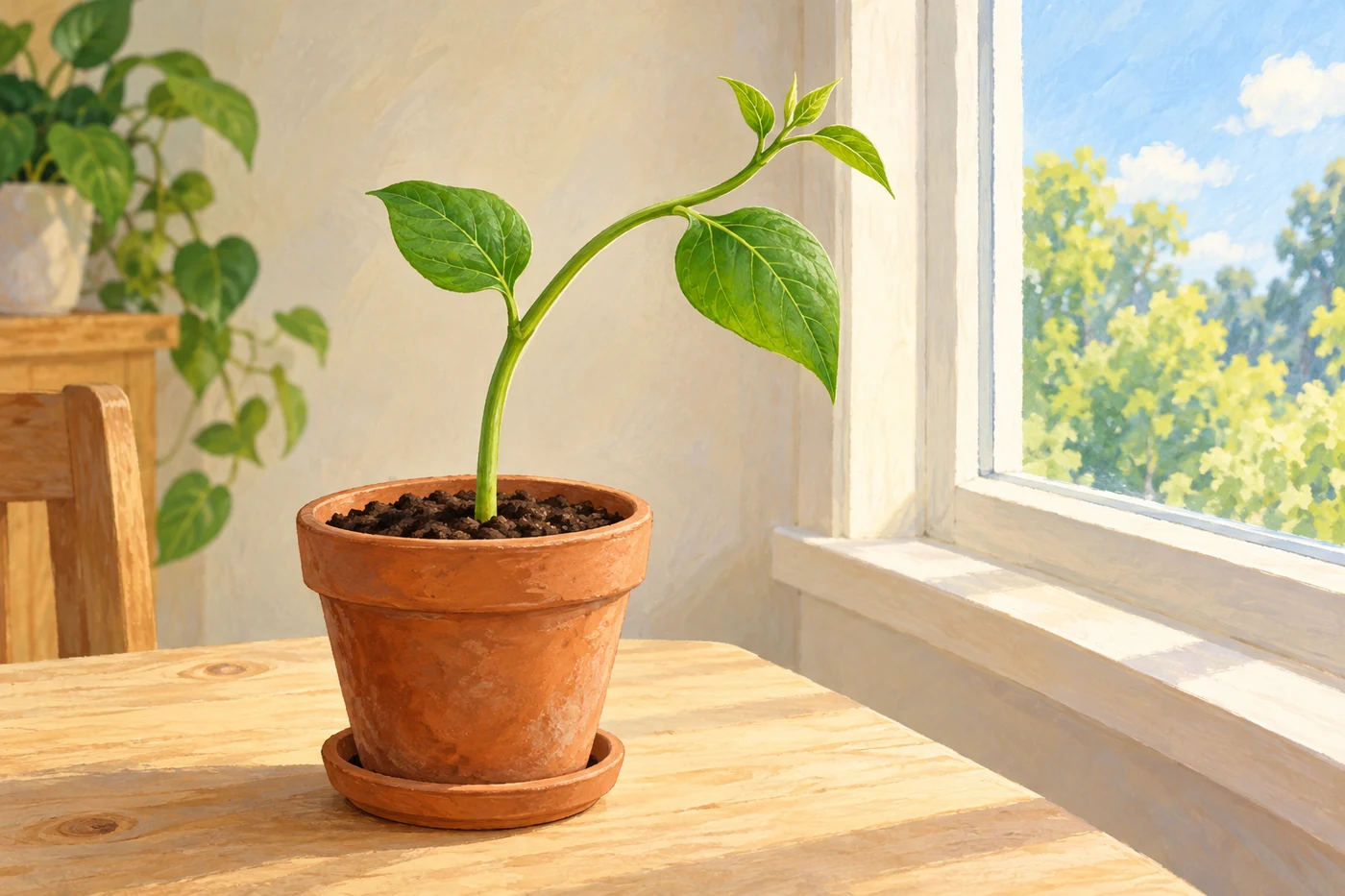
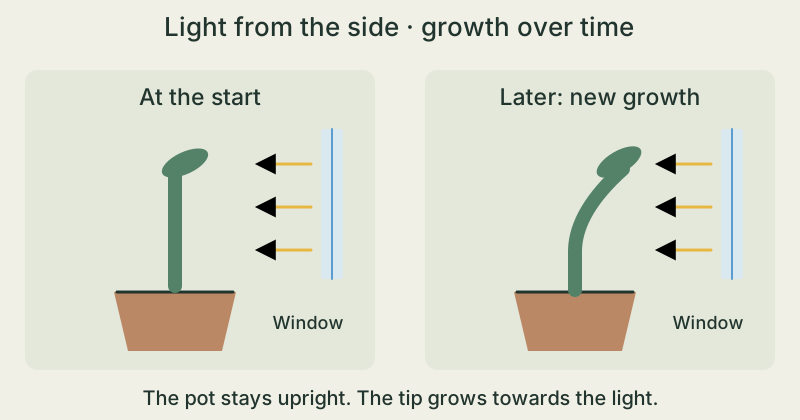
Many young shoots direct their growth towards light. When light comes from one side, the shaded side of a growing stem can lengthen more than the lit side. This makes the shoot curve towards the brighter side. This directional growth response is called positive phototropism.
The cover is an illustration of a young shoot by a window, not a measured experimental result. Photographs taken over several days can help you observe the change.
Plants detect light
Plants do not need eyes to respond to light. Special light-sensitive proteins in their cells trigger signals.
Sensors for blue light, called phototropins, are especially important for this direction of growth. Ordinary daylight includes blue light too.
A chemical messenger changes growth
An important plant messenger is called auxin. With light from one side, more of it can accumulate on the shaded side of a young shoot.
There, auxin promotes more cell elongation than on the lit side. The difference between the sides matters; the whole pot is not being pulled towards the light.
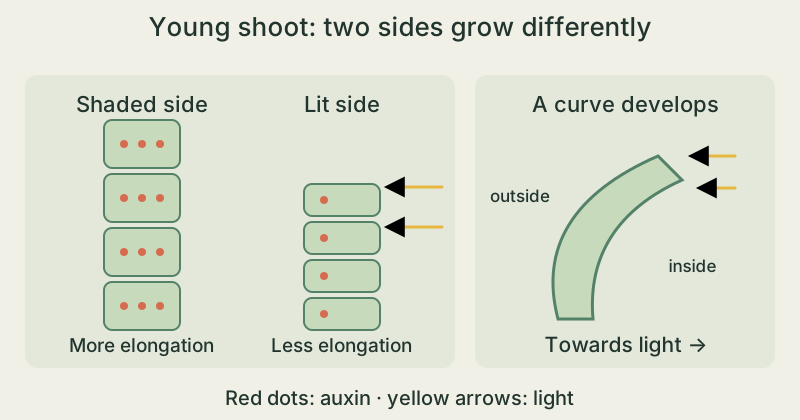
The longer side is on the outside
As one side lengthens more, it forms the outside of the developing curve. The shorter, lit side is on the inside, so the tip leans towards the light.
This happens mainly in regions that are still growing. An old woody stem may therefore show no visible bending. Species, age and lighting conditions affect the response.
A curve does not tell the whole story
This orientation can put leaves in a better position to receive light, which supplies energy for photosynthesis. Gravity also affects the direction of growth.
A tilted pot, wilting or a support can also cause a lean. Watch new growth with the pot upright and care kept similar. A photograph alone cannot show that auxin is present.
Follow new growth by a window
- With an adult, choose two healthy young bean plants of the same variety and similar size, in matching pots with similar soil. Place both upright side by side in a bright spot with window light from the side, away from hot direct sun and draughts. Mark the front of each pot with tape and photograph both from the same direction.
- Leave the pots unchanged for one day. Then turn just one pot half a turn around its upright axis without tilting it. Photograph it immediately: that rotation itself is not yet a growth response. Photograph both plants from the same direction at the same time each day for the next three days.
- Compare the youngest stem sections in particular: does their direction towards the window change? Keep water, temperature and distance from the window as similar as possible; note weather and care. Repeat with more plants when possible. Little or no bending is also a result; you are not measuring auxin levels.
Have an adult help move the pots. Put them securely on saucers away from the table edge, and do not climb onto windowsills. Do not eat the plants or soil; wash your hands afterwards. Do not bend stems, cut off tips or shut plants in the dark. Do not use hot lamps or plant growth chemicals.
The takeaway
Young shoots can grow towards light because their two sides lengthen by different amounts. Light signals and the messenger auxin help control this response. Observe new growth over time; a lean alone does not establish its cause.
Which side of a young shoot typically lengthens more as it curves towards light from one side?
Sources & further reading
New York Botanical Garden · Houseplant Basics ↗NASA / Goddard Space Flight Center · Plant Maze Experiment ↗Cambridge University Press · NSSC Biology, Module 2, Phototropism (PDF, S. 7–8) ↗OpenStax / Rice University · Plant Sensory Systems and Responses ↗Our stories explain the main idea in our own words. Pictures and models simplify reality and are not drawn to scale.