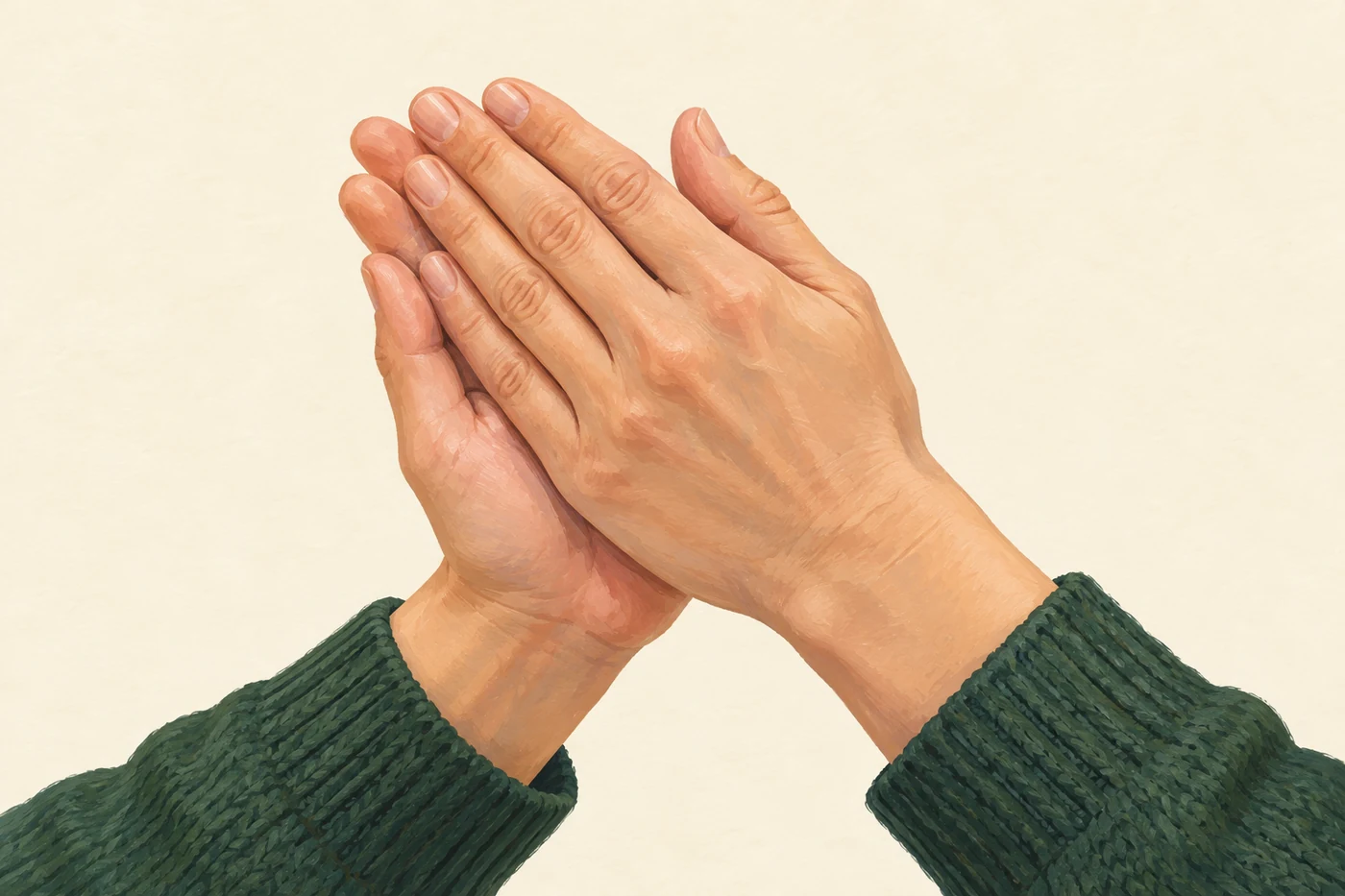
Friction acts between your palms as you rub them. Your muscles have to work against this resistance. Some of the energy transferred becomes thermal energy in the skin, so your hands can get warmer.
The cover illustration shows two palms touching. It is not a thermal image and does not show a measured temperature.
Friction acts where surfaces touch
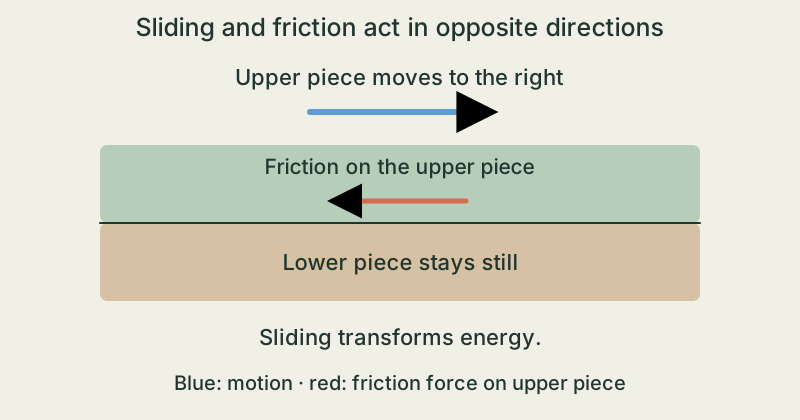
When two surfaces slide past each other, sliding friction opposes their relative motion. This is why you need to keep using muscle force to rub your hands.
Even surfaces that look smooth have tiny structures. Forces between particles also act at their contact points. Friction is more than tiny bumps getting caught on each other.
The energy comes from your work
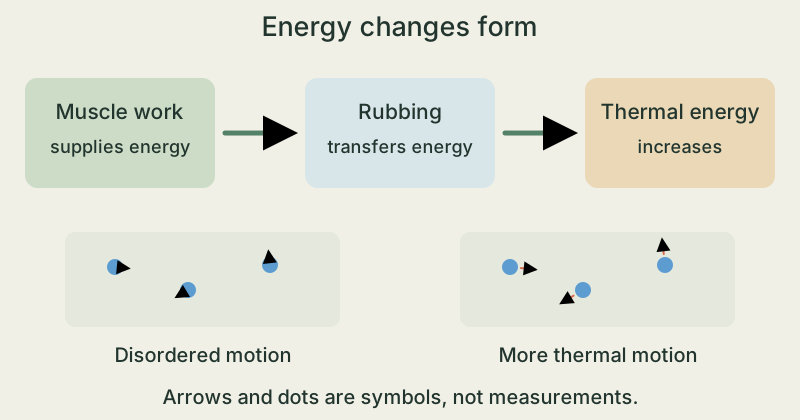
Moving your hands transfers energy to them. At the contact points, the surfaces deform by tiny amounts and their particles interact.
Some of the energy becomes disordered movements and vibrations of particles. It does not disappear; part of it is now present as thermal energy.
A whole hand and tiny particles
The hand's visible back-and-forth motion is different from the disordered motion of its particles. More thermal motion can raise the skin's temperature.
Your hands do not have to keep speeding up for this to happen. Rubbing at a steady pace can supply energy continuously. At the same time, your hands transfer energy to their surroundings.
A feeling is not a thermometer
How warm it feels also depends on the starting temperature, duration and condition of your skin. There is no need to press harder for our observation.
The comparison below records only your feeling of warmth. It measures neither friction force nor degrees Celsius. It cannot fully separate body warmth and surroundings from the effect of rubbing.
Compare still contact with gentle rubbing
- Observe together with an adult at a comfortable room temperature. Use clean, dry hands with unbroken skin. Let them rest loosely for a minute. Then touch your palms lightly together for ten seconds without moving them. Record: unchanged, a little warmer or much warmer?
- Let your hands rest loosely again until they feel about the same as at the start. Now rub your palms gently past each other with light contact for ten seconds. Use a comfortable pace and stop immediately if it feels unpleasant. Record your feeling of warmth using the same scale.
- Compare your notes. If your skin still feels comfortable, you can swap the order once after a rest. Keep the time, location and light contact as similar as possible. No clear difference is a result too. You are describing a feeling, not an exact temperature or amount of energy.
Rub briefly and gently only; stop immediately if you feel burning, pain or skin irritation. Skip the activity if your skin is sensitive or broken and discuss the pictures instead. Do not use rough surfaces, tools, hot objects, creams or other additives. Do not try experiments with fire or brakes.
The takeaway
Friction can turn energy from your muscles' work into thermal energy. Your skin often becomes warmer as a result. Energy is transferred and transformed; the hand observation does not measure temperature.
Where does some of the energy that warms your hands during rubbing come from?
Sources & further reading
American Chemical Society · Friction – A Hot Topic! (PDF) ↗Government of the Northwest Territories · Science Module 2: Friction (PDF, S. 19–20) ↗OpenStax / Rice University · University Physics: Friction ↗OpenStax / Rice University · Nonconservative Forces and Energy ↗Our stories explain the main idea in our own words. Pictures and models simplify reality and are not drawn to scale.