When salt dissolves in water next to ice, it makes salt water. This freezes at a lower temperature than pure water. Under suitable conditions, more ice therefore melts than refreezes. Melting requires energy, and the mixture can actually become colder.
In winter, salt is sometimes spread to help clear ice. How can a grain of salt help? We will look at the boundary between ice and liquid water. The cover is an illustration, not a measured experimental result.
More happens at ice than you can see
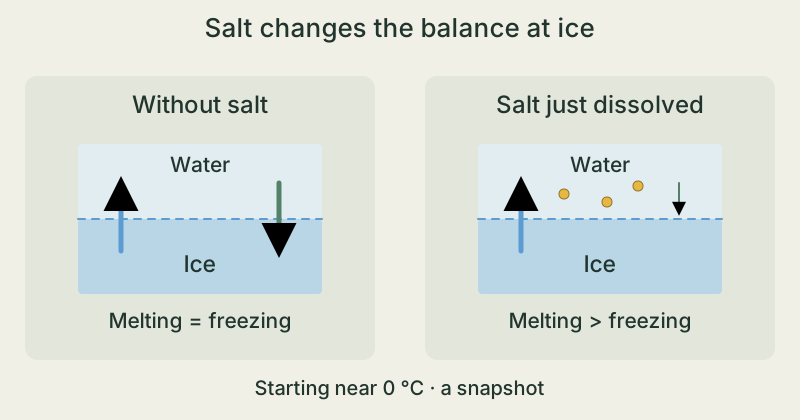
At normal air pressure, pure water and ice can coexist at around 0 °C. At their boundary, water molecules leave the ice while others attach to it again.
At equilibrium, melting and freezing happen at the same rate. The visible amount of ice then stays the same, although individual molecules keep changing places. A warm room supplies extra energy and gradually melts ice.
Dissolved salt shifts the balance
On an already wet ice cube, salt can dissolve in the liquid water. This makes a salt solution. Dissolved salt is what matters; a dry grain is not a tiny heater.
At the same temperature, less water freezes back from the salt solution. More ice can now melt than is being formed. Ice and salt solution reach equilibrium at a lower temperature: the freezing point has dropped.
Melting can cool the mixture
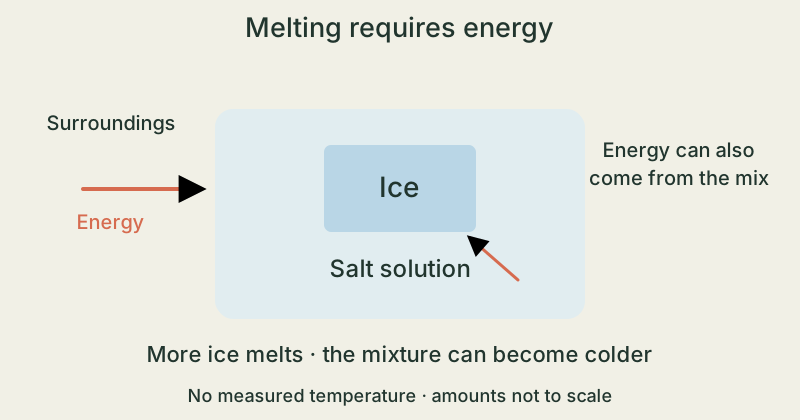
Melting ice requires energy. Water molecules leave their fixed arrangement and can slide past one another as a liquid. They do not split into hydrogen and oxygen.
The energy can come from the mixture itself and from its surroundings. An ice-salt-water mixture can therefore cool below 0 °C while ice melts in it. More liquid water does not automatically mean a higher temperature.
It does not work at every temperature
How far the freezing point falls depends on how much salt is dissolved in the water. Salt solutions do not all freeze at the same temperature. In severe cold, ordinary table salt cannot keep melting ice indefinitely.
Time, the ice's starting temperature and the energy supplied also affect the result. Our small comparison in a warm room cannot tell us whether a pavement is safe, and it does not measure an exact freezing point.
Compare two ice cubes in small bowls
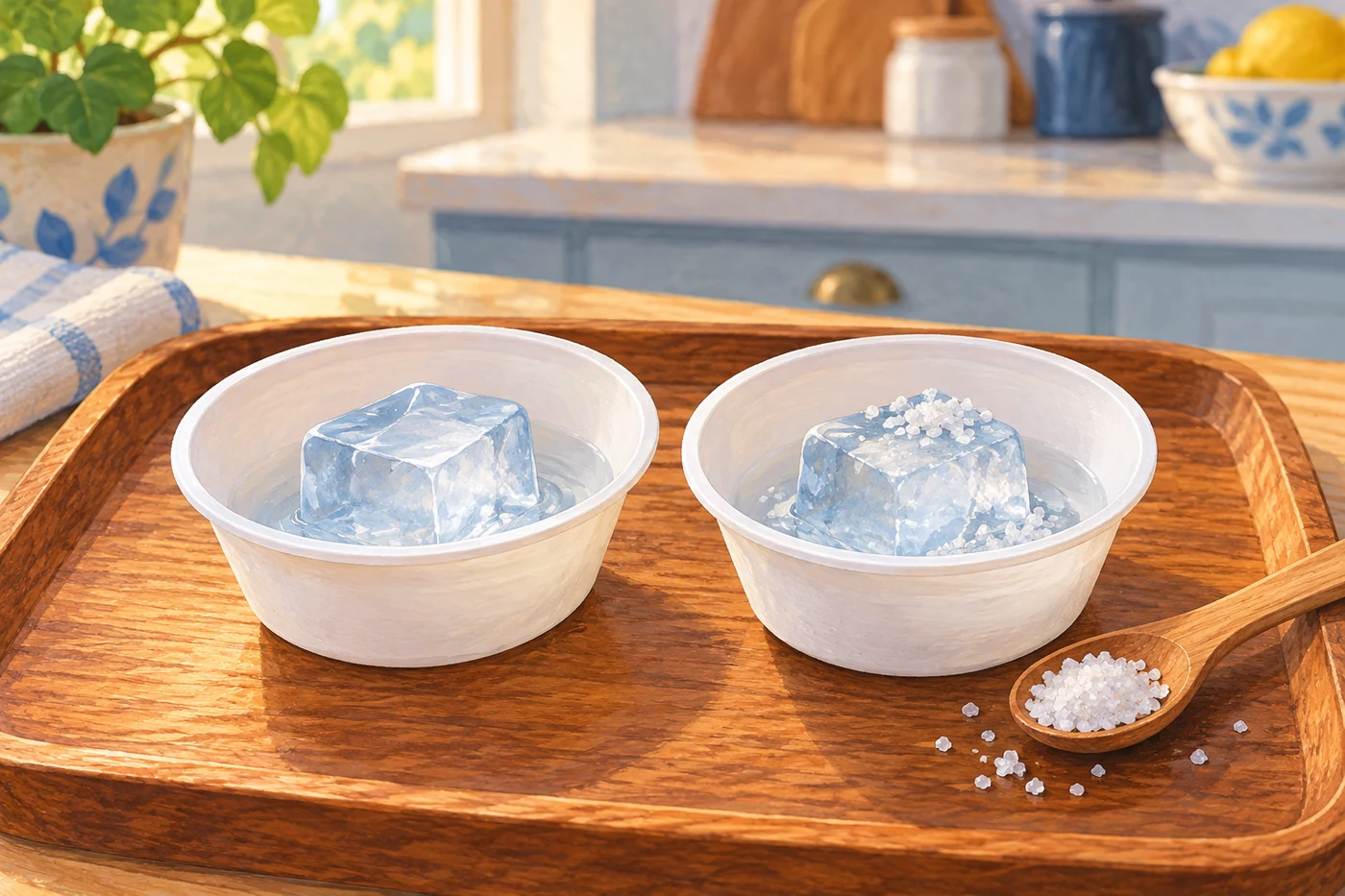
- With an adult, put two identical shallow plastic bowls on a waterproof tray. The adult uses tongs to place one similar-sized ice cube from the same mould in each. Wait until both surfaces are a little wet.
- The adult sprinkles about a quarter of a teaspoon of table salt on just one cube. Leave the other without salt. Start a timer. Keep both bowls in the same place; do not touch, heat or stir them.
- Draw the shape of each cube at the start and after three and six minutes. Look for hollows and liquid around the ice. Record a small difference too. Cube size, starting temperature and unevenly spread salt can affect what you see.
Work with an adult and small amounts of table salt. Do not let hands or skin touch the ice, especially the ice-salt mixture; the adult uses tongs. Do not taste anything or use road salt or dry ice. Keep splashes away from eyes and wipe spills immediately. Afterwards, the adult lets everything melt completely and rinses the bowls.
The takeaway
Dissolved salt lowers water's freezing point. Ice can then melt even below 0 °C. This requires energy, and the mixture can become colder as it happens.
Why can table salt help ice melt?
Sources & further reading
University of Washington · Freezing Point Depression ↗American Chemical Society · Changing State—Freezing ↗American Chemical Society · Why Does Salt Make Ice Colder? (PDF) ↗American Chemical Society · Changing State—Melting ↗Our stories explain the main idea in our own words. Pictures and models simplify reality and are not drawn to scale.