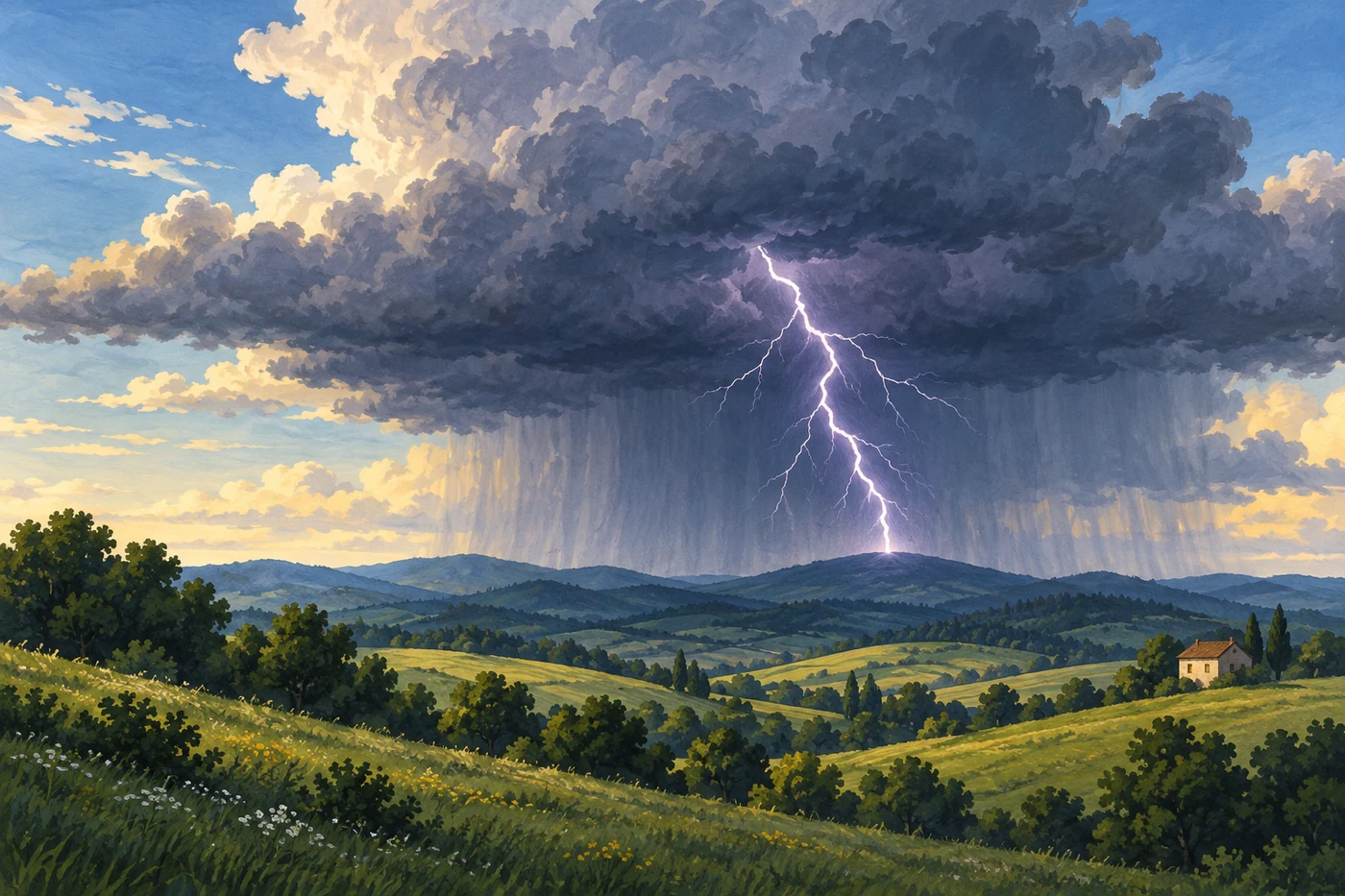
Light from lightning reaches us much faster than sound. The electrical discharge suddenly heats the air; its rapid expansion creates the pressure wave we hear as thunder. The sound takes longer to reach us.
In a storm recording, you see a bright flash. A little later, you hear thunder. The main reason is that light and sound travel at different speeds. The cover is an illustration, not a recording of a measured storm. Our observation activity needs no storm at all.
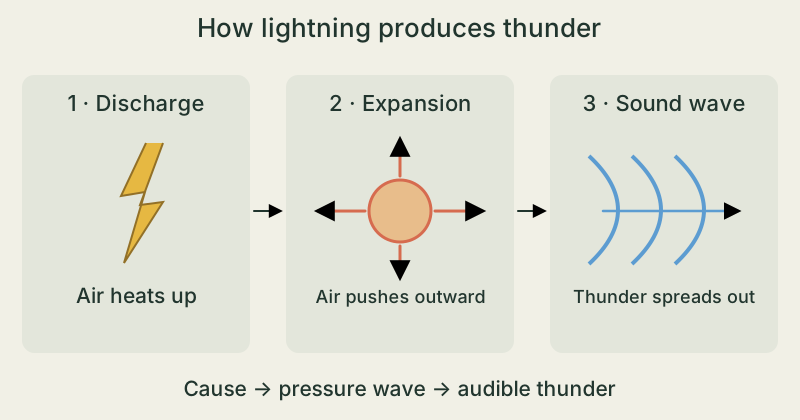
Lightning suddenly pushes the air outward
Lightning is a powerful electrical discharge. It can happen within a cloud or between a cloud and the ground. Air along its path becomes extremely hot very quickly.
That air expands suddenly. This creates a pressure wave that spreads into the surroundings. When it reaches our ears, we hear thunder. Thunder is caused by lightning, not by clouds bumping into each other.
The light arrives almost immediately
Light travels astonishingly fast: about 300,000 kilometres per second in a vacuum. Across the distances involved in a thunderstorm, it reaches us through air almost immediately too.
Almost immediately does not mean no travel time. Over a few kilometres, the time is simply too tiny for us to notice in everyday life. We therefore see the flash while the much slower sound is still on its way.
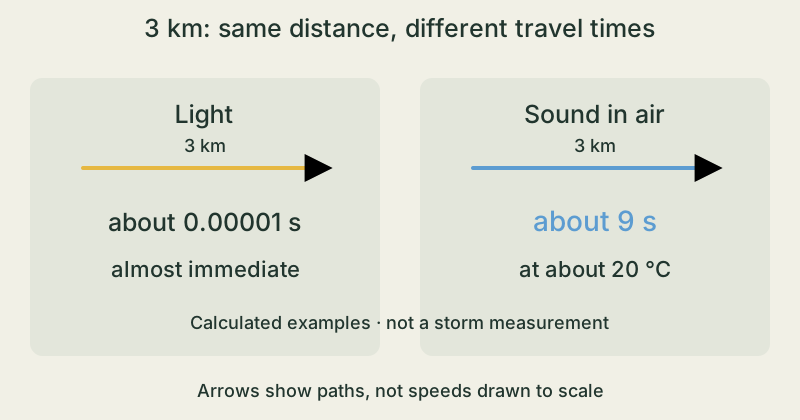
The sound takes seconds
In air at about 20 °C, sound travels roughly 343 metres in one second. It takes about three seconds to cover one kilometre. Temperature affects this speed.
Here is a calculation: sound takes about nine seconds to travel three kilometres. Light needs only a tiny fraction of a second for that distance. The gap is mainly travel time, not a wait for the lightning to start making thunder.
Why can thunder rumble for a while?
A lightning channel is long and often branched. Sound from nearer and farther sections reaches us at different times. This helps produce a longer rumble.
A long gap does not make it safe to stay outside. Hearing thunder already means lightning danger. An adult should take you into a substantial building immediately; do not wait for rain or a closer flash.
Compare seeing and hearing indoors
- With an adult, choose a quiet time when there is no thunderstorm. Stand about two to three metres apart in a clear room. Keep feet on the floor and do not run around.
- The adult claps once, softly or at a normal volume. Watch their hands and listen at the same time. Do the movement and clap seem simultaneous? Write down your impression. Repeat only a few times, without getting louder.
- Compare your observation with the three-kilometre calculation diagram. Sound takes only about nine thousandths of a second to travel three metres. You usually cannot reliably pick out such a tiny delay in this activity. Your perception does not prove equal speeds or measure a storm's distance.
Do this indoors with no current thunderstorm; do not look for lightning at a window or try to recreate it. If real thunder sounds, seek shelter in a substantial building immediately, stay away from windows, electrical equipment and plumbing, and remain sheltered for at least 30 minutes after the last thunder. Never clap close to an ear; skip the activity if anyone is sensitive to sound.
The takeaway
Lightning produces light and makes thunder by rapidly expanding the air. Light reaches us almost immediately, while sound arrives much later. Their different travel times explain the gap.
Why do we usually hear thunder after seeing the lightning?
Sources & further reading
NOAA / National Weather Service · Understanding Lightning Science ↗NOAA / National Weather Service · Understanding Lightning: Thunder ↗OpenStax · University Physics Volume 1: Speed of Sound ↗NASA · How Does Webb See Back in Time? — Traveling Light ↗NOAA / National Weather Service · Lightning Safety Tips ↗Our stories explain the main idea in our own words. Pictures and models simplify reality and are not drawn to scale.