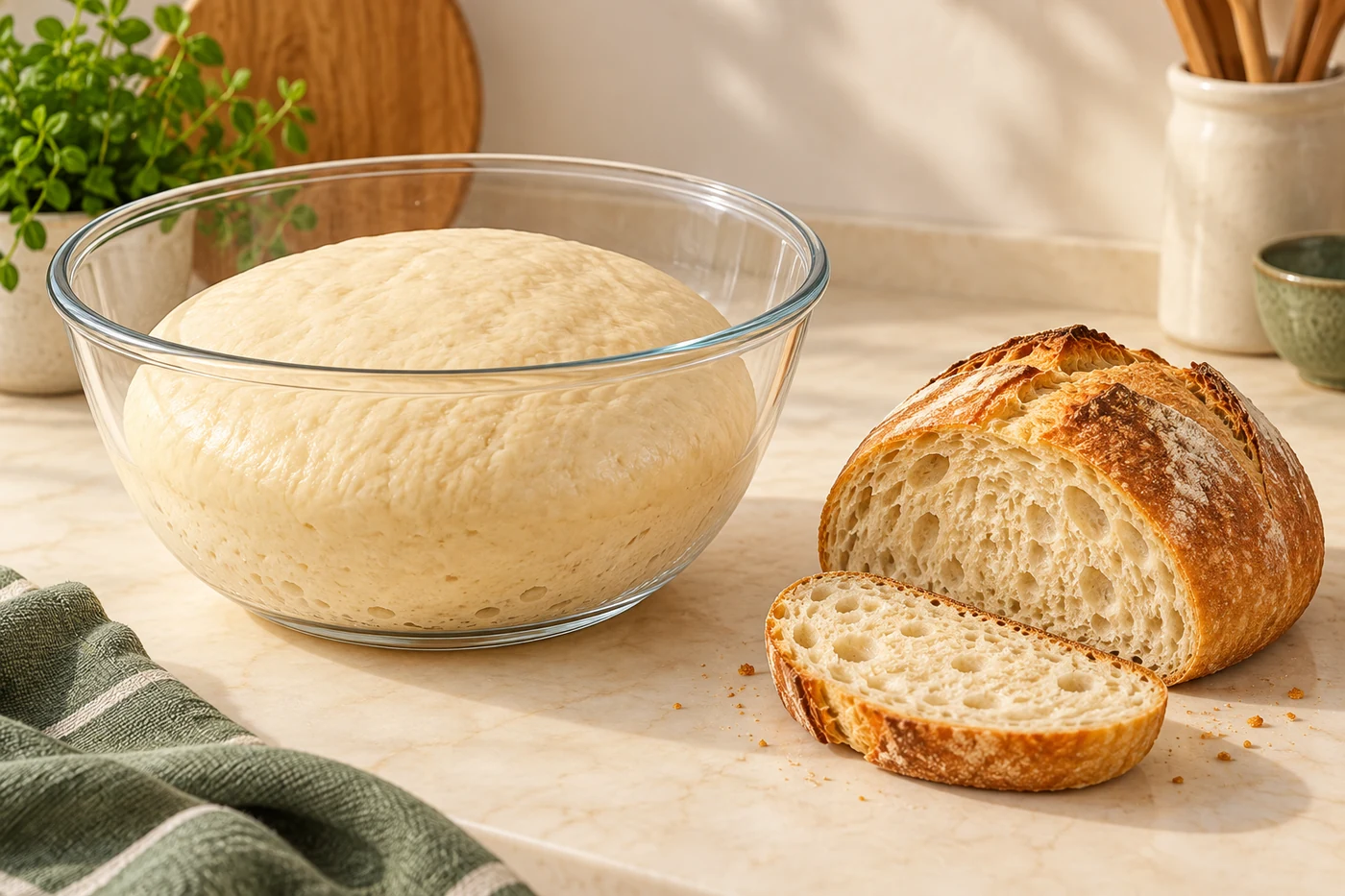
Yeast breaks down sugars and produces carbon dioxide. This gas enlarges bubbles inside the dough. A stretchy network of flour proteins holds much of it in, so the dough takes up more space.
A pale dough is waiting to be baked. After a while, it sits higher in its bowl. Let's look at a simple wheat dough made with baker's yeast: living cells are at work, and gas collects inside it. The cover is an illustration of dough and bread, not a recorded before-and-after measurement.
Yeast is made of living cells
Baker's yeast is a single-celled fungus. One yeast cell is too small to see with your unaided eyes. The granules in a yeast packet contain many of these cells.
With water and suitable conditions, the cells can become active. They use sugars. Some sugars are already present in flour, and enzymes in the flour also make sugars available from starch.
Sugar breakdown produces gas
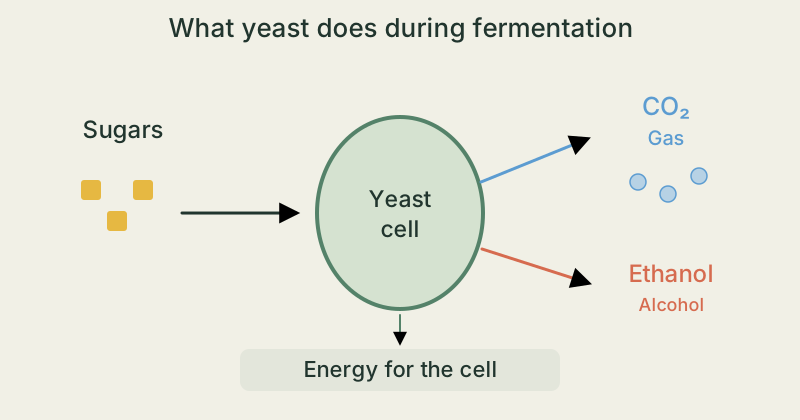
Breaking down sugars lets yeast obtain energy for its cell activities. During alcoholic fermentation, it produces carbon dioxide, or CO₂, and ethanol, a type of alcohol. CO₂ is especially important for making the dough rise.
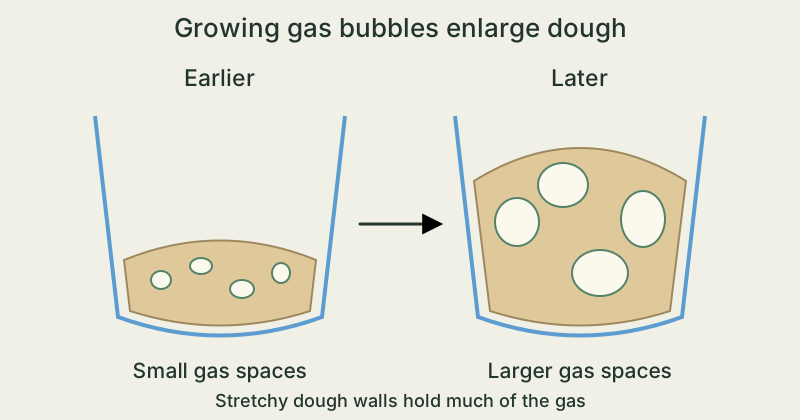
CO₂ is a gas. It enters gas bubbles in the dough and makes them larger. Many growing bubbles together take up more room: the dough rises. It can do this before it enters a hot oven.
A stretchy network holds the bubbles
Gas on its own could easily escape. Wheat flour contains proteins called gliadin and glutenin. With water, mixing and kneading, they form a stretchy gluten network.
This network helps keep gas bubbles inside the dough. You can think of it a little like the stretchy skin of a balloon. The walls between bubbles in real dough are more complicated: our drawing is only a simplified model.
Time and the recipe make a difference
How fast dough grows depends on factors such as temperature, the amount of yeast and the recipe. Cooler dough often takes longer. Very high heat damages yeast cells, so warmer does not mean endlessly faster or better.
During baking, the gas spaces can initially grow further. As the dough gets hotter, yeast stops working and the dough's structure sets. The many cavities help give bread its airy crumb. Other breads can be made without baker's yeast; here we are explaining wheat dough leavened with yeast.
Watch dough grow
- Watch an adult make bread normally using a tried-and-tested recipe. They put the wheat yeast dough in a transparent food-safe bowl with plenty of spare room and cover it loosely as the recipe directs. You watch without touching the raw dough.
- Place removable tape on the outside to mark roughly the top of the dough. Record the time. During the resting period specified in the recipe, look from the same side about every 15 minutes and sketch the height on paper. Leave the covering in place.
- Compare your sketches at the end of that resting period. Has the dough risen, and can you see bubbles through the bowl? No visible change is also an observation. Height alone measures neither the amount of CO₂ nor the exact dough volume. The adult continues baking according to the recipe; do not extend the resting time just for the observation.
An adult handles dough, knives and the oven. Never taste raw flour or raw dough, or use them as play materials. Clean hands, equipment and work surfaces thoroughly after contact, and keep raw dough away from ready-to-eat foods. Observe away from the hot oven; do not seal containers airtight.
The takeaway
Yeast cells produce CO₂ as they break down sugars. The gas enlarges bubbles, and a stretchy network holds many of them inside wheat dough. That lets the dough grow while it rests.
What makes wheat yeast dough rise while it rests?
Sources & further reading
Exploratorium · Bread Science 101 ↗Science World · Yeast-Inflated Balloons ↗OpenStax · Biology 2e: Metabolism without Oxygen ↗Exploratorium · Yeast Is Fussy About Temperature ↗CDC · Raw Flour and Dough ↗Our stories explain the main idea in our own words. Pictures and models simplify reality and are not drawn to scale.