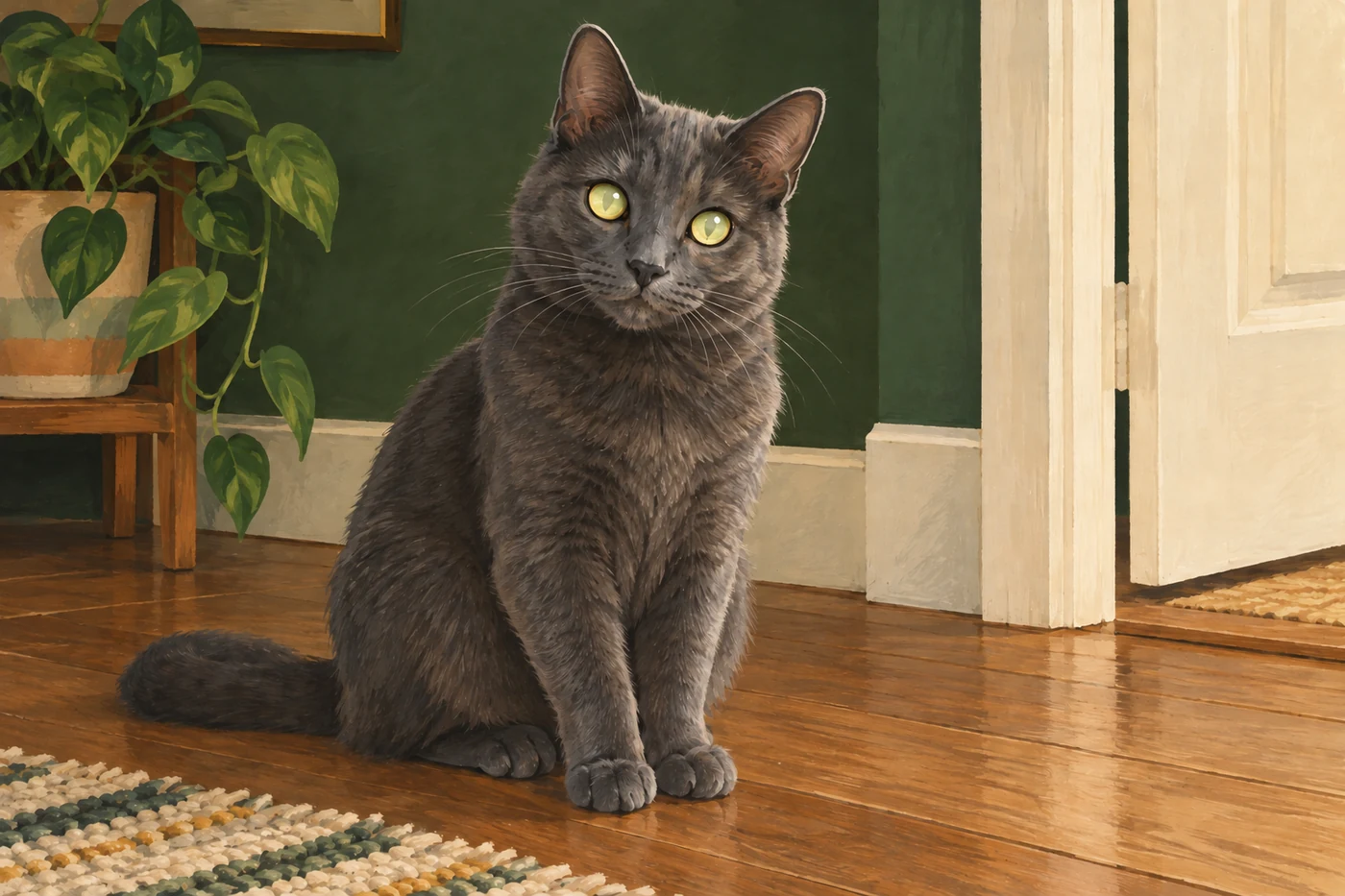
Many cats have a reflective tissue layer behind the retina: the tapetum lucidum. It sends light back through the retina. Some can leave the eye again and reach us as bright eyeshine. The eye needs light from outside for this to happen.
The cover is an illustration, not a lighting experiment on an animal. The diagrams show greatly simplified light paths, not complete anatomy.
Light enters the eye
Light enters through the pupil. The lens helps focus it onto the retina, where light-sensitive cells respond. The resulting signals travel to the brain; the light itself does not travel into the brain as a picture.
A second chance for the retina
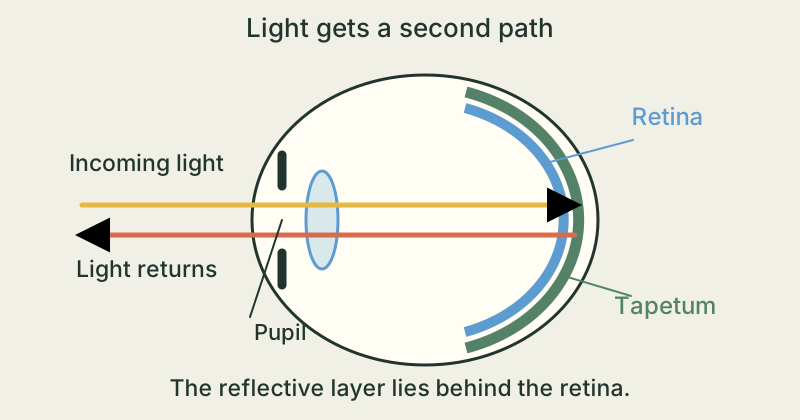
Not all the light is absorbed on its first pass. The tapetum lucidum behind the retina reflects some back. The light-sensitive cells then have another chance to respond. This biological layer is not a built-in glass mirror, but it plays a similar role in sending light back.
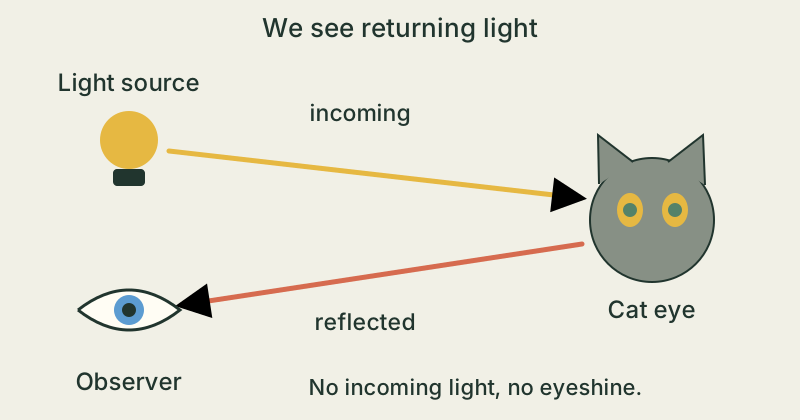
Some light returns to us
Not all the reflected light is absorbed. Some can pass out through the pupil again. We see this returning light as eyeshine. The reflection is often yellow-green, but its appearance can vary. It is not a beam of light produced by the cat.
Cats still need some light
The reflective layer helps make better use of faint light. A wide-open pupil and many sensitive visual cells help too. But with no incoming light, there is neither this reflection nor a visible image of the surroundings. Seeing better in dim light does not mean seeing without light.
Observe light on paper and foil
- An adult lines the inside bottoms of two empty cardboard cups: one with matt black paper and the other with a piece of aluminium foil. Place both cups open on the table.
- Keep the room light on. The adult lights each cup in turn with the same small torch. Look at the inside surfaces from the side: where do bright reflections stand out? Gently change the direction without aiming light at anyone's eyes.
- Switch off the torch, keeping the room light on. Compare and draw what you notice. Room light can still be reflected. This model only shows light being reflected; it contains neither a retina nor a real reflective eye layer.
Observe with an adult using an ordinary small torch. Do not stare into the lamp or bright reflections. Never shine it at eyes or animals, and use no lasers, camera flashes or direct sunlight.
The takeaway
The tapetum gives incoming light a second path through the retina. Light that leaves the eye again can become visible as eyeshine.
Where does the light in typical cat eyeshine come from?
Sources & further reading
Cornell University · Feline Health Center: Feline Vision Problems, Basic Components ↗Cornell University · Randy Wayne: Animal Eyes (PDF, printed p. 187) ↗ABC Education · Braidee Foote, University of Tennessee: Why do cats' eyes glow in the dark? ↗Our stories explain the main idea in our own words. Pictures and models simplify reality and are not drawn to scale.