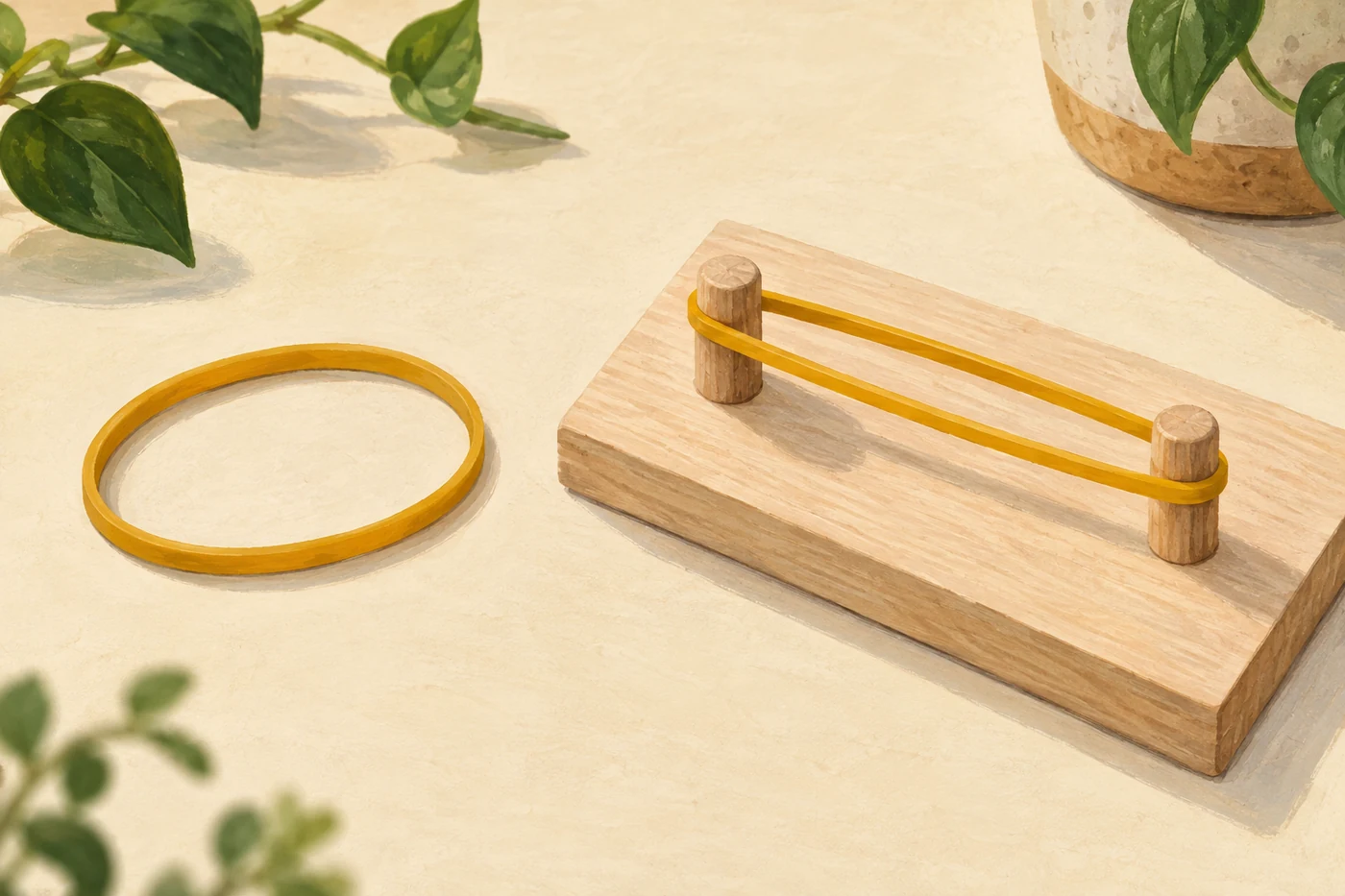
Rubber contains very long, flexible molecular chains. Pulling makes the coiled chains more aligned. When the pull eases, their constant thermal motion lets them take up many curled shapes again. Connections between chains help the rubber band keep its shape.
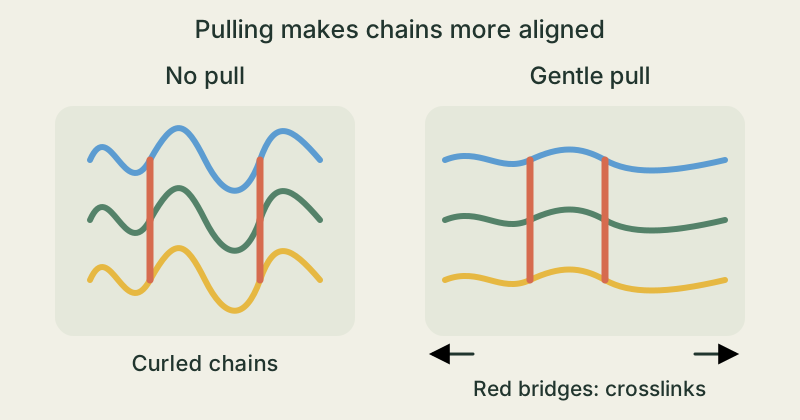
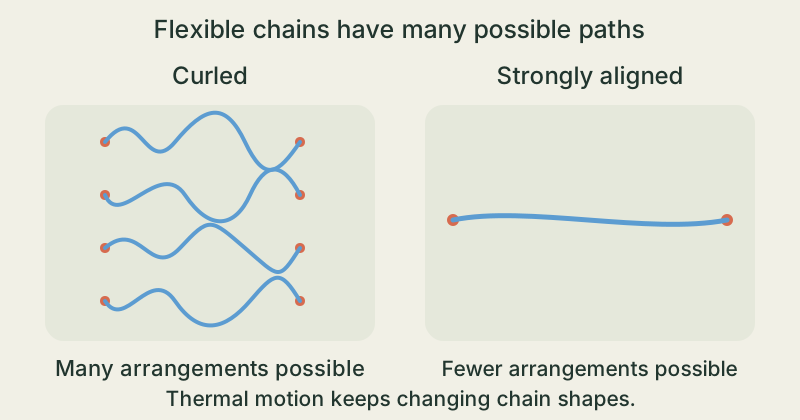
The cover is an illustration. The diagrams are greatly simplified models: coloured lines represent molecular chains, and red bridges represent connections between them. They are not microscope images.
Long chains in a small space
A polymer is a very large molecule made of many linked building blocks. In rubber, these chains are flexible. A relaxed band does not contain neatly straight threads: its chains follow winding paths and are always moving. They are moving even when the band lies still on the table.
Pulling mainly changes their shape
When you stretch the band moderately, the chains become more aligned along the direction of the pull. Many of their coils open out. This change in the chains' shapes accounts for much of the large stretch. The chemical bonds along a chain do not simply have to be pulled proportionally longer.
There are many ways to curl up
A strongly aligned chain has fewer possible arrangements than a loosely curled one. Once the external pull is removed, thermal motion takes the chains through many possible curled arrangements again. This helps the band become shorter. Physicists describe this important part of rubber elasticity using entropy: here, the idea concerns how many arrangements are possible.
Small bridges hold the network together
In a typical rubber band, chains are connected to one another at some points. These crosslinks stop the chains from simply sliding permanently past each other. Flexible chains and their connections work together. This model explains gentle stretching; it does not mean you can stretch any band as far as you like. Pulling too hard can damage or break it.
Relaxed, a little longer, relaxed again
- With an adult, lay an undamaged rubber band flat beside a ruler. Note its approximate length without pulling it. You do not need a precise measurement.
- Hold it low over the table and gently pull it just a little longer, without using force. Compare its length with before. Keep hold of both sides.
- Slowly move your hands back together until there is no tension in the band. Put it down and compare its length. Draw the chains more aligned and then curled: you cannot see the actual molecules with your eyes.
Observe with an adult using an intact band. Do not flick it, point it at faces or wrap it around body parts. Do not stretch it hard or heat it. Anyone with a known rubber or latex allergy should look at the pictures only.
The takeaway
Moderate stretching mainly changes the arrangement of long molecular chains. Thermal motion lets them return to curled shapes, while crosslinks hold the chains together.
What helps a gently stretched rubber band become shorter again?
Sources & further reading
OpenStax · Organic Chemistry 31.7: Polymer Structure and Physical Properties ↗Pennsylvania State University · MATSE 202: Skeletal Structure ↗University of Washington · Department of Chemistry: Entropy of a Rubber Band ↗University of Lethbridge · Marc R. Roussel: Rubber elasticity (PDF, pp. 1–3) ↗Our stories explain the main idea in our own words. Pictures and models simplify reality and are not drawn to scale.