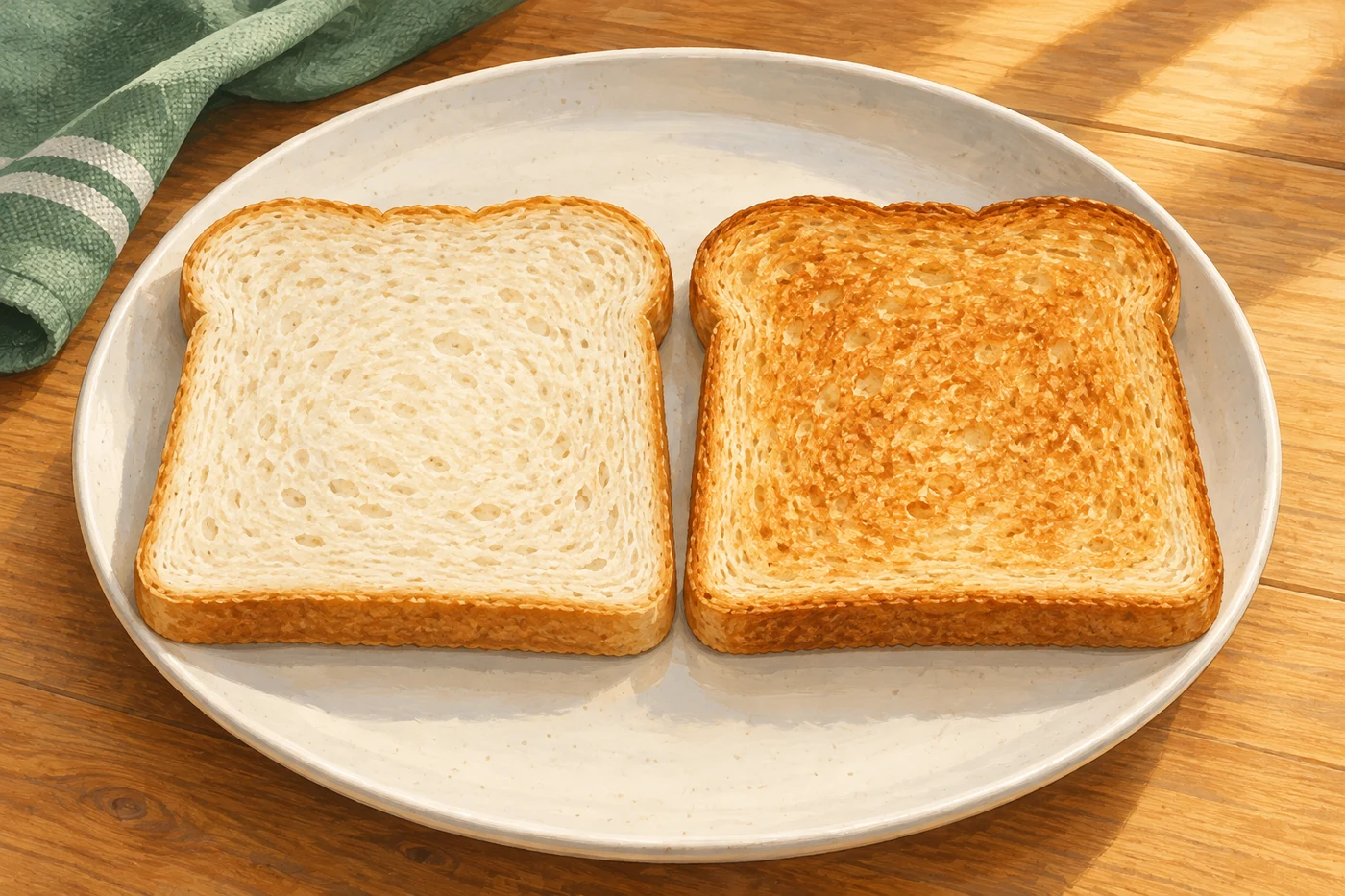
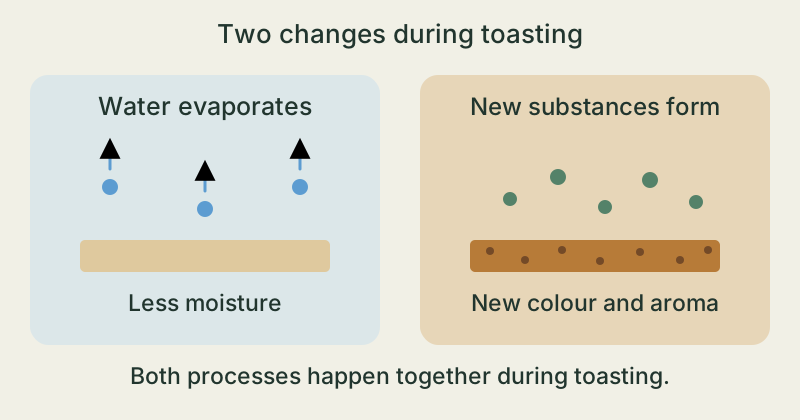
Chemical reactions take place at the hot surface during toasting. Certain sugars react with amino groups, including those in proteins. These Maillard reactions produce new brown substances and many aroma compounds. At the same time, the bread loses water.
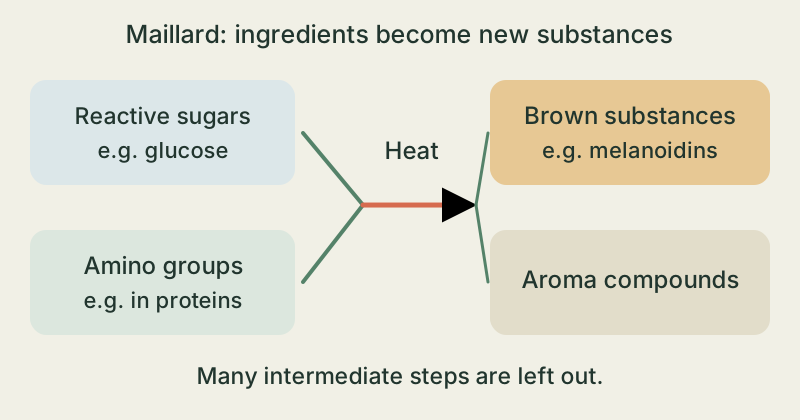
The cover is an illustration. The diagrams show simplified processes, not actual molecular shapes or a complete chemical equation.
The ingredients are already in the bread
Bread contains water, starch, proteins and smaller amounts of different sugars. The Maillard reaction involves certain reactive sugars, such as glucose. These are called reducing sugars. They react with amino groups, which are part of amino acids and are also found in proteins. Nobody needs to sprinkle sugar onto the slice for this to happen.
Heat helps new compounds form
The sugars and amino groups react through several intermediate steps, producing a mixture of new substances. Brown products include melanoidins, while other products contribute to the familiar toasted aroma. The name Maillard reaction therefore describes a whole family of reactions rather than just one step.
Why does the surface change first?
The surface receives heat directly from the toaster. At first, energy is also needed to evaporate water. As the outer layer becomes drier and hotter, browning reactions there speed up. Losing water also makes the surface crisper. Drying and chemical browning happen together, but they are different processes.
Brown can happen in different ways
A cut apple turns brown with the help of enzymes and oxygen. In toast, heat-promoted Maillard reactions are central. Caramelisation is different again: sugars change without needing amino groups as reaction partners. Similar colours do not automatically mean the same chemistry.
Compare bread and toast at breakfast
- When toast is already being made for a meal, ask an adult for a piece of untoasted bread and a golden toasted piece of the same kind of bread. Leave all the toasting to the adult.
- Wait until the toast has cooled. Compare the colour and surface. If you can safely handle that bread, gently touch each piece with clean hands: which is soft, and which is crisp? You do not need to eat anything for this observation.
- Write down two observations. Match them to the models: water loss changes moisture, while new substances change colour and aroma. Colour alone cannot tell you exactly which individual molecules have formed.
Handle only cooled bread. Do not touch the toaster or hot slices, and never put hands or objects inside the toaster. Do not deliberately make dark or blackened toast. Observe any known food allergies.
The takeaway
Maillard reactions between certain sugars and amino groups produce new colour and aroma compounds during toasting. Water loss also helps make the surface crisp.
What explains the brown colour and new toasted aroma?
Sources & further reading
Exploratorium · The Maillard reaction: why cooked food changes colour and aroma ↗Kansas State University · The Maillard Reaction ↗American Society of Baking · Maillard Reaction ↗Science on Stage Europe · Food, Cooking and STEM: Kitchen Gadgets, Toaster (PDF, pp. 12–13) ↗Our stories explain the main idea in our own words. Pictures and models simplify reality and are not drawn to scale.