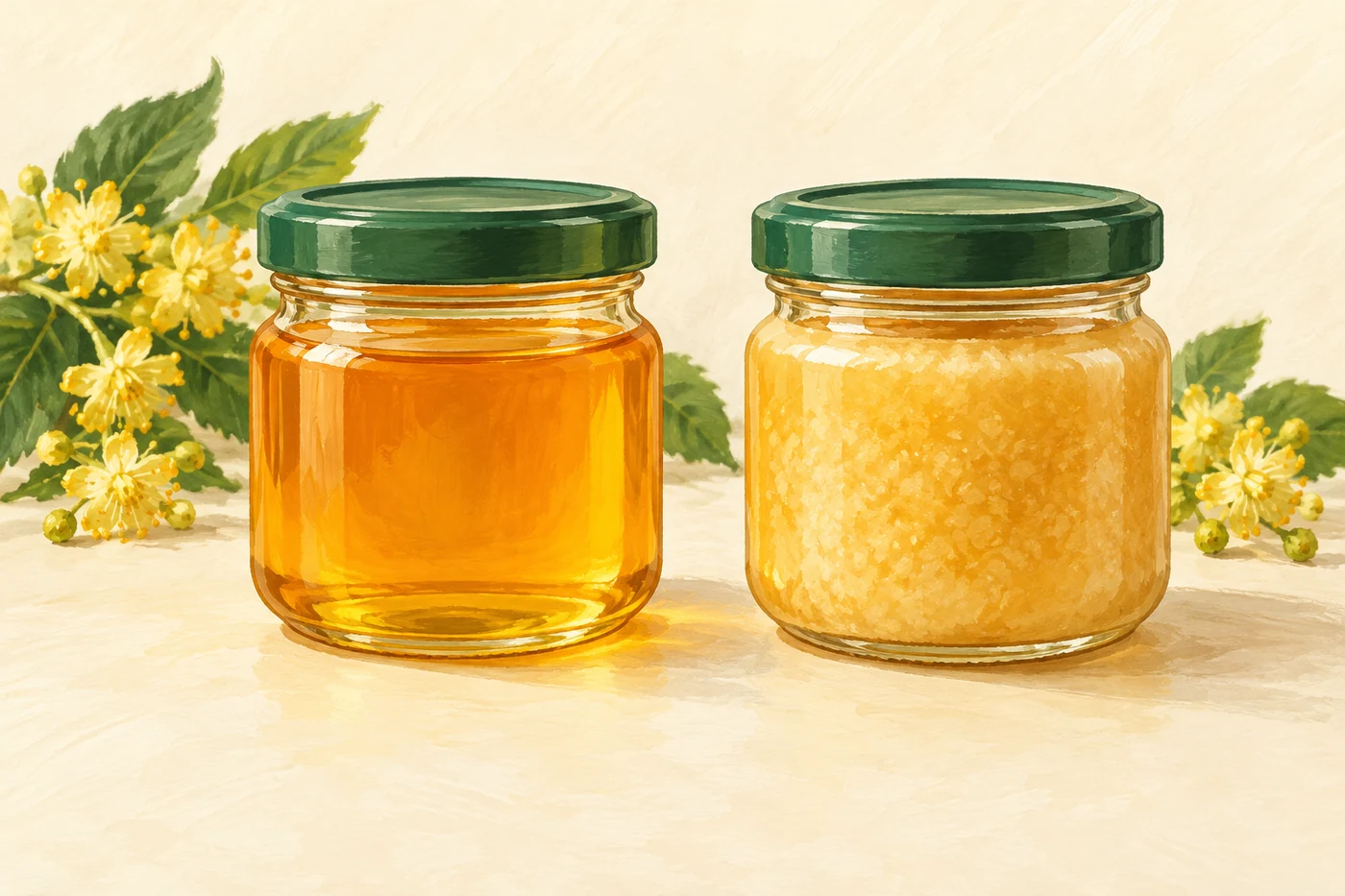
Honey contains a lot of dissolved sugar and little water. Some of that sugar, mainly glucose, can join together in ordered crystals. Many crystals make the honey grainy or spreadable.
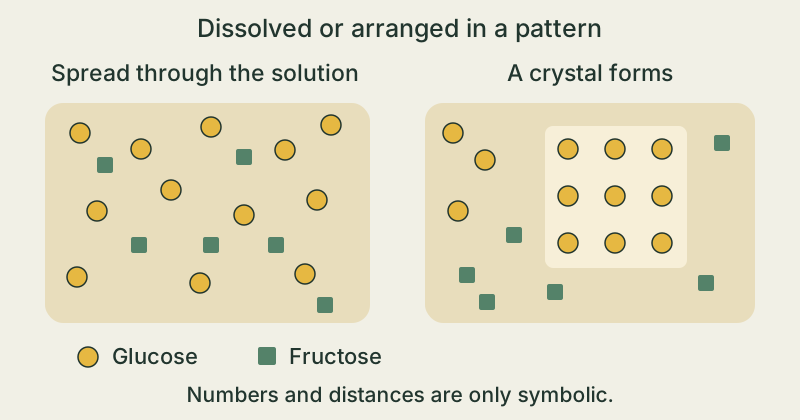
The cover is an illustration. The particle pictures are simplified models, not microscope images. Crystallisation alone proves neither spoilage nor added sugar; our observation is not a food safety test.
Lots of sugar in little water
The main sugars in honey are glucose and fructose. At first they are dissolved in water. Honey can contain more dissolved glucose than will remain dissolved under the conditions. This is called a supersaturated solution. It does not have to form visible crystals straight away.
Particles form ordered crystals
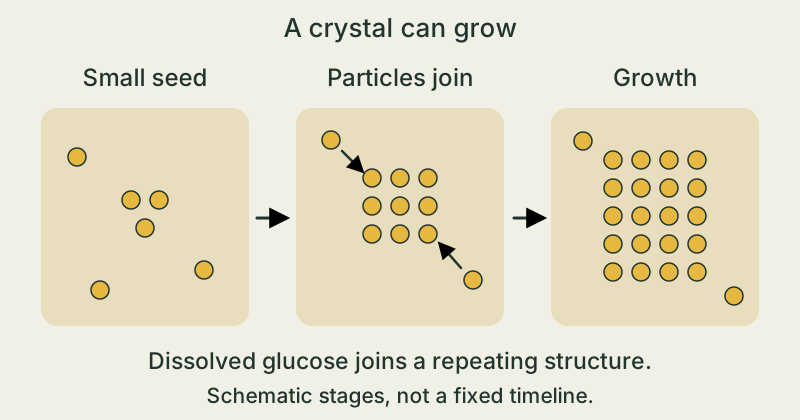
Glucose molecules can join in a repeating arrangement. This forms solid sugar crystals, with the remaining liquid between them. Under usual storage conditions, these glucose crystals also contain water in their structure. The honey has not frozen into ice. Fructose stays dissolved more readily than glucose.
A tiny starting point helps
An existing small crystal can provide a starting point: more matching particles join it. Tiny particles such as pollen can also help crystallisation begin. Many crystals change the texture. Very fine crystals can produce creamy honey; larger ones tend to feel grainy.
Different honeys take different times
The flower source affects the balance of sugars. Honeys with more glucose often crystallise faster. Water content, starting points and temperature matter too. Colder does not mean faster without limit: at very low temperatures, particles move slowly. A firm or runny jar alone cannot tell you exactly how long it has been stored.
Compare two closed jars
- With an adult, find a runny honey and an already crystallised one, if available. Keep both jars closed. Note differences in appearance and any flower source listed on their labels.
- Gently tilt the tightly closed jars over the table. Do their contents flow equally easily? Draw what you see. This shows their texture, not individual molecules.
- Look at one jar again on several days in the same storage place. Record it even if nothing visible changes. Different varieties are not a controlled experiment; new crystals may take longer than a few days to appear.
Handle glass jars safely with an adult. For this observation, do not open, heat, add anything to or taste the honey.
The takeaway
During crystallisation, some dissolved glucose joins ordered solid structures. Composition, starting points and temperature affect how quickly this happens.
What are the grains in crystallised honey mainly made of?
Sources & further reading
FAO · Value-added products from beekeeping: Honey, section 2.2 (Crystallization) ↗University of Arkansas System · All About Honey: Crystallized honey ↗Southern Cross University · Crystallisation In Honey (PDF, pp. 2–3) ↗European Commission · CORDIS: Why did my honey crystallise? ↗Our stories explain the main idea in our own words. Pictures and models simplify reality and are not drawn to scale.