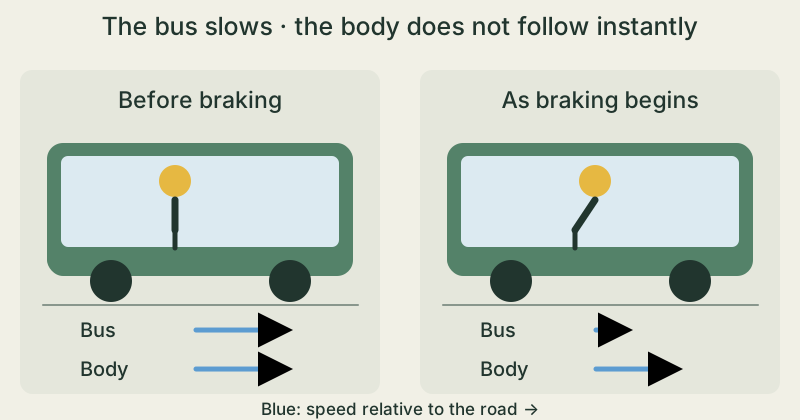
Before braking, the bus and your body travel forwards together. The bus slows down, while your body initially tends to keep its previous motion. You therefore move forwards relative to the bus. Contact forces, for example at your feet, a seat or a belt, also slow your body down. This property of bodies is called inertia.
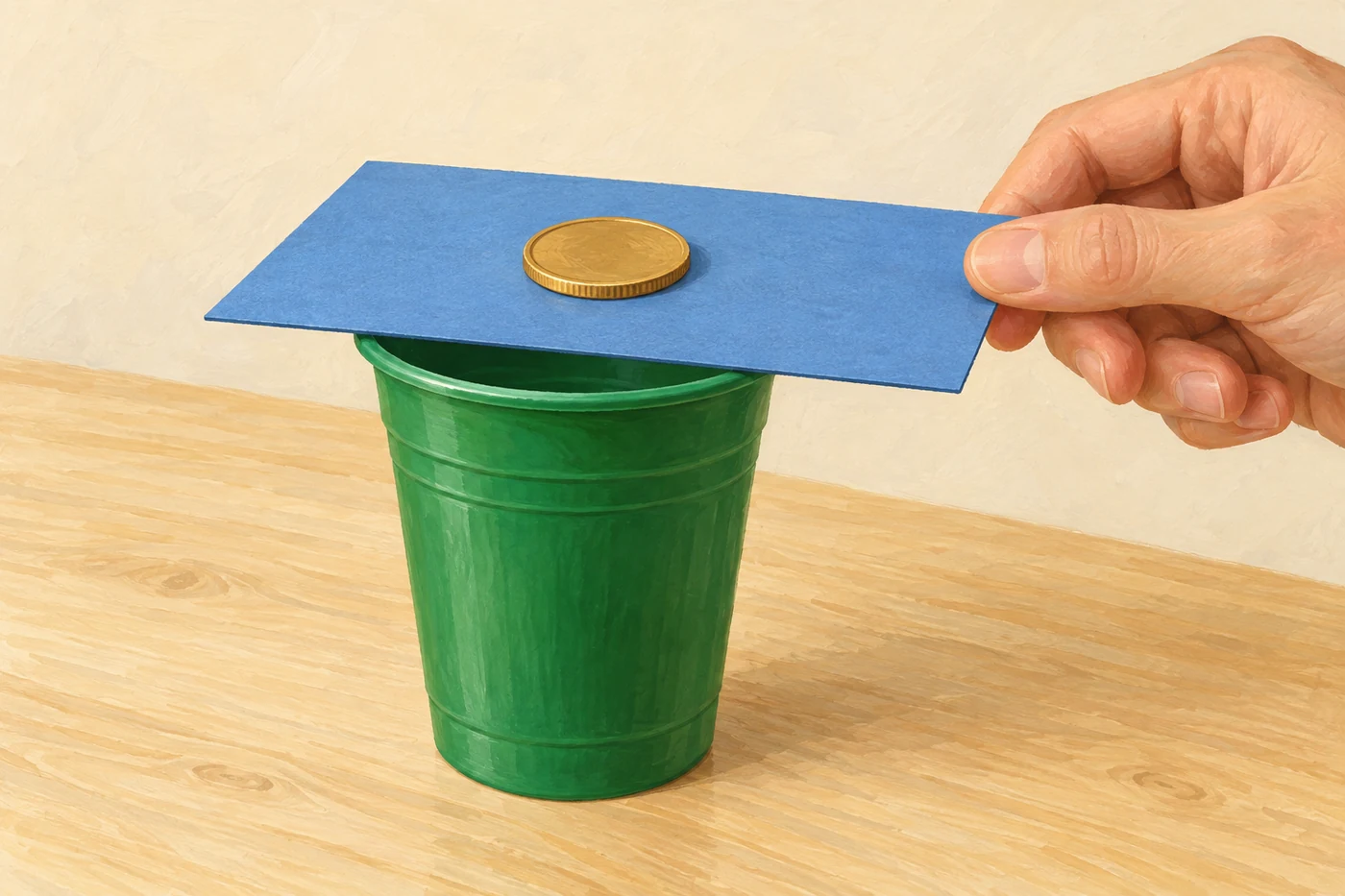
The cover shows a different inertia observation: a coin on a card above a cup. It is an illustration, not a photograph of a completed experiment. You do not need a moving bus to try this.
Motion does not change by itself
An object stays at rest or moves in a straight line at constant speed as long as the external forces balance overall. This is Newton’s first law.
Speeding up, slowing down or changing direction requires a net force: the forces no longer balance. Inertia does not mean that an object has intentions or its own engine.
The bus and your body are separate objects
The brakes and the tyres’ contact with the road slow the bus. Your body is not rigidly attached to it. How your motion changes depends on the forces acting on you.
If contact with the floor slows your feet, your upper body may still move forwards. A belt also transfers a slowing force to your body. How much you move depends on your posture, the contact forces and the braking, among other things.
Forwards: seen from where?
Seen from the roadside, you were already moving forwards before the braking began. You do not need a new forwards push when it happens. The bus beneath you is slowing down.
Seen from inside the bus, your position therefore shifts forwards. That description uses the bus as its reference. The blue arrows in the first drawing instead show speeds relative to the road, not forces.
A resting coin has inertia too
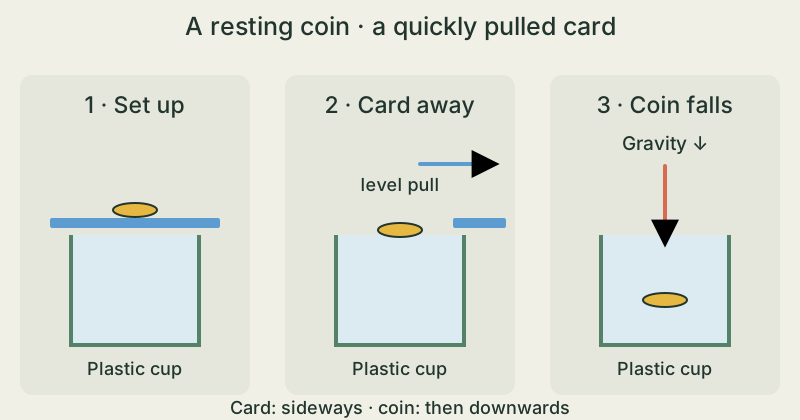
When a coin rests on a card, friction can carry it along if the card is pulled slowly. A quick, level pull removes the card after only brief contact. The coin often moves only a little sideways.
Once the card no longer supports it, gravity makes the coin fall into the cup. Inertia does not pull it down. The activity demonstrates rest and changes in motion; it is not a scale model of a braking bus.
Watch a coin, a card and a cup
- Have an adult put an empty, stable plastic cup in a large shallow catch tray, well away from the table edge. Lay a smooth stiff card across the opening and place one large coin flat at its centre. The coin must fit through the opening. Predict what might happen with a slow pull and with a quick pull.
- The adult holds the cup steady and first pulls the card slowly sideways, keeping it level. Watch whether the coin moves with it. Reset the setup. Now the adult removes the card with one short, swift horizontal pull without tilting it upwards. Watch from the side at a distance to see where the coin lands.
- Repeat each version three times with the same card, coin and starting position. Record: moved along, fell into the cup or fell outside it. Not every attempt works. A rough or bent card and a slanted pull can change the result. Compare your observations with the roles of friction and gravity.
Use this only as a supervised tabletop activity. The adult pulls the card; keep the coin away from mouths, eyes and young children. Do not use glass, sharp edges or stacks of coins, and do not throw anything. Watch from a distance. Never test braking in traffic or experiment in a vehicle without holding on or using a belt.
The takeaway
Your body does not automatically slow down at the same time as the bus. Inertia describes maintaining rest or straight-line motion at constant speed without a net external force. Contact forces change motion; gravity makes the unsupported coin fall.
Why does your upper body move forwards relative to the bus when it brakes?
Sources & further reading
NASA Glenn Research Center · Newton’s Laws of Motion ↗OpenStax / Rice University · Newton’s First Law of Motion: Inertia ↗NASA STEM · The Law of Inertia: Newton’s First Law ↗Science World · Playing Cards and Pennies ↗Fleet Science Center · Inertia ↗Our stories explain the main idea in our own words. Pictures and models simplify reality and are not drawn to scale.