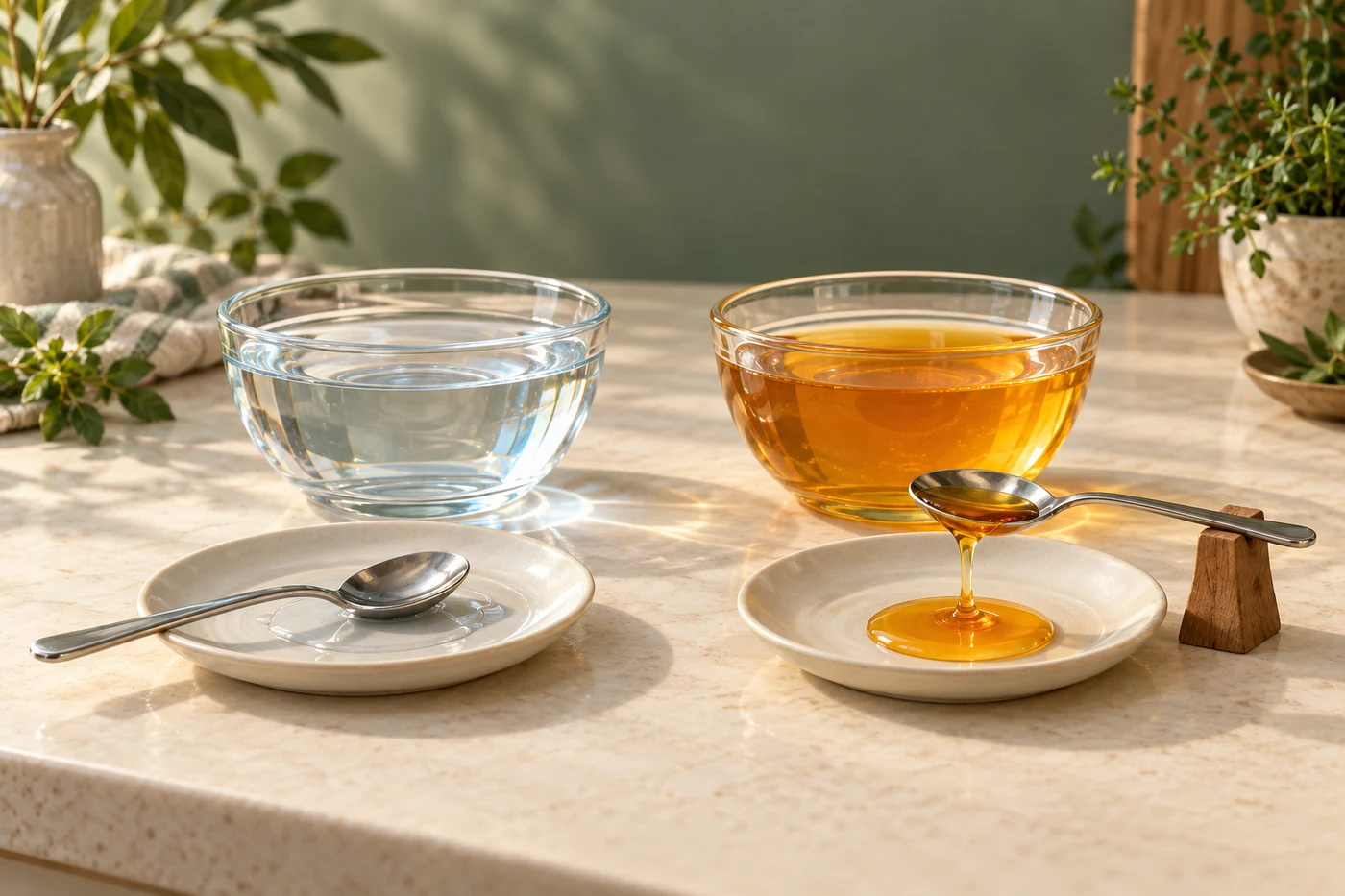
At the same room temperature, liquid honey has a much higher viscosity than water. This means it offers more internal resistance to flow. Its particles move past one another less easily. Under comparable conditions, honey therefore flows more slowly.
Honey and water are both liquids, yet they move differently when poured. The cover illustrates the materials; it is not a measured comparison using identical spoon positions.
Flow means rearranging
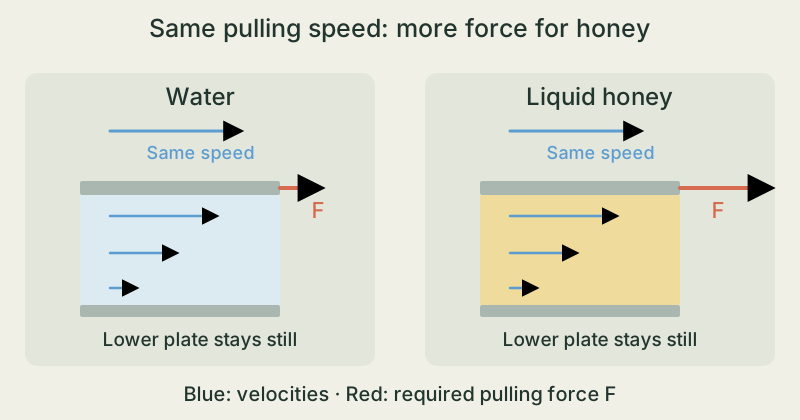
As a liquid flows, its tiny particles, called molecules, change neighbours. Different parts of the liquid can move at different speeds. Viscosity describes how strongly the liquid resists this relative motion.
We can picture imaginary layers to help explain it. They are not solid plates inside honey. Higher viscosity means greater resistance between regions moving at different speeds.
Honey contains lots of dissolved sugar
Honey consists mainly of sugars and water. How easily its molecules pass one another depends on their shapes, sizes and mutual attractions. Rearranging is harder in this sugar-rich mixture than in pure water.
Honeys differ. Their composition, water content and any crystals present affect how they flow. Here we mean ordinary liquid honey, rather than solid or gel-like honey.
Viscosity and density describe different things
Density tells us how much mass there is in a given volume. Viscosity tells us how strongly a liquid resists flowing. These are two different properties.
When you pour, gravity pulls the liquid downwards. Slope, amount and the surface also affect its flow. A slowly moving drop alone is therefore not a precise measurement of viscosity.
Temperature matters too
Warmer liquid honey usually has a lower viscosity and pours more readily. Extra thermal motion helps its molecules rearrange past one another.
A comparison therefore needs similar temperatures. For our observation, leave both liquids in the same room. There is no need to heat them.
Watch two liquids on the same slope
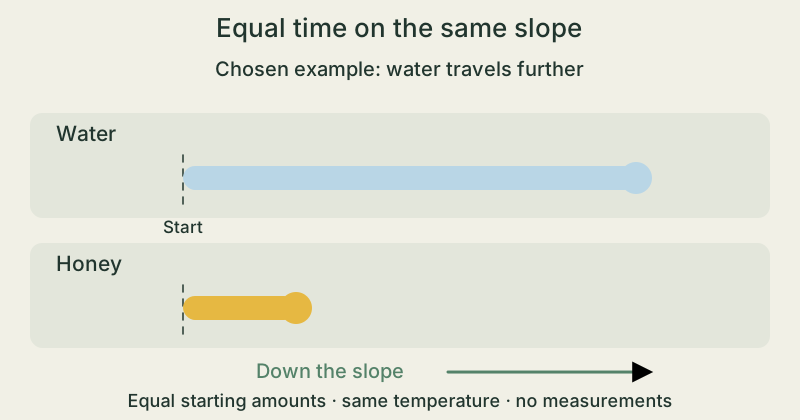
- With an adult, leave water and liquid, uncrystallised honey in the same room for about 30 minutes. Put a large, smooth plastic tray with a rim flat on the table. Mark two widely separated starting areas at the same height on the outside.
- Put half a level teaspoon of each liquid in its starting area. An adult gently tilts the whole tray in one common direction and holds it still for ten seconds. Keep the liquids apart. Also record if the water spreads before the tray is tilted.
- After ten seconds, compare how far the leading edges have travelled. Repeat three times on the cleaned, dry tray. Water will usually travel further, faster. Wetting, starting shape and density also play a part; this comparison shows a difference but does not give an exact viscosity value.
Use small amounts on a stable table and do not tilt far enough to spill over the rim. Use no heating equipment. Wipe up spills immediately to avoid a slippery floor. Clean the tray and spoons afterwards.
The takeaway
High viscosity means strong internal resistance to flow. Liquid honey has much more of it than water at the same temperature. Composition and temperature affect viscosity; density describes a different property.
What does high viscosity mean?
Sources & further reading
OpenStax · Chemistry 2e: Properties of Liquids ↗University of Leeds · Viscosity ↗FAO · Value-added Products from Beekeeping: Honey ↗NASA · Flight Testing Newton's Laws: Viscous Friction, S. 4.10 ↗Our stories explain the main idea in our own words. Pictures and models simplify reality and are not drawn to scale.