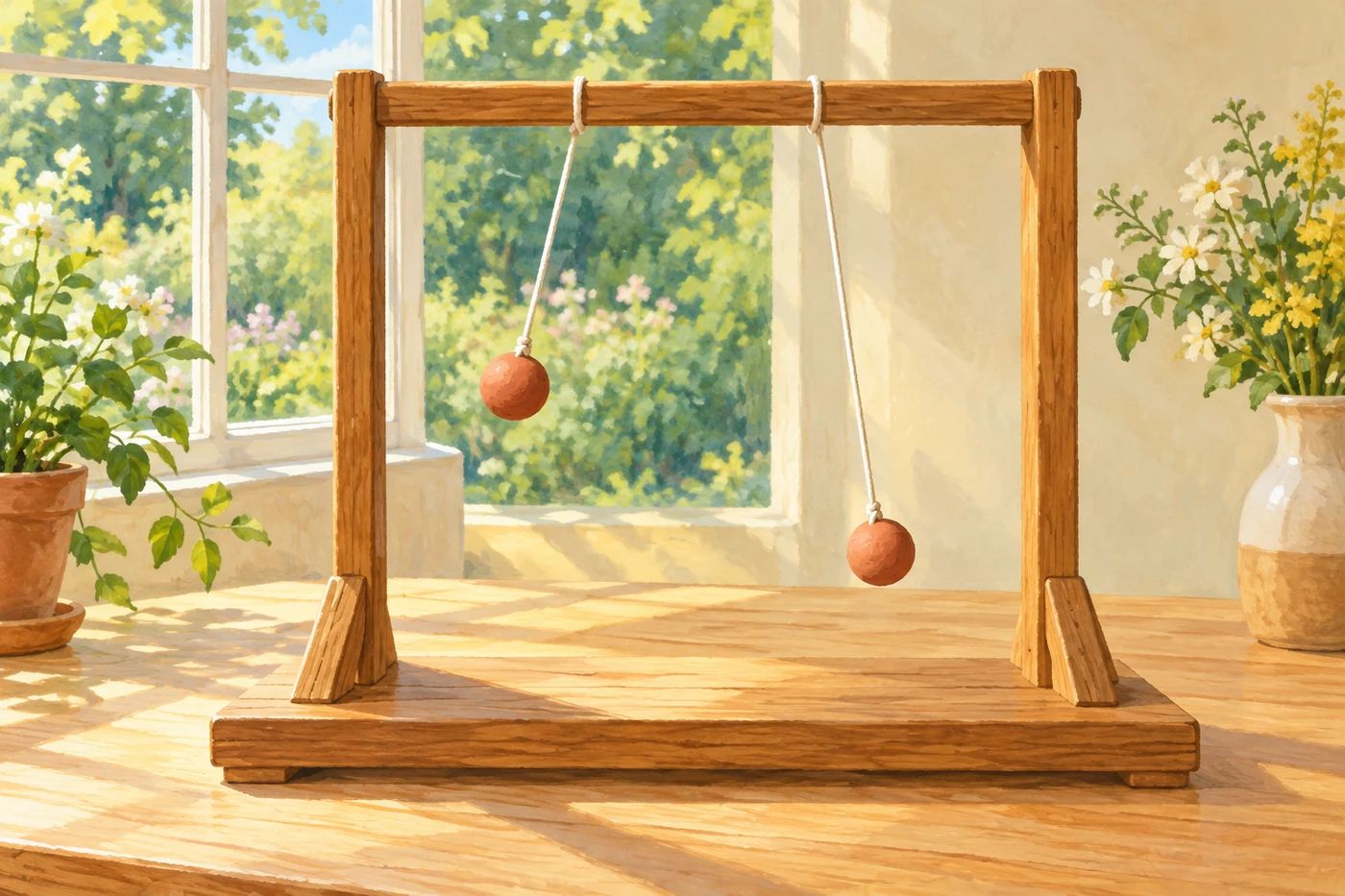
For small swings, a long string pendulum takes more time for a complete back-and-forth trip than a short one. At the same starting angle, its arc is longer and gravity changes its angular motion more slowly. In the simple model, the pendulum's length and gravity set the rhythm, rather than the bob's mass.
The cover is an illustration. Our model is a small bob on a light string that hardly stretches. It helps explain a playground swing's rhythm, although a real swing with a moving person is more complicated.
Gravity brings it back
A resting bob hangs below its support. Pull it a little to one side and let go: gravity brings it back towards the lowest point along its curved path.
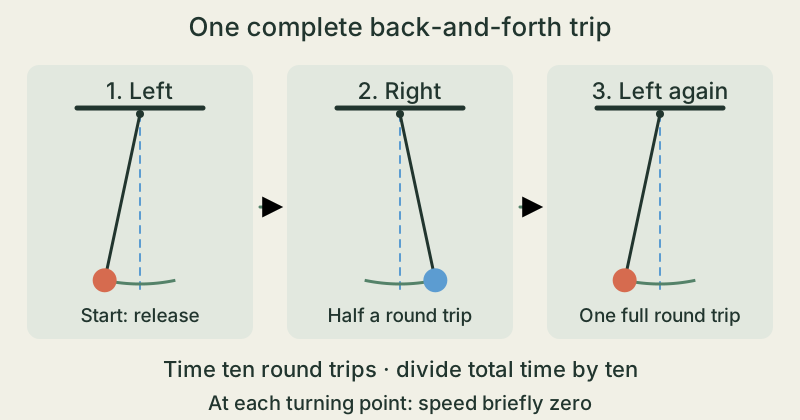
It keeps moving through that point and rises on the other side. At a turning point its speed is zero for an instant, then it moves back. A complete back-and-forth trip ends at the same turning point where it began.
More length means a slower rhythm
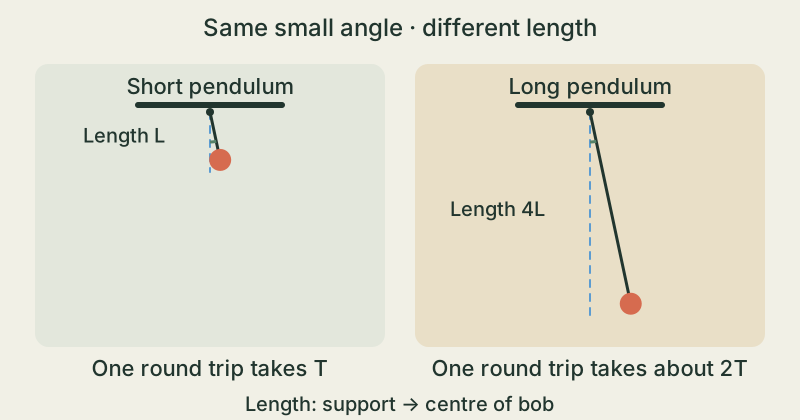
Compare two pendulums in the same place, released from the same small angle. The longer one makes fewer round trips in the same time. Measure length from the support to the centre of the small bob, rather than just to the string's knot.
The period does not increase in direct proportion to length: four times the length gives about twice the period. This follows from T ≈ 2π√(L/g). T is the time for a round trip, L is pendulum length and g is local gravitational acceleration. This approximation applies to small angles.
A heavier bob is not a faster clock
Earth pulls more strongly on a heavier bob. But more force is also needed to change its motion by the same amount. These effects cancel in the simple pendulum model.
At the same length and small angles, changing mass alone therefore leaves the rhythm approximately unchanged. Air resistance, friction and a stretchy string can affect a real experiment. The swings gradually become smaller.
A playground swing is a similar system
A swing with a greater effective pendulum length takes more time for a round trip under comparable conditions. A precise description must also include the seat, body position and how mass is distributed. Chain length alone does not describe everything.
Moving your legs or being pushed changes the motion too. Large swings also depart from the small-angle approximation. For our comparison, we release a small bob without an extra push from an angle of about 5 to 10 degrees.
One bob, two pendulum lengths
- With an adult, securely attach a small soft modelling-clay ball to a string. The adult holds the top as still as possible above a clear tabletop. First measure 15 cm from the holding point to the ball's centre. Leave room so it cannot hit anything.
- Move the bob only a little to one side of vertical, about 5 to 10 degrees, and release it without pushing. Time ten full round trips: left–right–left counts once. Start at zero; the next return to the left turning point counts as one. Repeat three times and divide each total time by ten.
- Lengthen the same pendulum to 60 cm, measured to the ball's centre. Keep the same bob and small starting angle, then repeat. Compare your results: the model predicts about twice the time per round trip at four times the length. Note differences and possible causes, such as a moving hand or a counting error.
Observe with an adult over a clear surface. Use soft modelling clay rather than heavy, sharp or breakable weights. Secure the bob to its string and keep it away from faces. Never loop string around body parts or put materials in your mouth; put everything away afterwards. Do not modify a playground swing or work on high supports.
The takeaway
A long pendulum has a slower rhythm at small angles. Four times the length gives about twice the period. Changing mass alone does not change the simple model's rhythm.
A simple pendulum's length is multiplied by four in the same place. What happens at small angles?
Sources & further reading
OpenStax · College Physics 2e: The Simple Pendulum ↗Idaho State University · Simple Pendulum ↗OpenStax · University Physics Volume 1: Pendulums ↗Our stories explain the main idea in our own words. Pictures and models simplify reality and are not drawn to scale.