
Airflow across the opening can make air in and near the bottle neck move back and forth. Air inside the body is alternately compressed and allowed to expand, acting rather like a spring. Together they have a preferred vibration frequency. Suitable blowing sustains resonance and produces a clear note.
The cover is an illustration, not a measurement photograph. We consider blowing across a bottle with a narrow neck and wider body. A tube or a glass being tapped can behave differently.
An air stream supplies energy
You blow across the rim rather than sealing the opening with your mouth. The air stream can fluctuate at the opening and keep driving the air motion.
A note needs suitable conditions. The angle and strength of your breath matter. Hearing only a rush of air is therefore a possible observation, rather than a failed proof.
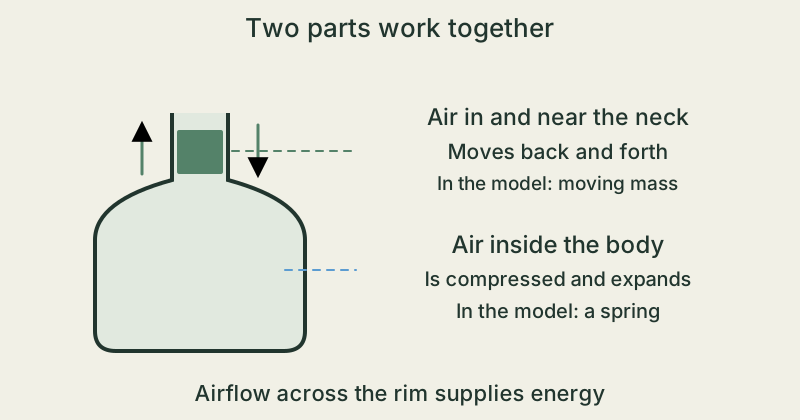
Air can spring back
When neck air moves a little inward, pressure in the body rises. The compressed air pushes back. Its inertia carries the neck air past its resting position; lower pressure inside then lets outside air push it inward again.
The system moves back and forth. In a simple model, neck air behaves like a moving mass and the air in the body like a spring. There is no actual metal spring inside. This model is called a Helmholtz resonator.
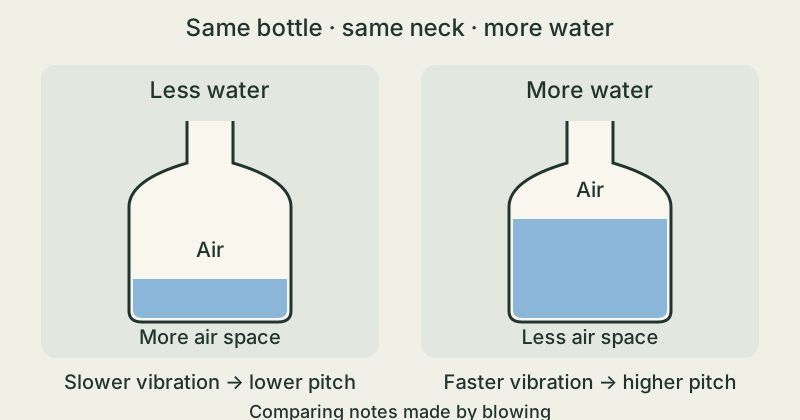
Less air space, a higher note
Adding water to the same bottle leaves less air space in the body. The opening and neck stay unchanged and above the water.
This smaller air space acts as a stiffer spring in the model. The preferred vibration becomes faster, with a higher frequency. We hear more vibrations per second as a higher note. Exact pitch also depends on the neck, opening and air temperature.
Blowing and tapping are different
When blowing, we mainly investigate vibrating air. Tapping a glass bottle also makes the glass vibrate with the water. In that case, adding water can lower the note.
Our comparison sticks to blowing. Louder and higher also mean different things: loudness describes a sound’s strength, while pitch describes its vibration rate. Blowing harder does not replace comparing water levels.
Listen to three water levels
- With an adult, choose a clean, stiff PET drinks bottle with a narrow neck. Check the rim for damage and put the cap away. Fill it roughly one quarter full of room-temperature water. Hold it upright without squeezing. Blow briefly and gently across the open rim without sealing it with your lips. Small changes of angle may help.
- If you hear a note, remember it as your reference. Fill the same bottle about halfway, then about three quarters full, keeping water below the neck. Try each level with a similar position and short, gentle breaths. Record higher, lower or no clear note. Compare pitch rather than just loudness.
- Pour water out to return to the first level and check whether roughly the same note returns. Compare the order three times with breaks, stopping if blowing feels uncomfortable. The levels are approximate, and you are not measuring frequency. If no note appears, compare the diagrams: the airflow must suit the bottle too.
Work with an adult. Use only an undamaged PET drinks bottle and room-temperature water. Do not cut, heat, strike or pressurise it. Do not breathe in from the bottle or put its cap on while blowing, and do not play it near anyone’s ear. Each person uses their own bottle. Blow briefly and gently, breathe normally between attempts and take frequent breaks; stop immediately if dizzy.
The takeaway
Air in the neck vibrates with the spring-like air inside the body. Suitable blowing sustains the resonance. In the same bottle, adding water reduces the air space and usually raises the blown note.
What usually happens when you blow across the same bottle after adding more water below its neck?
Sources & further reading
UNSW Physics · Helmholtz Resonance ↗University of California, Santa Barbara · Wind instruments ↗University of Guelph · Simple Instruments: Bottle Organ ↗University of Jyväskylä · How to model a bottle? Student version ↗Our stories explain the main idea in our own words. Pictures and models simplify reality and are not drawn to scale.