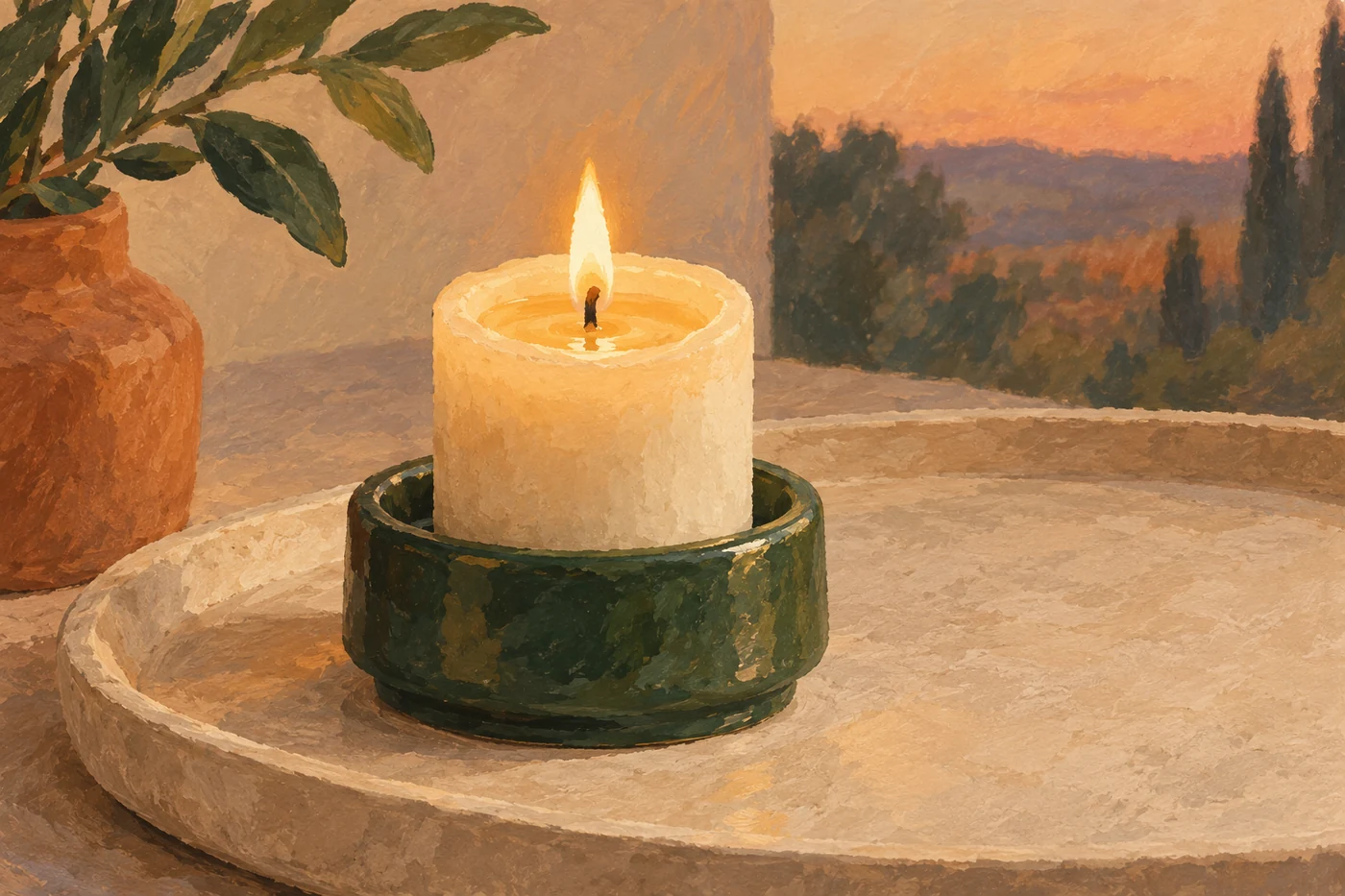
In an ordinary wax candle, some wax first melts. Liquid wax travels up the wick and becomes gas near the flame. This wax vapour reacts with oxygen from the air, producing mainly carbon dioxide and water vapour. These spread into the surrounding air: the wax is being changed into other substances.
The cover is an illustration. We are discussing an ordinary wax candle, rather than an electric LED candle. The observation activity below uses no flame at all.
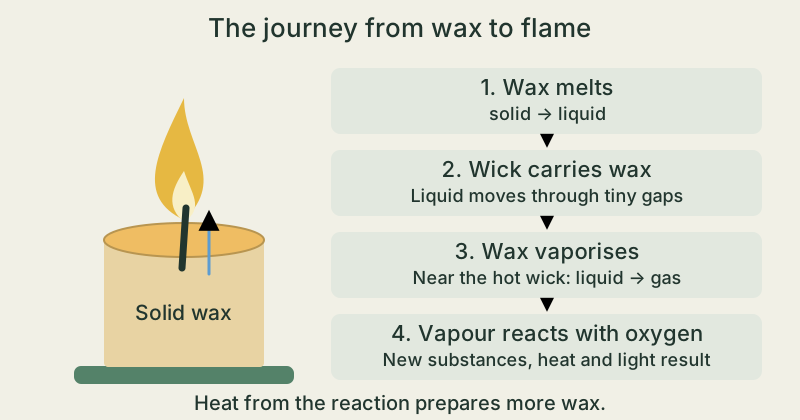
First the wax melts
The flame heats wax near the wick. A small pool of liquid forms there while wax farther away stays solid.
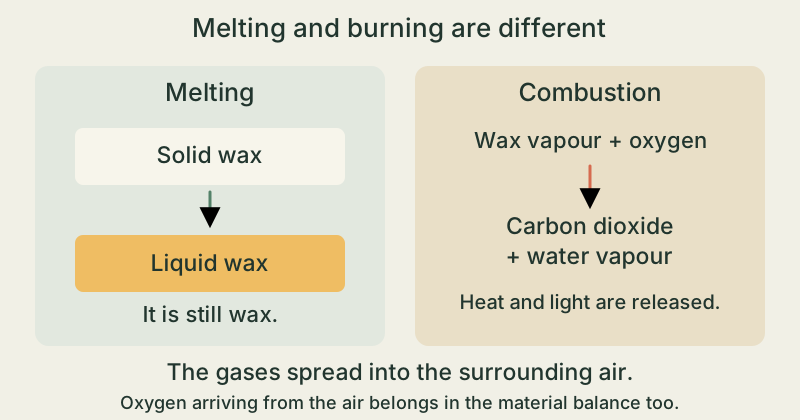
Melting alone makes no new substances. Liquid wax can become solid again as it cools. This is a change of state: solid or liquid.
The wick keeps supplying fuel
Liquid wax can travel through the tiny gaps in the wick. This capillary action is similar to a paper towel soaking up water.
Wax vaporises near the hot upper wick. The gaseous fuel mixes with air and reacts. The wick itself can also char and burn away, but the main store of fuel is the wax.
Burning makes new substances
Ordinary paraffin wax contains carbon and hydrogen. During combustion, these atoms combine with oxygen from the air in new arrangements. Major products are carbon dioxide and water, which is vapour at the hot flame.
The reaction releases energy as heat and light. Some of the heat melts and vaporises more wax, maintaining the fuel supply while conditions remain suitable.
Invisible does not mean gone
The gases leave the candle. It therefore becomes lighter and smaller even though matter has not simply vanished. A full comparison of the substances must also include oxygen arriving from the surroundings.
Combustion is not complete everywhere. Soot and other by-products can form, and some drops of wax remain. Yellow-glowing soot particles contribute to candlelight. The bright flame is therefore not a visible cloud of carbon dioxide.
Investigate a wick without a flame
- With an adult, examine a completely cold, unlit wax candle. Find its solid wax body and wick. Draw both and keep two kinds of notes: what you can actually see and what the model explains. Do not light the candle for this activity.
- Lay a clean, undyed cotton thread on a waterproof plate. Dip only one end into a small puddle of room-temperature water, leaving the rest outside it. Watch for a few minutes to see how far the damp patch spreads. The type of thread and any coating can affect the result.
- Compare this with diagram 1: a candle wick also carries liquid through tiny gaps. Our water thread demonstrates only that transport. It does not demonstrate wax vaporising or burning. Mark which other stages in your drawing are described by the explanation and sources rather than directly observed.
Work with an adult and a completely cold, unlit candle. Use no matches, lighters or heat sources. Keep water on the plate and away from electrical devices. Do not put wax or thread in your mouth, and put short threads away afterwards. The candle illustrations and linked demonstrations are not instructions to try fire experiments yourself.
The takeaway
Melting and vaporising prepare the fuel. Reacting with oxygen then changes wax vapour into new substances. Much of it leaves the candle as carbon dioxide and water vapour.
Why does a burning wax candle get smaller over time?
Sources & further reading
American Chemical Society · Combustion and Burning ↗Hong Kong Observatory · How does a candle burn? ↗National Science Teaching Association · Combustion and a Jumping Flame ↗Our stories explain the main idea in our own words. Pictures and models simplify reality and are not drawn to scale.