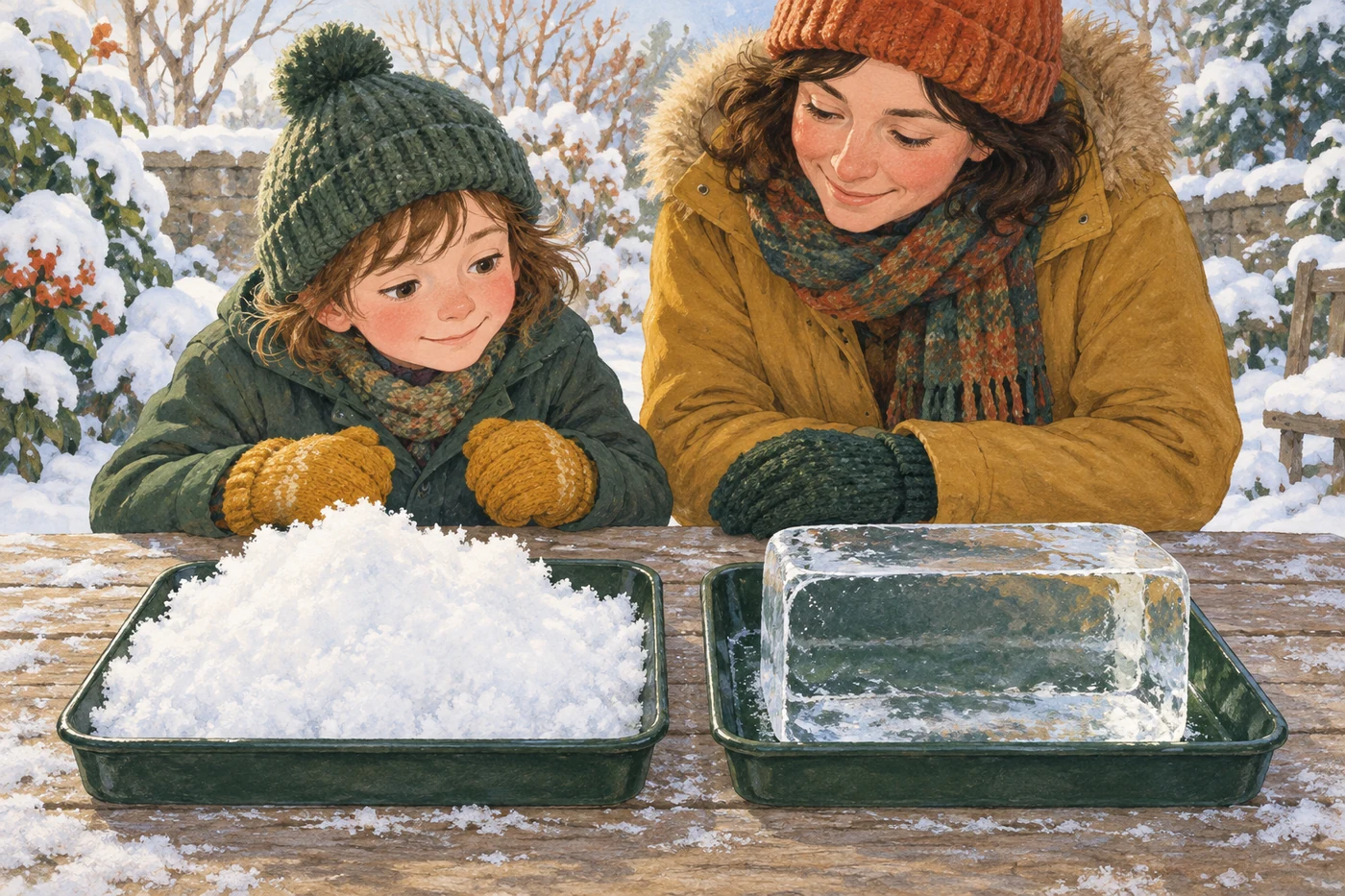
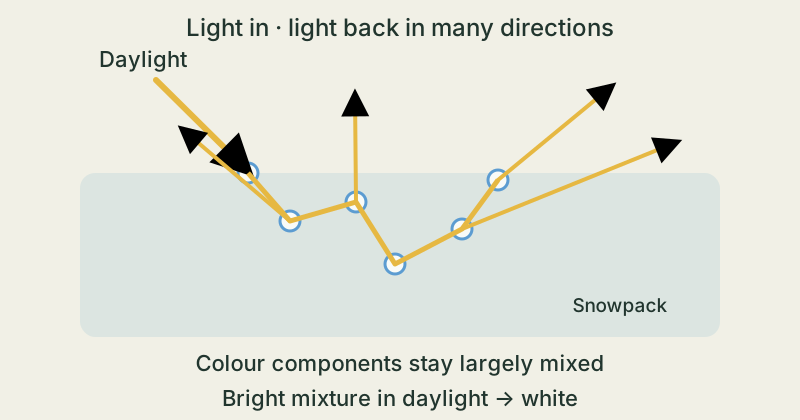
Snow contains many tiny ice crystals with air between them. At their boundaries, light is refracted and partly reflected. After many changes of direction, much of it emerges again. Clean snow sends back the visible colour components of daylight largely together. This mixture looks white to us.
The cover is an illustration, not a photograph of a measured experiment. We compare clear ice with a sufficiently thick layer of clean snow in ordinary daylight.
Clear ice and many little grains
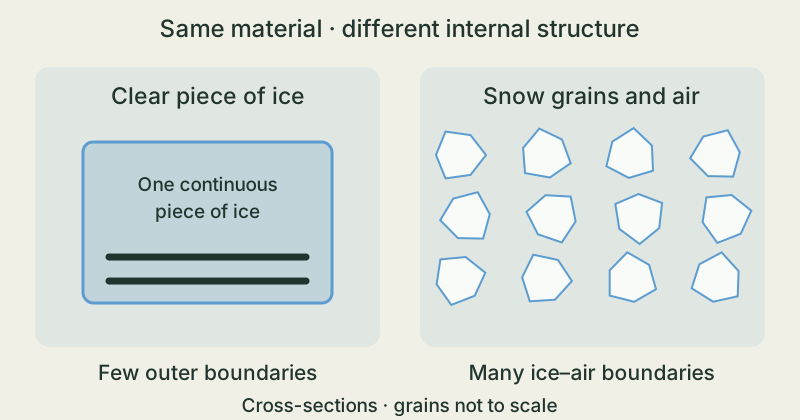
A single clean ice crystal can transmit visible light well. A snowpack contains very many crystals or ice grains, with air between them.
Light therefore encounters many boundaries between ice and air. Not every crystal is a star: snow on the ground can contain grains of many different shapes.
Light takes many new paths
Light can change direction as it passes between air and ice. This is refraction. Some light is also sent back, or reflected. Many boundaries facing different ways redirect it repeatedly.
Together, these changes spread light in many directions. We call this scattering. Some of the light eventually reaches our eyes. We see a bright snow surface rather than a clear image of what lies underneath.
White is a mixture
Daylight contains many visible colour components. Clean snow returns much of that light without strongly selecting a single colour. The mixture looks white to us.
Snow does not have to create those colours. It does not make its own light either. Under coloured lighting or in shadow, its appearance can change.
Snow is not always pure white
Dust and soot can darken snow by absorbing more light. Lighting changes its colour too: a shadow can look bluish, for example.
A different effect can occur along long light paths through snow or ice: red light is absorbed more strongly than blue, so a blue tint can remain. This effect is not needed to explain the usual white appearance of a snowpack.
Look through flat and crumpled film
- Ask an adult to prepare two equal pieces of clean, clear household food wrap, about 30 by 30 centimetres each. Draw thick black stripes on paper. Hold one piece loosely and as flat as possible above it. Look down at the stripes under ordinary white room lighting.
- Loosely crumple the second piece and hold its centre at roughly the same height above the paper. Keep your eyes and lamp in place. Compare: how clear are the stripes, and where do bright reflections appear? Sketch both observations; the crumpled film need not look equally white everywhere.
- Compare the two shapes three times. Many folds and air gaps change the light paths; appearance also depends on the film and lighting. This is a simplified model using plastic, not real snow or a measurement of its brightness. Then compare it with the two explanatory diagrams.
Work at a table with an adult. Keep film away from mouths, noses and faces, and put it all away afterwards. Use no glass fragments, crushed ice, hot lamps or lasers. Look at the paper rather than into the lamp. This model needs no real snow.
The takeaway
Many boundaries between ice and air scatter light. Clean snow sends back many visible colour components together; in daylight the mixture looks white. Lighting, dirt and long light paths can alter its colour.
Why does a thick layer of clean snow usually look white in daylight?
Sources & further reading
WSL-Institut für Schnee- und Lawinenforschung SLF · Optical Properties ↗National Snow and Ice Data Center · Science of Snow: The colors of snow ↗UCAR Center for Science Education · Is Snow White? Maybe, or Maybe Not. ↗Met Office · Snowflakes: What makes snowflakes white? ↗Our stories explain the main idea in our own words. Pictures and models simplify reality and are not drawn to scale.