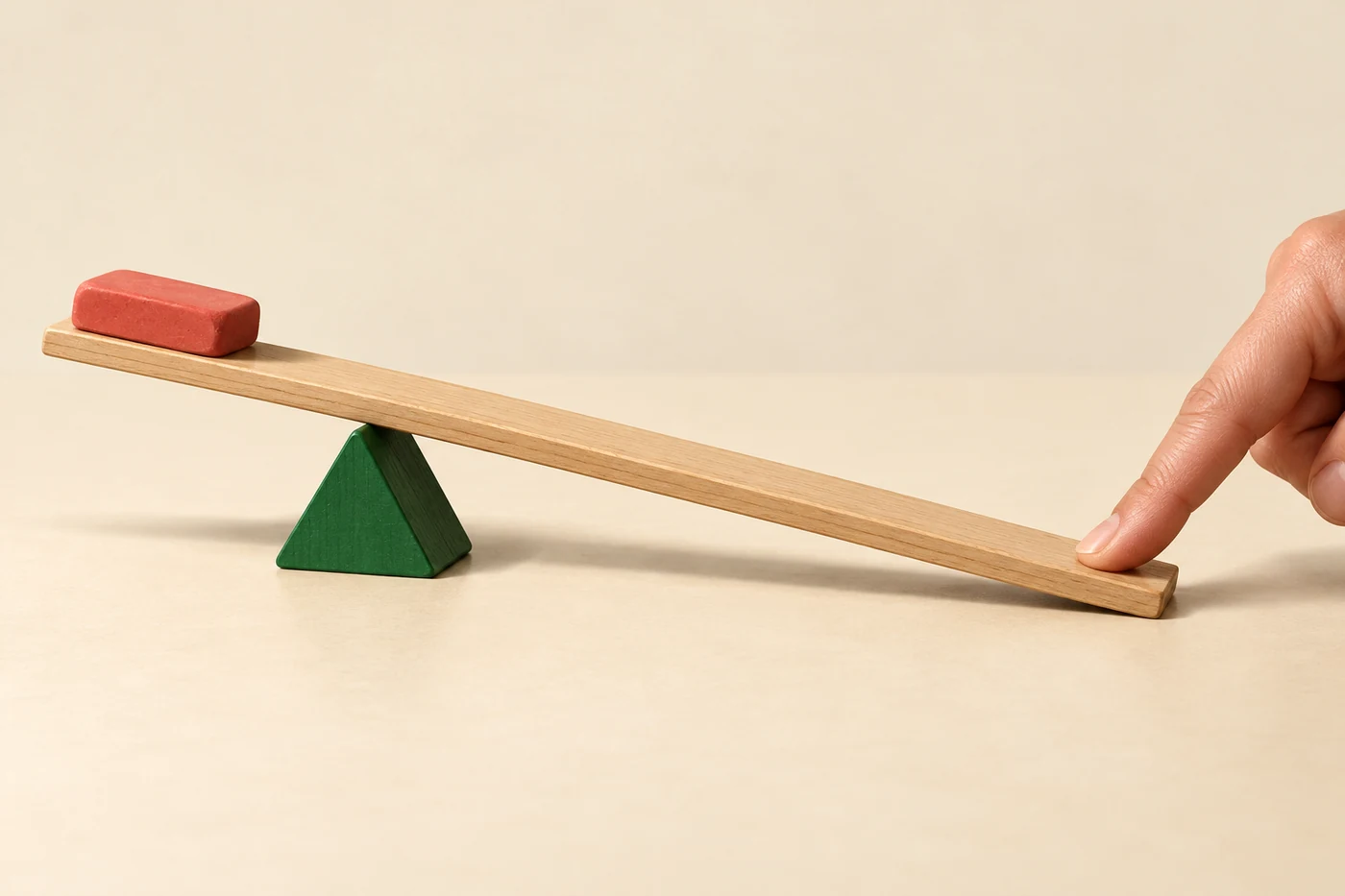
A lever turns around a support. Push farther from the pivot and the same force has a greater turning effect. This lets a smaller hand force lift a load on the short arm. In exchange, your hand moves farther than the load.
Many tools use this idea. A stiff ruler on a low support can already act as a tiny seesaw.
A bar, a support and two sides
A lever is a body that stays fairly rigid while it turns around a pivot. In our seesaw, the support lies between the load and your hand.
The load presses down on one side. Slowly push the other side down and the loaded side can swing upward. The support holds the lever up from below.
Distance gives a force more turning effect
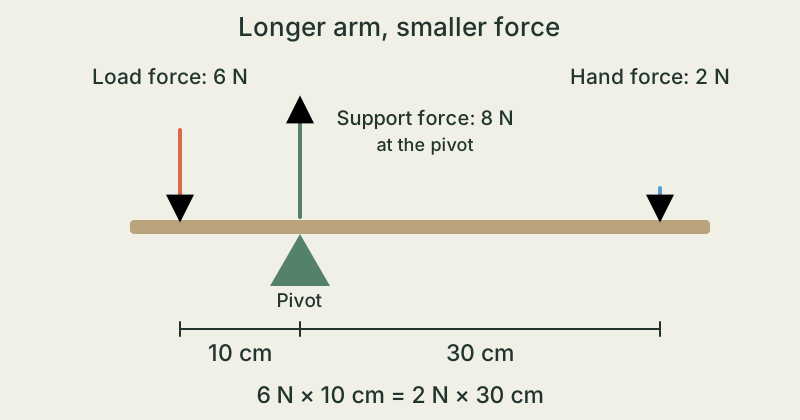
A force can turn something. Its turning effect is called torque. For a horizontal lever with vertical forces, what matters is force times distance from the pivot.
Here is an ideal example in balance: a load force of 6 newtons acts 10 centimeters to the left of the pivot. A hand force of 2 newtons, 30 centimeters to the right, balances it. Both 6 × 10 and 2 × 30 give the same result. The newton is a unit of force. This example ignores the lever's own weight and friction.
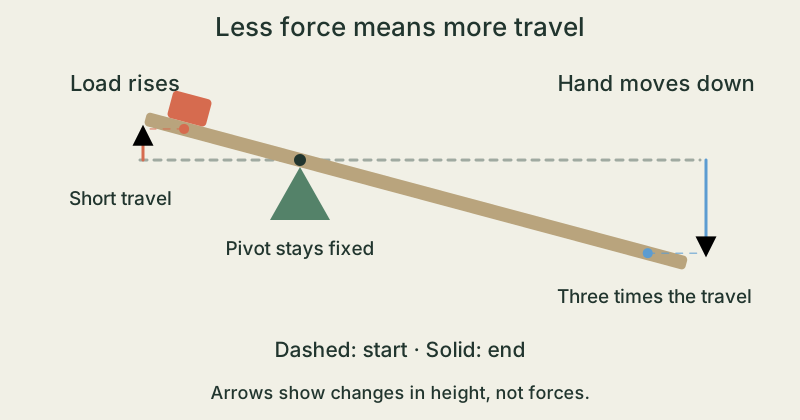
Less force means more travel
As the lever turns, the long end travels farther than the short end. If the effort arm is three times as long as the load arm, it traces an arc three times as long through the same angle.
The lever does not create extra energy. In an ideal, slow movement, the greater travel makes up for the smaller force. A real lever's own weight and friction also matter. A longer tool is no source of free energy.
Why the door handle is far from the hinges
A door also turns around an axis: its hinges. Pushing across the door near its outer edge is easier than pushing close to a hinge. The extra distance helps the turning effect.
Direction matters too. An angled push works differently from a perpendicular one. In general, the lever arm is the shortest distance between the pivot axis and the imaginary line along which the force acts. A tool's total length alone does not decide the result.
An eraser on a ruler seesaw
- Have an adult place an unsharpened hexagonal pencil across a shallow tray, underneath a light, stiff ruler. Tape the pencil ends down to stop it rolling. Carefully slide the empty ruler until it balances roughly level. Keep that support position for the comparison.
- Put a small eraser on the ruler about 5 centimeters left of the pivot. First press slowly down about 5 centimeters to its right, until the eraser rises only a few millimeters. Gently lower it again. Repeat with your finger about 10 centimeters to the right. Keep the load and support in the same places.
- Compare three times and record easier, the same or unclear. Pressing farther out should require less hand force. Also watch your finger travel farther for the same small lift. Your sense of effort is not a precise force measurement; rolling, slipping or a bending ruler makes the comparison unreliable.
Work with an adult and only a small eraser. Press slowly; never flick the ruler or launch objects. Keep hands out from under it. Avoid sharp, brittle or heavy objects. Keep everything low in the tray, well away from table edges and faces.
The takeaway
Turning effect depends on force, distance and direction. A long effort arm can reduce the force you need. Your hand then travels farther; no extra energy is created.
What do you trade for less hand force on a long lever arm?
Sources & further reading
OpenStax Physics · 9.3 Simple Machines ↗TeachEngineering · Engineering: Simple Machines ↗OpenStax College Physics 2e · 9.2 The Second Condition for Equilibrium ↗Our stories explain the main idea in our own words. Pictures and models simplify reality and are not drawn to scale.