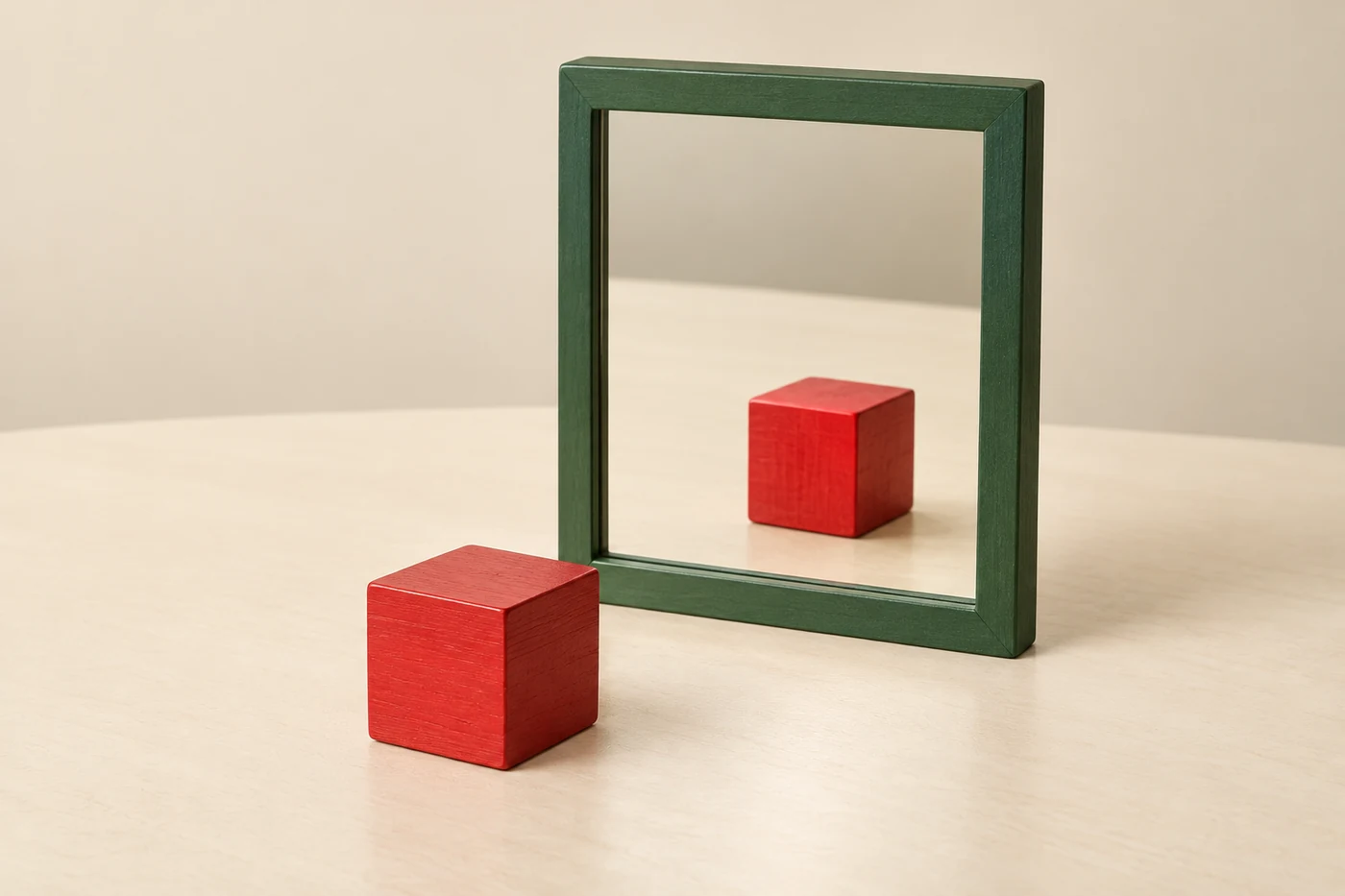
Light from an illuminated object reaches the mirror and bounces toward your eyes. This is called reflection. The very smooth mirror surface redirects the rays in an orderly way. You can therefore see a clear image that seems to lie behind the mirror.
We are looking at a plane mirror: a flat one without a curve. Following the light explains why it seems like a window into another room.
Light changes direction at the mirror
Light from the illuminated cube reaches the mirror. Some of it reflects in a direction that leads into your eye. A mirror therefore needs light; it does not shine by itself.
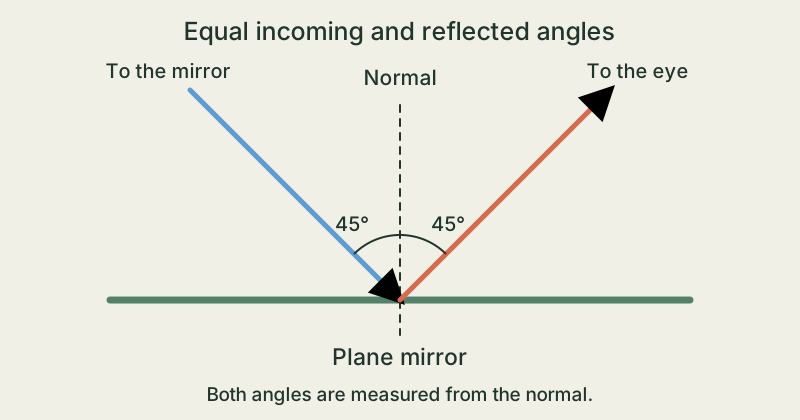
There is a fixed rule: the incoming angle and the reflected angle are equal. Both are measured from an imaginary line at right angles to the mirror surface. This guide line is called the normal.
Why does the image seem to be behind it?
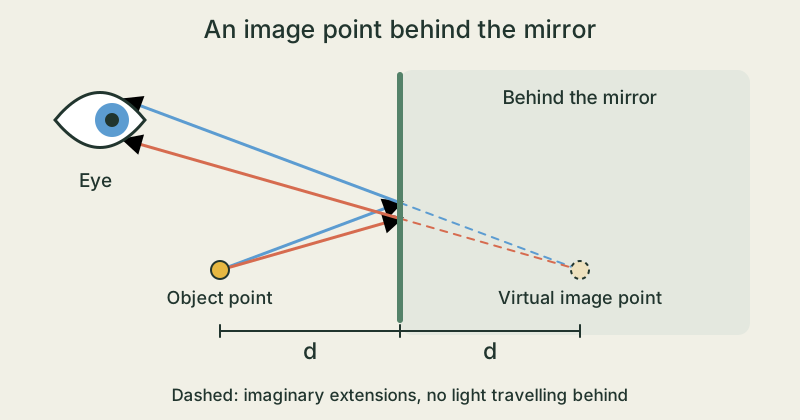
Your eye receives light arriving from particular directions. If we extend those reflected paths straight behind the mirror in a drawing, they meet at an image point there.
There is no second cube at that point. The light rays do not actually travel through the mirror to it. The image is called virtual: you can see it, but you cannot catch it on a sheet of paper placed there.
Equal distances on the two sides
For a plane mirror, each image point lies as far behind the reflecting surface as its object point lies in front. If a cube stands 10 centimeters in front, its image seems to lie 10 centimeters behind.
The image is upright and the same size as the object. More distant things can still look smaller: the size of the image and how large it looks from your viewpoint are different things.
Why doesn't white paper show a clear reflection?
Paper also reflects light. Its fine structure, however, spreads the light in many directions. This is called diffuse reflection. It lets you see the paper from different sides.
The smooth surface of a plane mirror preserves the orderly relationship between light paths. That is why you can recognize an image of the cube. Reflecting lots of light alone is not enough to produce a clear mirror image.
One cube, two distances and a paper surface
- An adult securely stands a small, flat, shatter-resistant plastic mirror upright on a table. Avoid curved magnifying mirrors and visibly bent mirrors. Place a ruler at right angles to it and put a small wooden cube 10 centimeters in front of the reflecting surface. Keep the room normally lit.
- Look from the front at an angle where you can see both the cube and its image. Move only the cube to 20 centimeters from the mirror, keeping your head as still as possible. Describe whether its image seems closer to the mirror surface or farther behind it. This is a qualitative observation of apparent depth, not a direct measurement.
- Return the cube to 10 centimeters. The adult holds a sheet of matte white paper immediately in front of the mirror surface. Stay at the same viewing position: do you still see a clear cube image, or just the paper? Record blurred or unexpected results too; a bent plastic mirror can distort the image.
Use only an intact, shatter-resistant mirror with covered edges; an adult should secure it against falling. Do not press on or bend it. Never redirect sunlight, lasers or bright lamps toward eyes. Normal room lighting is enough for this observation.
The takeaway
A plane mirror redirects existing light according to a fixed angle rule. Its virtual image appears as far behind it as the object stands in front. Paper reflects light too, but spreads it diffusely.
A cube stands 10 centimeters in front of a plane mirror. Where does its image appear?
Sources & further reading
OpenStax / Rice University · University Physics 3: The Law of Reflection ↗OpenStax / Rice University · Images Formed by Plane Mirrors ↗Optical Society of America / Florida State University · The Reflection of Light ↗Science Learning Hub / University of Waikato · Reflection of light ↗Our stories explain the main idea in our own words. Pictures and models simplify reality and are not drawn to scale.