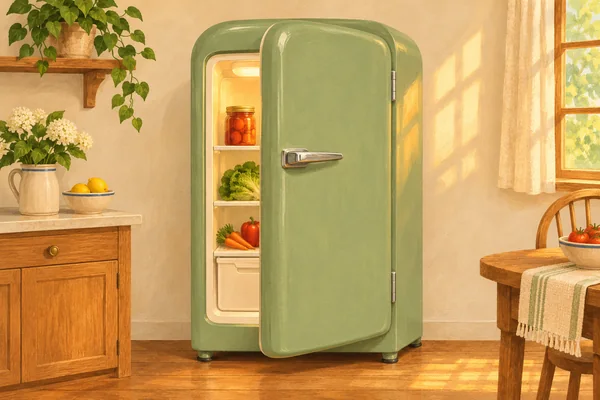
When you briefly stop a spinning raw egg, the shell stops first. The liquid inside keeps turning for a moment. As soon as you let go, it can pull the shell along again. In a hard-boiled egg, the shell and solid contents stop together.
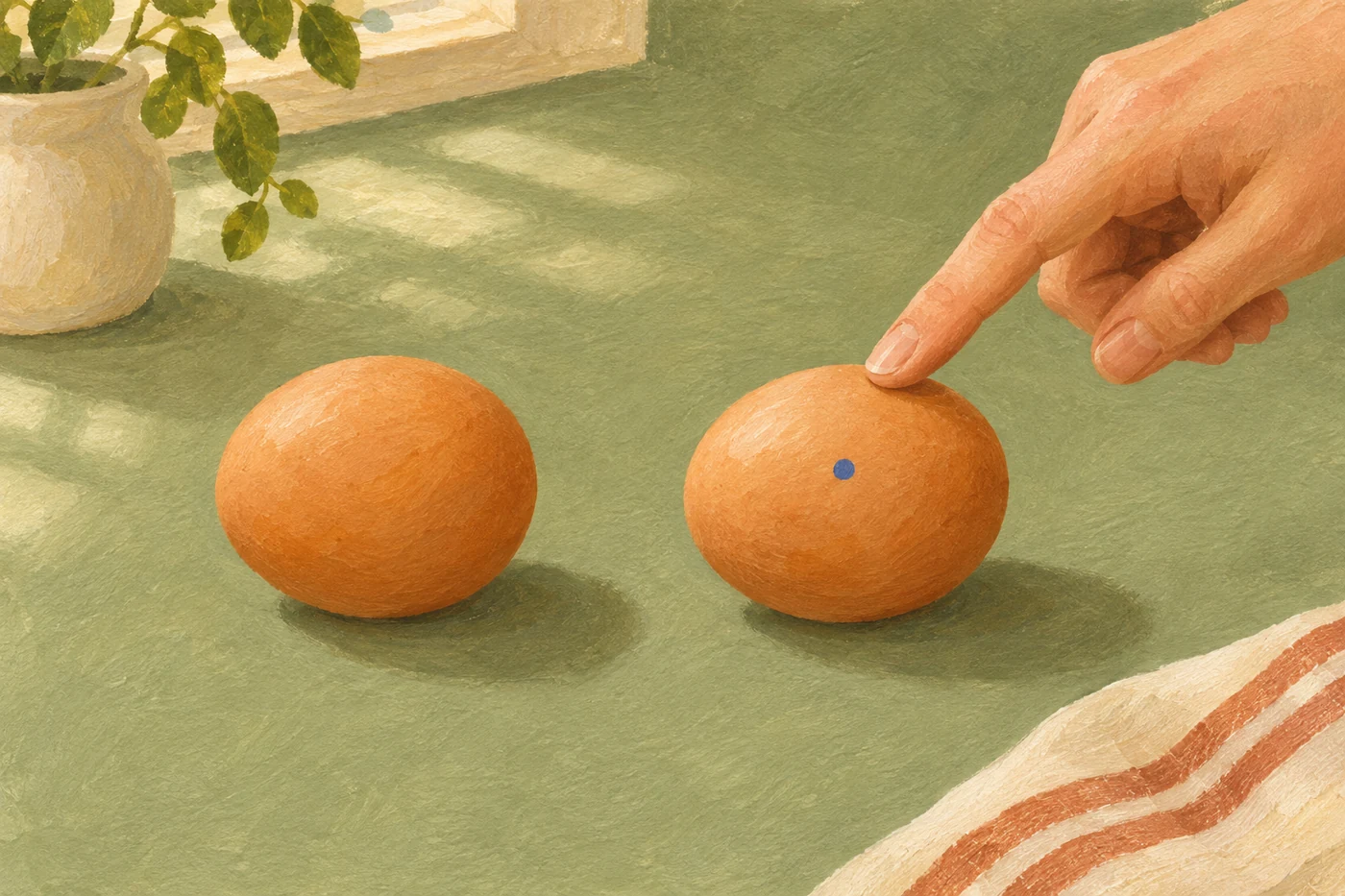
Two eggs sit side by side on the table. One is raw and the other is hard-boiled. They look almost the same from the outside. Spin them one at a time like little tops. A quick touch of your finger can tell you something about what’s inside.
The contents of a raw egg can move
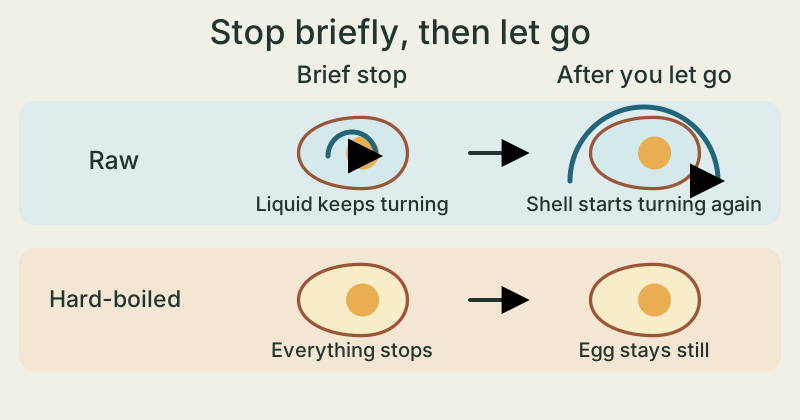
When you start the spin, your fingers grip the shell. In a raw egg, the liquid closest to the shell starts moving first. The liquid farther in takes a little longer to catch up. That’s why a raw egg often spins less smoothly when you give it a twist.
In a hard-boiled egg, the white and yolk are solid. The shell carries them along from the start, so the whole egg can spin together.
A quick stop slows the shell first
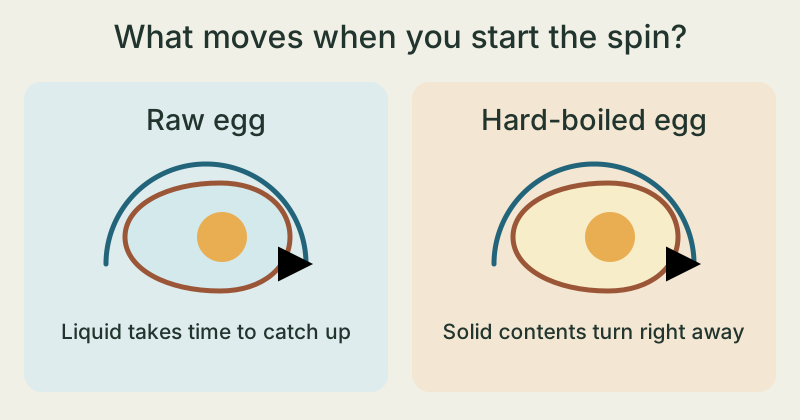
Touch the top of the raw egg for a moment and your finger stops the shell. The liquid inside keeps moving for a little while. This tendency to keep moving is called inertia.
Lift your finger right away and friction between the liquid and the shell can pull the shell along. The egg turns a little more. If you hold it still for longer, the liquid comes to rest too. In the hard-boiled egg, your finger stops the shell and the contents together.
A small dot makes the spin easier to see
Draw a dot on the side of the shell. If it moves after you let go, you can see the shell turning again. How far the egg turns also depends on your starting twist and the surface. Look mainly for whether the egg moves again after you lift your finger.
Compare a raw egg and a hard-boiled egg
- Take one raw egg and one cooled hard-boiled egg. Draw one dot on the side of the cooked egg and two on the raw egg. Place both on a smooth, level worktop, well away from the edge.
- Give the cooked egg a gentle spin. Touch the top just long enough for the shell to stop, then lift your finger immediately. Watch to see whether it moves.
- Repeat with the raw egg. Compare what happens after you let go. If you can barely see any movement, try again with a similarly gentle spin and a shorter stop.
Use eggs with intact shells and spin them gently. If the raw egg breaks, clean the surface and wash your hands.
The takeaway
The liquid in a raw egg can keep turning while the shell briefly stops. In a hard-boiled egg, the shell and solid contents stop together.
Why can a raw egg spin again after you let go?
Sources & further reading
Institute of Physics · Spinning Eggs ↗NASA JPL Education · Planetary (Egg) Wobble and Newton’s First Law ↗University of Illinois · Eggs: Hard-Boiled or Raw? ↗Our stories explain the main idea in our own words. Pictures and models simplify reality and are not drawn to scale.