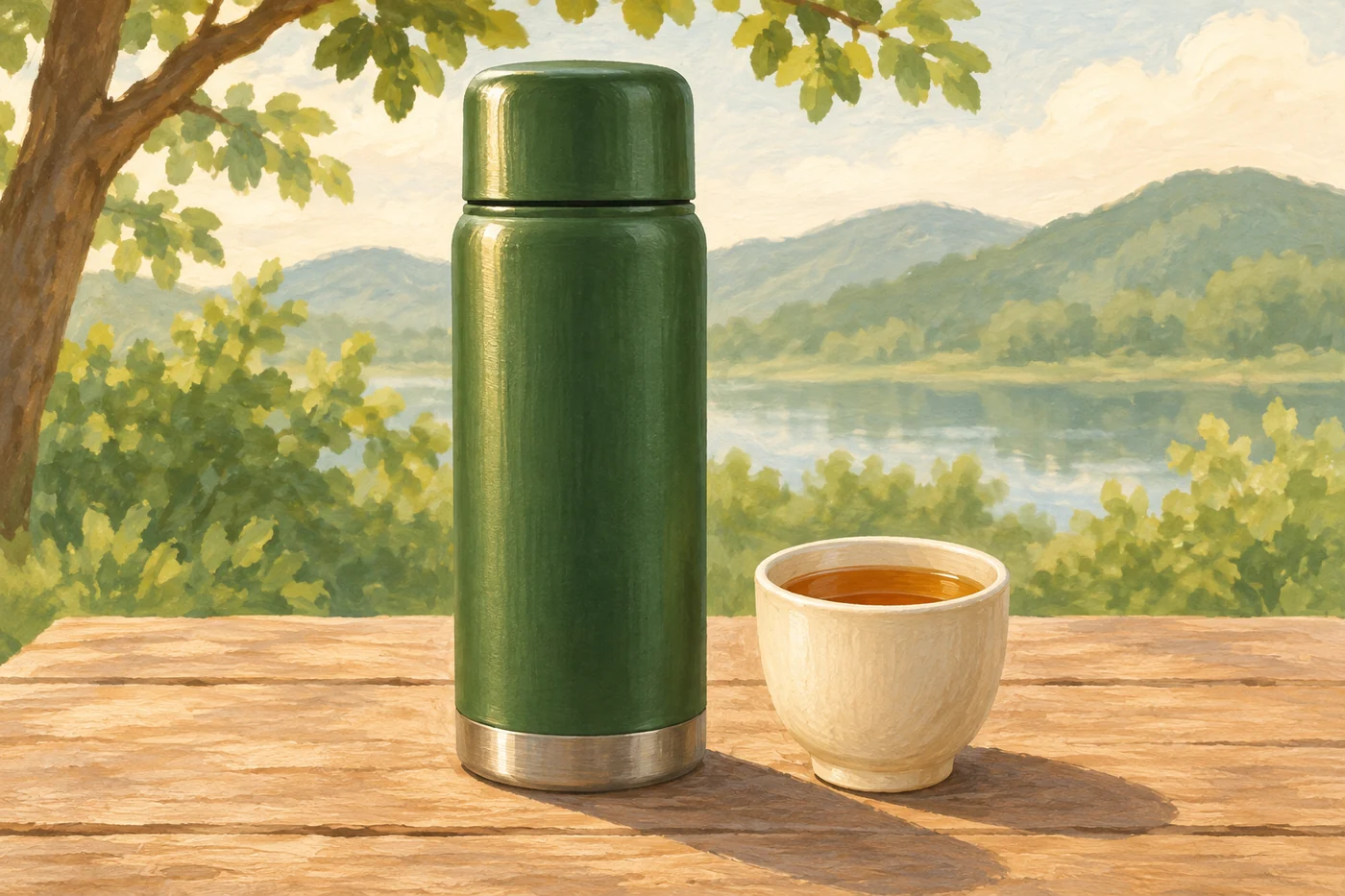
A vacuum flask has two walls with an almost airless gap between them. Very little heat travels across that gap. Shiny surfaces and an insulated lid help too. That’s why warm tea cools down more slowly and cold water warms up more slowly.
You’re out for a walk, and the tea from your flask is still warm when you stop for a second break. On a summer day, the same flask keeps your water cool for longer. How can it do both?
There’s almost no air between the walls
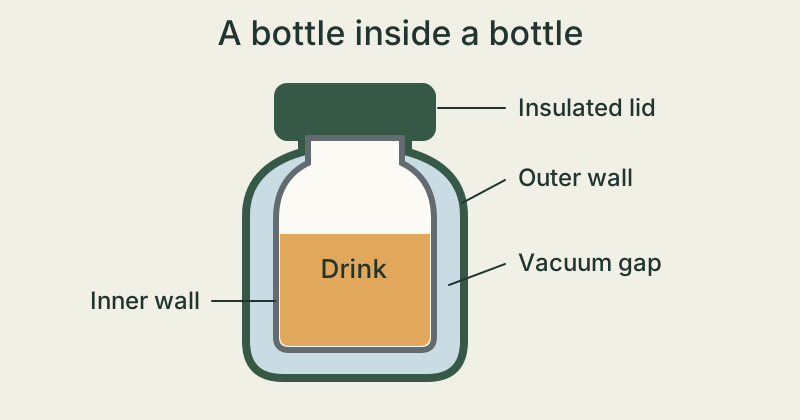
Imagine a small bottle inside a larger one. The inner wall touches the drink. The outer wall touches the air around the flask. A narrow gap separates the two walls. During manufacturing, almost all the air is pumped out of that gap, leaving a near vacuum.
In a gap full of air, air particles can pass heat along. Moving air can carry heat too. In a vacuum, there are hardly any particles to do that. So much less heat passes from one wall to the other this way.
Shiny surfaces and the lid help
Heat can also travel across the gap as invisible radiation. It can do this even through a vacuum. Many vacuum flasks have shiny surfaces facing the gap. These surfaces cut down on heat transfer by radiation.
The walls meet at the neck of the flask. Heat can still travel through the material there. A snug, insulated lid slows heat transfer at the opening.
With cold water, heat moves inward
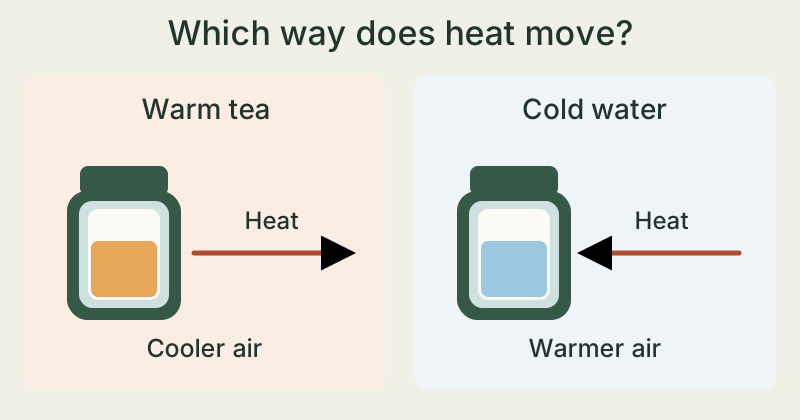
When the tea is warm, heat moves overall from the tea to the cooler surroundings. With cold water in a warm room, it goes the other way, from the room to the water. The flask slows both processes.
Even in a vacuum flask, a drink’s temperature gradually gets closer to the temperature around it. It just takes longer.
Compare two bottles of cold water
- Pour equal amounts of refrigerated water into a vacuum flask and a similar-sized single-wall water bottle. Measure the water temperature in each with a kitchen thermometer, then screw on both lids.
- Put the bottles next to each other in a shady spot indoors. Leave them closed for 30 minutes.
- Measure the water temperature in both bottles again. Which changed less? If the difference is small, close both bottles and measure again after another 30 minutes.
You only need cold water and two clean, undamaged bottles for this comparison.
The takeaway
The vacuum between the walls, the shiny surfaces and the lid slow down heat transfer. Warm drinks stay warm longer and cold drinks stay cold longer.
Why does cold water stay cold longer in a vacuum flask?
Sources & further reading
LEIFIphysik / FWU · Thermosflasche ↗The University of Queensland Physics Museum · Vacuum Flask ↗University of Colorado Boulder · Thermos Set ↗Our stories explain the main idea in our own words. Pictures and models simplify reality and are not drawn to scale.