
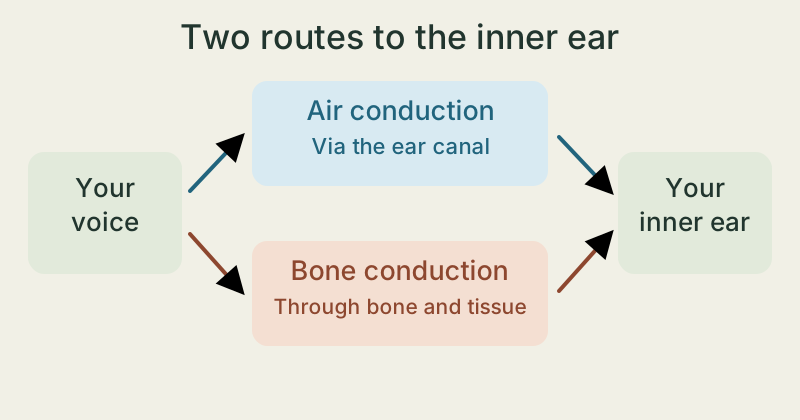
When you speak, sound travels through the air to your ears. At the same time, bone and other tissues in your head carry some of the vibrations to your inner ear. When you play a recording through a speaker, that direct path through your body is missing. That changes how your voice sounds.
You listen to a voice message you just recorded. The words are familiar, but the voice sounds brighter or thinner than you expected. When you speak, you hear the same voice by two different routes.
Two routes come together when you speak
Your vocal folds vibrate in your voice box. The vibrations travel as sound through the air. Some of that sound goes from your mouth to your ear canals. Your eardrum and tiny bones in your middle ear pass the vibrations on to your inner ear. This route is called air conduction.
At the same time, bones and other tissues in your head vibrate slightly. These vibrations reach your inner ear too. This second route is called bone conduction. As you speak, you hear the two contributions together.
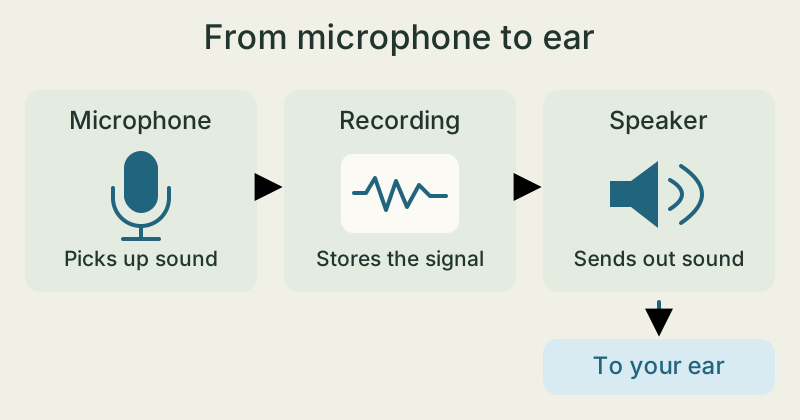
A speaker plays back the recorded sound
Your phone’s microphone picks up sound from the air. When you play it back, the speaker sends sound through the air again. The direct route the vibrations take through your head while you speak is missing.
The two routes carry low and high parts of the sound differently. Lower parts can stand out more to you when you speak. That’s why a recording can sound brighter even if the pitch of the spoken voice stays the same.
Other people mostly hear you through the air
Someone standing beside you mostly hears the sound that travels through the air from your mouth. That’s why the recording may sound more familiar to them than it does to you.
A recording still won’t sound exactly like a conversation in the same room. The distance from the microphone, the room and the speaker can all change what you hear.
Compare a sentence with its recording
- Find a quiet room. Say a short sentence at your normal speaking volume and record it on your phone.
- Play it through the phone’s speaker at a comfortable volume. Say the same sentence again. Describe what changes. Does the recording sound brighter, more muffled or simply unfamiliar?
- If someone wants to join in, let them hear you say the sentence and then listen to the recording. Compare what you noticed. Who finds the recording more familiar?
A short recording of your own voice is enough. You can keep it on your device.
The takeaway
When you speak, you hear your voice through both air conduction and bone conduction. When you play it through a speaker, you mainly hear sound through the air.
Which extra route carries sound to your ear as you speak?
Sources & further reading
Royal Society Open Science · Bone conduction facilitates self-other voice discrimination ↗EPFL · Perception of one’s own voice ↗National Institute on Deafness and Other Communication Disorders · How Do We Hear? ↗Our stories explain the main idea in our own words. Pictures and models simplify reality and are not drawn to scale.