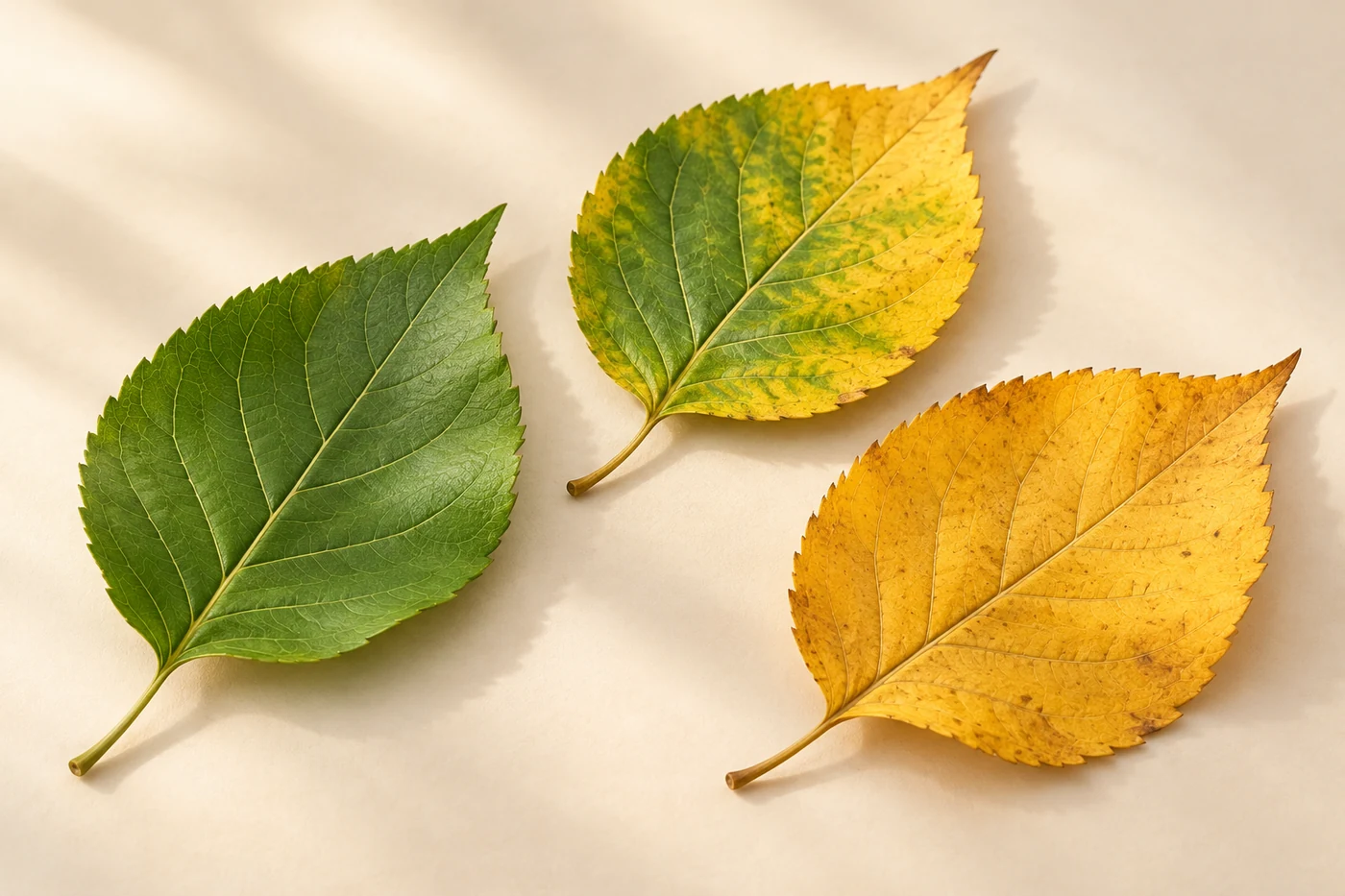
In many deciduous trees, green chlorophyll breaks down in autumn and is replaced less and less. Yellow and orange pigments that were already in the leaf then become more noticeable.
Sometimes one branch carries several colours: green, yellow-green and bright yellow. Nobody has painted the tree. The mixture of pigments inside its leaves is changing. Let's see how this works in many trees that lose their leaves for winter.
Green helps capture light
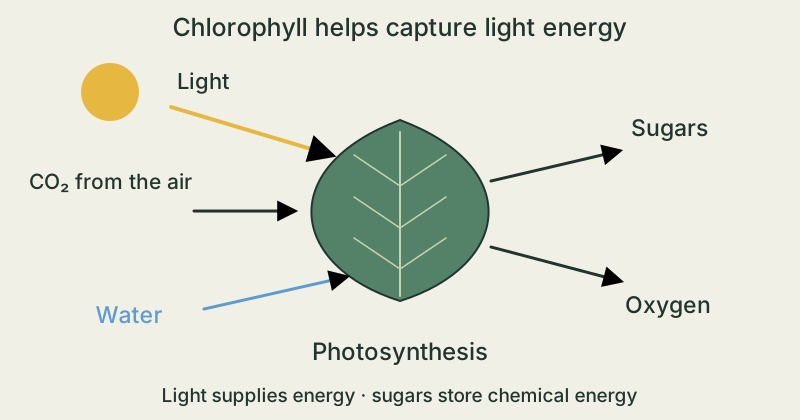
Chlorophyll is a green pigment in the chloroplasts of leaf cells. These tiny cell structures are sites of photosynthesis. Chlorophyll absorbs light and helps make its energy available.
Using light energy, the plant builds energy-rich sugars from carbon dioxide and water. Oxygen is also produced. During summer, chlorophyll is continually broken down and made again. Its strong green colour dominates the appearance of many leaves.
Shorter days signal autumn
Shortening days and changing temperatures act as seasonal signals for many trees. Leaves prepare for the end of their life. Chlorophyll breaks down, while the production of new chlorophyll slows and eventually stops.
The tree recovers valuable nutrients from its ageing leaves. This reorganization happens gradually. Individual leaves on the same tree can therefore change colour at different times.
Yellow pigments become more visible
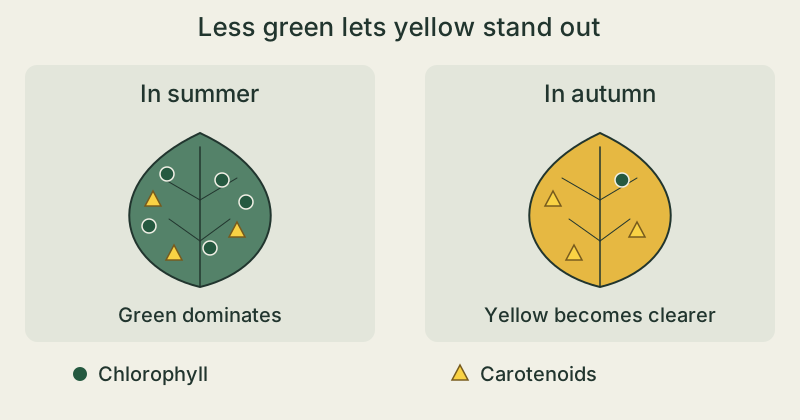
A green leaf also contains yellow and orange pigments, including carotenoids. While chlorophyll is abundant, their contribution to the leaf's colour is less obvious. As the green fades, they become easier to see.
Carotenoids can also break down as a leaf ages. However, some remain longer than chlorophyll and contribute to yellow autumn colour. The diagram shows only this basic idea; its symbols are not measured quantities.
Every tree has its own colour pattern
Species, the individual plant and weather affect the colours and timing. Some leaves turn yellow, others reddish or brown. Many autumn leaves that turn red also make new pigments called anthocyanins.
A yellow leaf alone does not tell us its cause for certain. Drought or other stresses can also change leaves early. In our observation, we record colours without using them to diagnose the tree's health.
Make a little colour chart for one tree
- With an adult, find a deciduous tree you can safely observe in autumn. Stay on a clear path away from traffic. Choose a low branch that you can see well from the ground. Leave every leaf attached.
- Draw three colour patches on paper: green, yellow-green and yellow. Look at ten clearly visible leaves on the chosen branch in daylight and roughly group their colours. Also record other colours or uncertain. Add the date and weather.
- Look again after a few days from the same safe spot and record ten visible leaves again. Are more yellow leaves present, or are leaves missing? If the branch is bare, record that. You cannot be sure these are the same individual leaves, and you are not measuring pigment amounts. Shade, lighting and which leaves you choose also affect the comparison.
Stay with an adult on firm paths. Do not climb, pull branches down, or touch or taste unfamiliar plants. Watch for slippery fallen leaves. Postpone the observation in storms or unsafe weather.
The takeaway
Less chlorophyll makes existing yellow and orange pigments stand out more. Autumn changes the pigment mixture. Different leaves and tree species follow different timetables.
Why can a leaf that was green look yellow in autumn?
Sources & further reading
U.S. National Park Service · Why Do Leaves Change Colors in the Fall ↗Harvard Forest · The Process of Leaf Color Change ↗USDA Forest Service · Why Leaves Change Color (Fact Sheet, PDF) ↗OpenStax · Biology 2e: Overview of Photosynthesis ↗Our stories explain the main idea in our own words. Pictures and models simplify reality and are not drawn to scale.