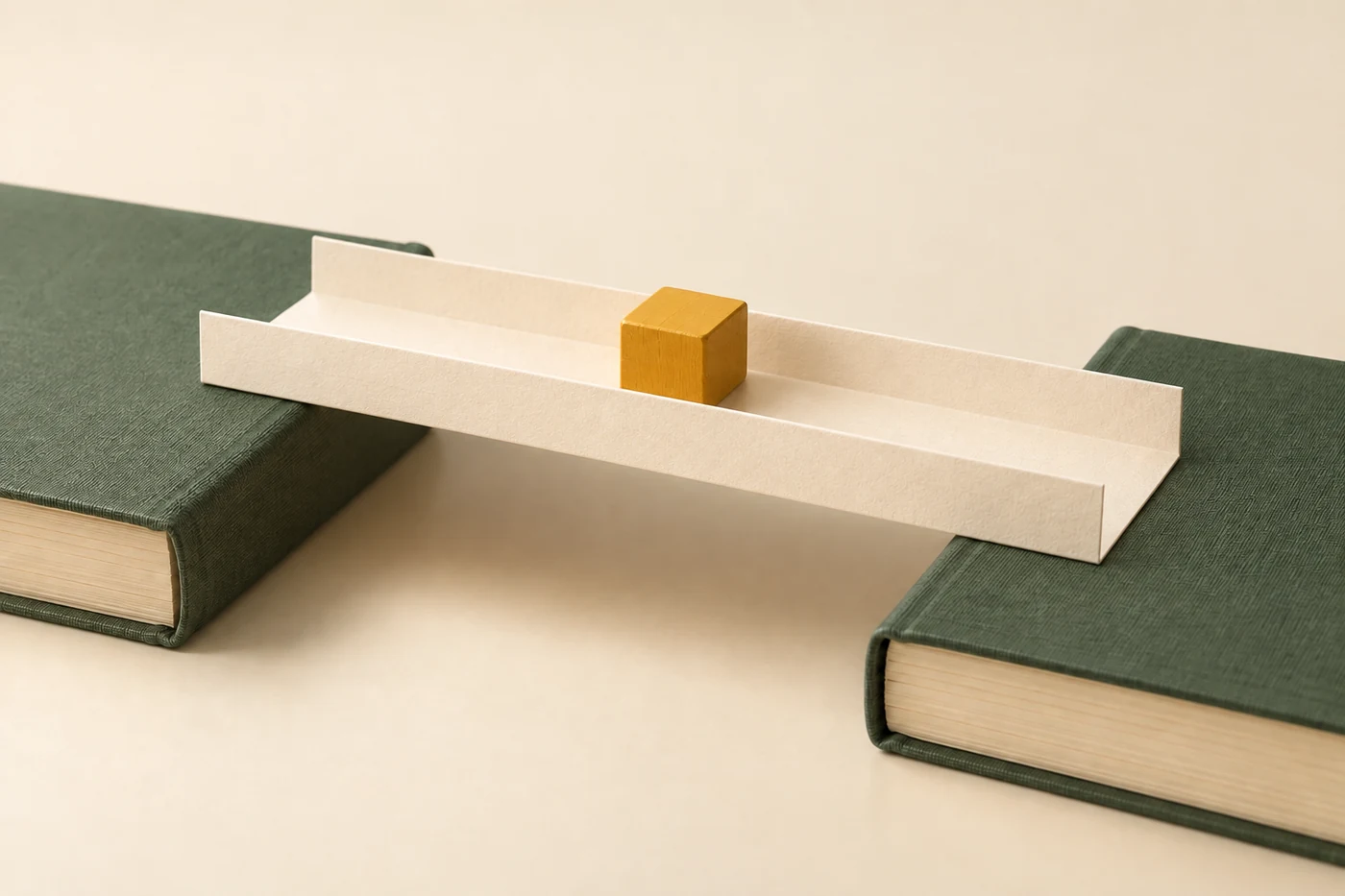
A flat sheet bends downward easily. Fold up its long edges and you create a deeper cross-section. Under this load, the upright strips act like little beams. The same amount of paper can then resist bending better, as long as the shape stays stable.
Lay paper across a small gap and even a light load can make it sag. Two well-placed folds can change the comparison.
The shape gains height
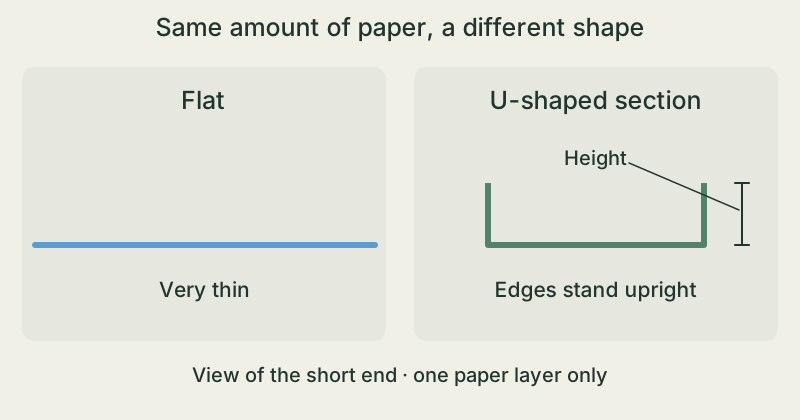
A flat sheet looks wide from above but very thin from the side. Fold up its two long edges and its end looks like a U. The creases run from one support to the other.
The amount of paper stays the same; its arrangement changes. Some material is now above the flat base. This extra height helps resist downward bending. The remaining base becomes narrower.
Bending involves squeezing and stretching
Imagine a beam resting on supports at both ends. A load pushing its middle down compresses material lengthwise at the top and stretches it at the bottom. These effects are called compression and tension.
During a small bend, regions farther from the neutral layer must change length more. This layer neither lengthens nor shortens along the beam. A deeper cross-section makes better use of the material's resistance to stretching and compression. Our U-shaped paper walls help in this way.
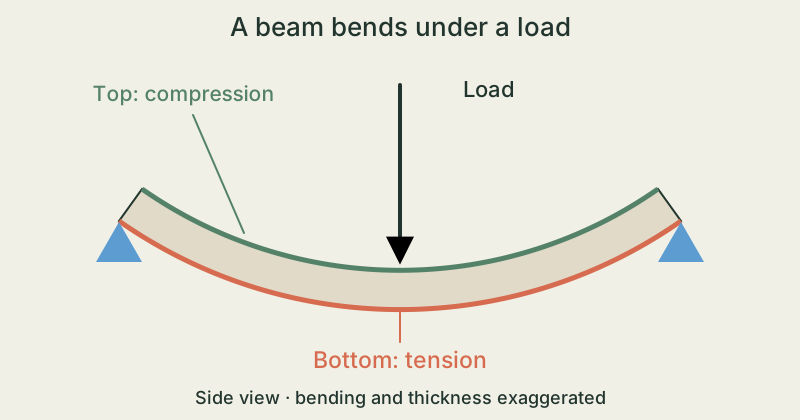
Stiffer does not mean unbreakable
Here, stiffer means bending less under the same load. That differs from the greatest load a structure can carry before it fails.
Paper walls can buckle, folds can open and supports can slip. Adding another fold does not always improve a bridge. Paper type, moisture, span and loading direction matter too. Our claim concerns the shape and load shown here.
Real beams use this idea too
Many metal beams have deep cross-sections, such as an I shape. Material is placed where it helps resist the intended bending.
A paper bridge illustrates this idea but is not a scale model of a road bridge. Real structures must withstand many loads and require professional calculations and testing.
A flat sheet or a U-shaped bridge?
- With an adult, put two low books of equal height on a clear tabletop about 12 centimeters apart. Mark their positions beside them on a separate sheet. Lay a dry A4 sheet lengthwise across the gap, with equal overlap at its short ends. Put one small, light eraser at the center and briefly observe from the side. Remove it straight away if the paper sags badly. Record barely, slightly or clearly bent. Also note if the unloaded sheet already sagged.
- Take a second undamaged sheet of the same type and size. Fold a strip about 3 centimeters wide up at a right angle along each long edge, without cutting or gluing. This makes an open U-shaped channel. Lay it in the same lengthwise direction with the same overlap across the unchanged gap. The creases must run between the books. Put the same eraser at the center of the channel's base and observe as before.
- Compare your notes for the same load. If possible, repeat with a fresh pair of sheets. Does the U shape bend less? Record a different or unclear result too. Add no extra loads. A damaged sheet, leaning walls or shifted books makes the comparison unreliable. The cover illustration shows the idea, not a measured load capacity.
Work with an adult and test with only one light eraser. Keep everything low and well away from the table edge. Avoid heavy weights, sharp objects, coin stacks and glass. Do not press the bridge or hold anything underneath it; stop if it sags badly.
The takeaway
The same amount of paper can have different bending stiffness in different shapes. Upright folded edges help resist bending in the direction shown. The shape must hold; more folds do not guarantee a greater load capacity.
What changes when you fold up the two long edges?
Sources & further reading
Australian National University · Paper Bridge Challenge ↗TeachEngineering / NYU · Building Our Bridge to Fun! ↗IIT Delhi · Bending of Beams ↗TeachEngineering / University of Colorado Boulder · Strong as the Weakest Link ↗Our stories explain the main idea in our own words. Pictures and models simplify reality and are not drawn to scale.