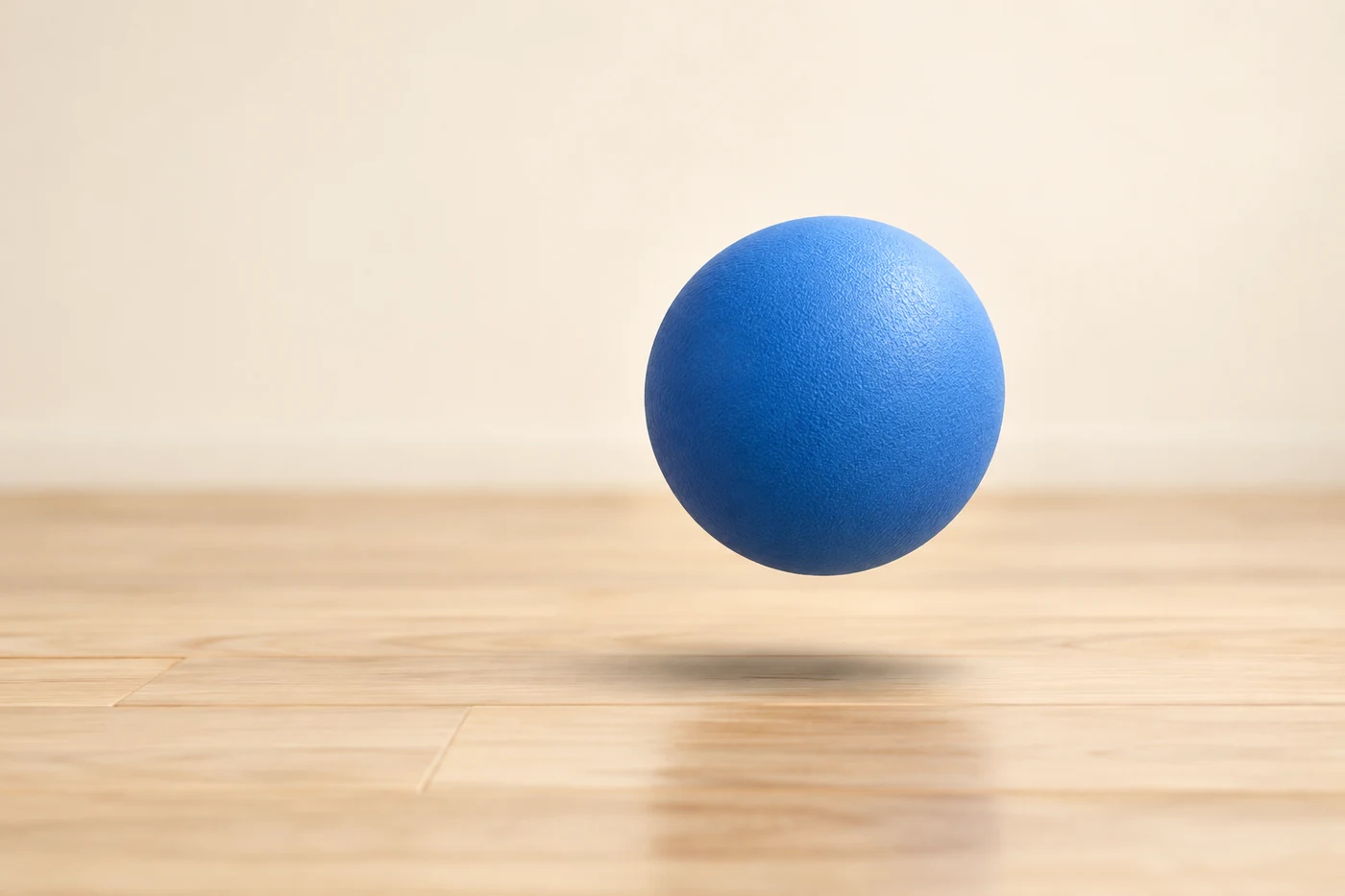
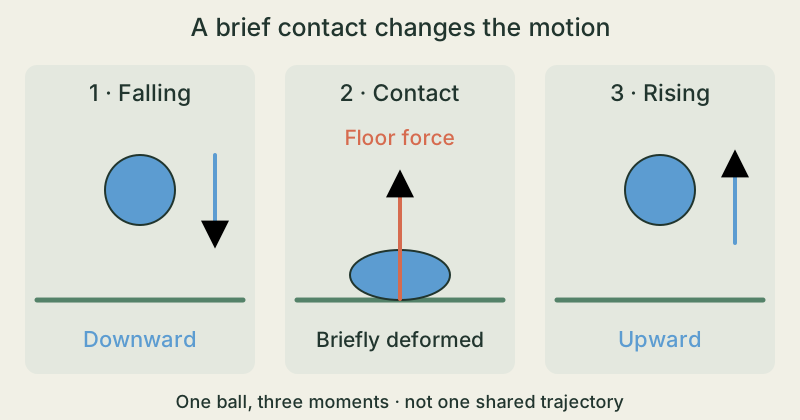
At impact, the ball and floor deform a little. Some motion energy is briefly stored as elastic energy. As the ball regains its shape, it pushes against the floor and the floor pushes it upward. Some energy changes into other forms, so an ordinary ball usually bounces back to a lower height.
You let a ball go, hear a soft plop and watch it rise again. The crucial moment often passes too quickly to see with the naked eye.
A ball briefly acts like a spring
Even a solid rubber ball is not perfectly rigid. Contact squashes it a little. Elastic means that a material can return to its earlier shape after deformation.
The change of shape temporarily stores energy, like a compressed spring. As the ball recovers, it pushes on the floor. The floor's opposing force changes the ball's motion upward. The floor deforms too, often too little to see. A solid rubber ball does not need trapped air to do this.
The energy does not disappear
Lifting the ball gives the ball–Earth system gravitational potential energy. Falling turns that into motion energy. At impact, some is briefly stored elastically and then becomes motion again.
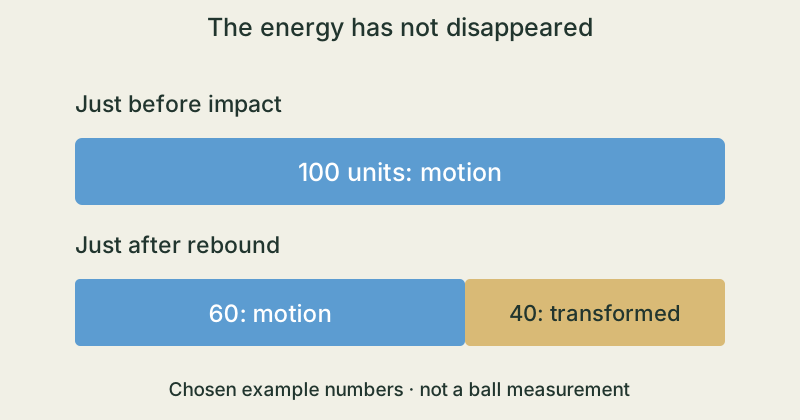
Some energy spreads into internal energy in the ball and floor, or into vibrations and sound in the surroundings. A quiet plop is one clue. The tiny warming need not be noticeable. Energy is conserved overall; it does not all return to the ball's upward motion.
Why the next bounce is lower
On a stationary floor, without an extra push, an ordinary ball usually does not regain its release height. Less motion energy remains for its next rise. Air resistance also plays a part.
Gravity still pulls downward while the ball rises, slowing it. At the highest point, its vertical speed is momentarily zero. Gravity has not disappeared there: it makes the ball fall again.
The ball and floor both matter
How well a ball rebounds depends on its material and the surface. A yielding carpet can absorb a lot of energy. A very hard ball will not necessarily bounce best on every floor.
Bouncing back does not by itself mean a perfectly elastic collision. In that ideal case, the total motion energy of the colliding bodies would be the same after the collision as before it. Everyday bounces convert some into other energy forms, even when the ball becomes round again.
Compare three little bounces
- With an adult, find a clear, level patch of floor, far from stairs and breakable objects. Choose one intact, light, soft play ball about the size of a tennis ball. Mark roughly 10, 20 and 30 centimeters above the floor on a sheet of paper held upright beside the bounce spot. One person holds the scale outside the ball's path. Stay low on the floor; nobody climbs on furniture.
- Hold the bottom of the ball level with the 30-centimeter mark. Open your hand without throwing or pushing down. The other person watches from the side for the bottom of the ball at the top of its first rebound. Record the approximate height or unclear. Listen for the sound too. Wait for the ball to come to rest before reaching for it.
- Repeat for three drops in total, using the same ball, floor and release point. Compare only the first rebound of each drop with the release height. It will usually be lower. Differences you see are not precise energy measurements; sideways motion, an accidental push and the brief viewing time make comparison harder. The energy diagram's numbers are invented, not results from this activity.
Work with an adult. Drop only from 30 centimeters and keep the area clear. Avoid marbles, metal or glass balls, heavy balls and stacked balls. Do not throw, inflate, heat or cool the ball. Keep faces out of its path; retrieve a rolling ball only when the route is clear.
The takeaway
Deformation can briefly store energy. Shape recovery and contact with the floor produce the upward motion. Total energy is conserved but also spreads into internal energy, vibrations and sound. Ordinary bounces therefore get smaller.
Why does an ordinary ball usually bounce back to a lower height?
Sources & further reading
Science World · How High? ↗OpenStax University Physics · 8.1 Potential Energy of a System ↗OpenStax University Physics · 9.4 Types of Collisions ↗Our stories explain the main idea in our own words. Pictures and models simplify reality and are not drawn to scale.