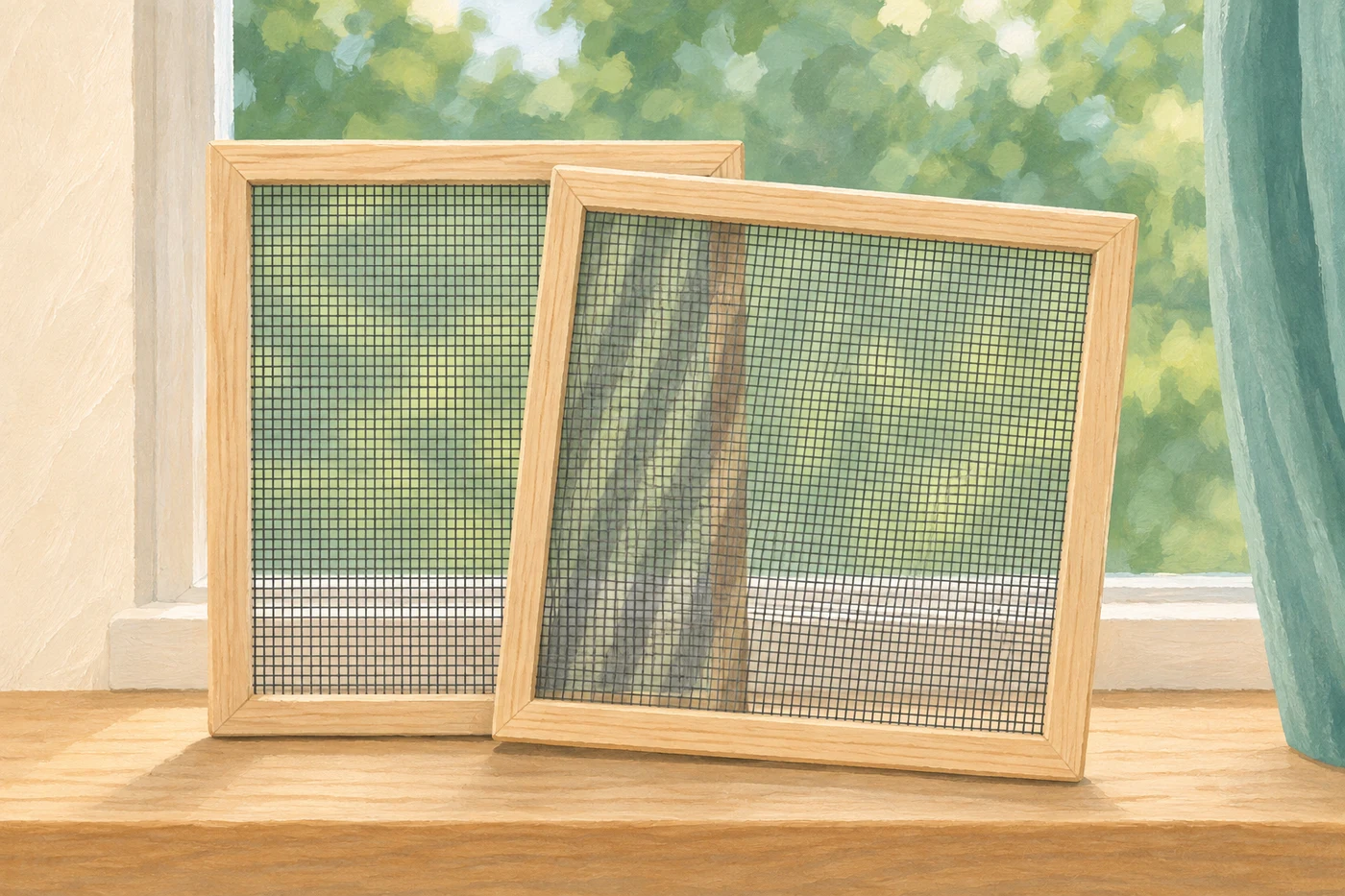
In some areas, the strands in the two screens line up almost exactly. Many of the holes stay clear, so more light gets through. A little farther along, strands from one screen partly cover the holes in the other. This repeats across the mesh and creates wide light and dark bands called a moiré pattern.
Hold two pieces of window screen close together and turn the front one a little. You may suddenly see broad bands or patches where they overlap. Where do those shapes come from when each screen has only small, evenly spaced holes?
How much light gets through both screens?
A window screen is made of dark strands with small holes between them. Put a matching screen directly on top and the strands line up, as do the holes. You still see the fine grid.
Turn one screen a little and the two grids line up only in certain areas. Where the strands are out of line, they partly cover holes in the other screen. Less light gets through those areas.
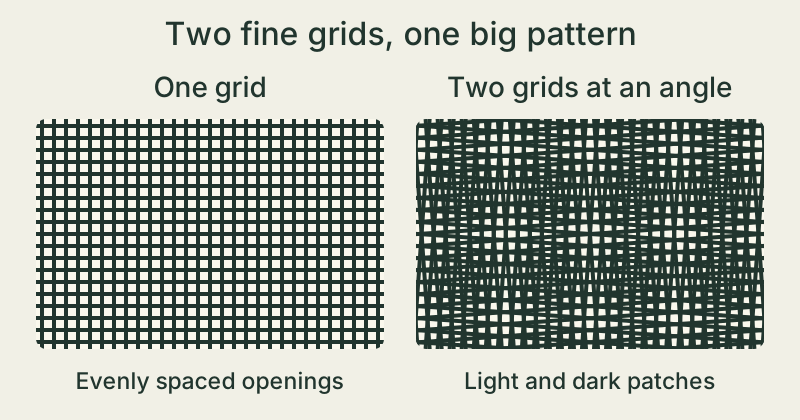
A small turn changes the big pattern
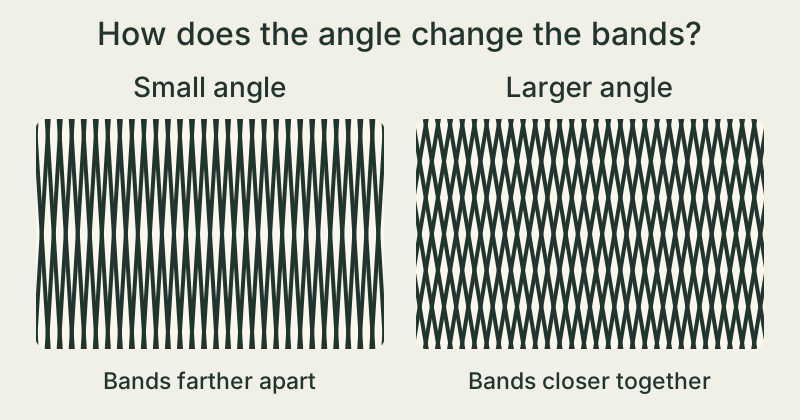
At a small angle, the strands shift only a little from one mesh opening to the next. It takes many openings for the two sets of strands to line up that well again. That’s why the bands can be much farther apart than the strands.
If you turn one screen a bit farther away from perfect alignment, the light and dark areas usually move closer together. The drawing shows this with two layers of straight lines. Window screens have strands crossing in two directions, so the big pattern can form patches as well as bands.
The bands can move
With the screens at a slight angle, slide one a little to the side. The places where the strands line up shift. The broad bands can travel much farther than the screen you moved.
You can see the same effect with two sheets and some straight lines. This makes it easy to watch the pattern move.
Turn two striped patterns against each other
- Use a ruler and a dark pen to draw about 25 straight, parallel lines on white paper, 5 millimetres apart. Lay a sheet of tracing paper on top and trace the lines.
- Leave the tracing paper on top of the white sheet and slowly turn it a little. Look at the whole area. Where do you see broad light and dark patches?
- Turn the top sheet a little farther from its starting position. Compare the spacing between the bands. Now slide the top sheet a little to the side and watch where the bands go.
You can do this on a table in normal room light.
The takeaway
Two fine grids can make one big pattern. Light areas form where the holes line up well. A small turn changes where those areas appear.
Where does the overlapping mesh look lighter?
Sources & further reading
University of Arizona · Moire Patterns ↗University of Wisconsin–Madison · Fun with Fringes! ↗Our stories explain the main idea in our own words. Pictures and models simplify reality and are not drawn to scale.