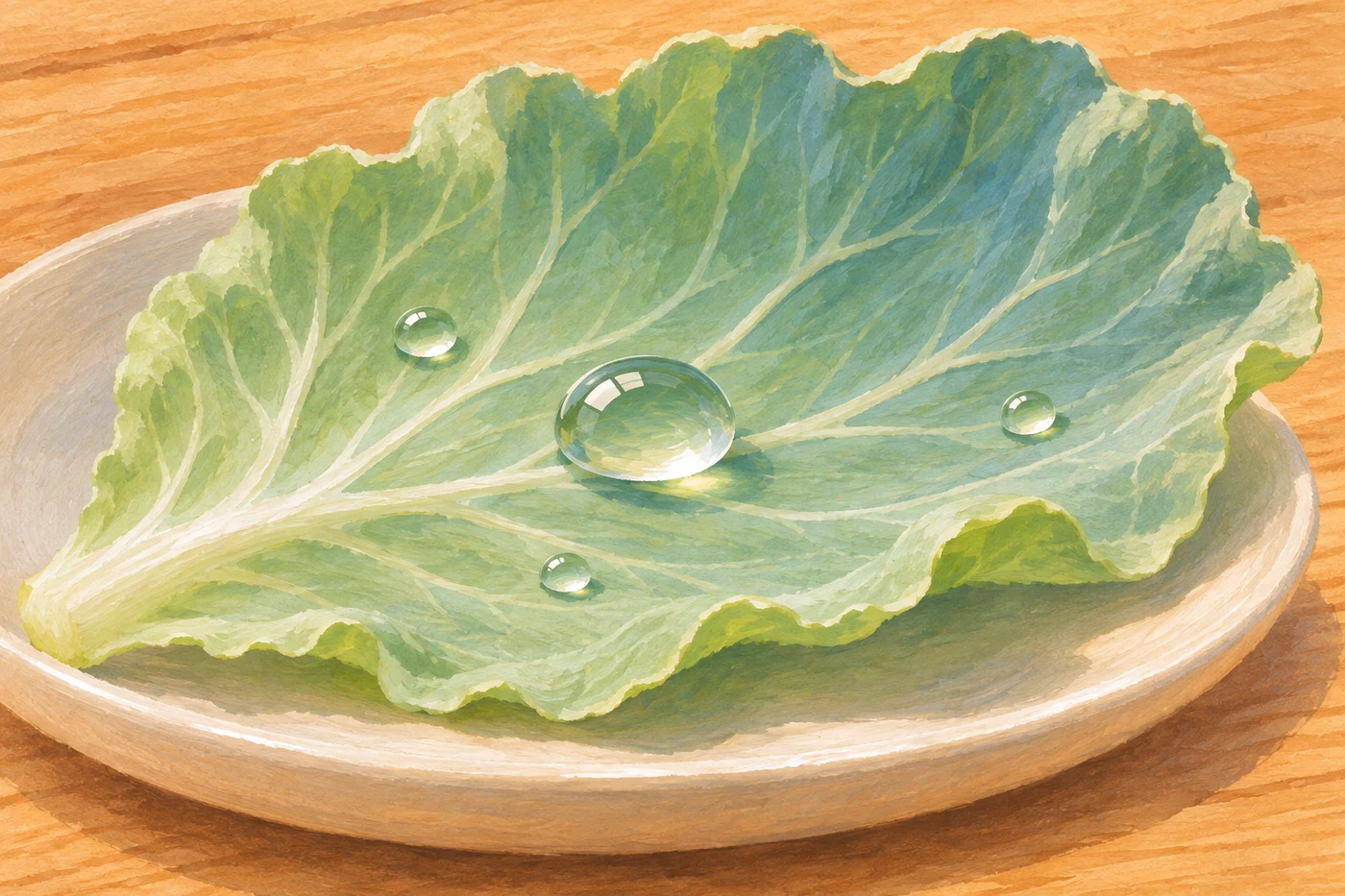
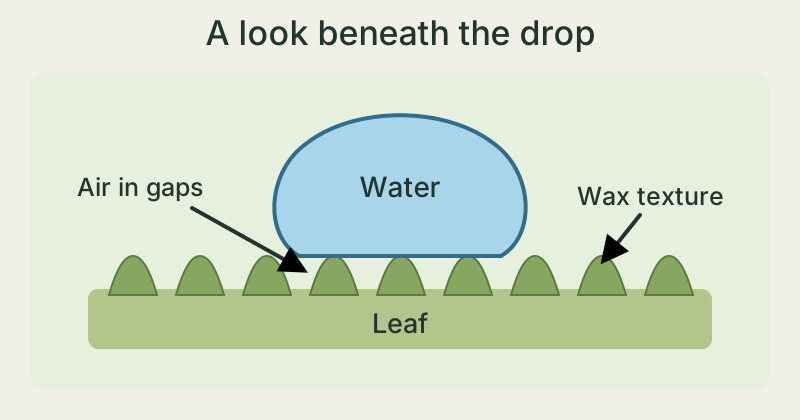
A cabbage leaf has a thin layer of wax on its surface. Water doesn’t spread easily on this wax. Tiny features in the wax can also keep the drop in contact with only a small part of the leaf. The drop stays rounded and can roll off when the leaf tilts.
When you rinse a cabbage leaf, you may see a row of little glassy beads on it. Tilt the leaf and the beads move. Why does water gather into drops here when it spreads out on other surfaces?
Water can spread out or stay rounded
Water molecules pull on one another. That pulls the surface of a small drop tight. This effect is called surface tension, and it helps the drop stay round.
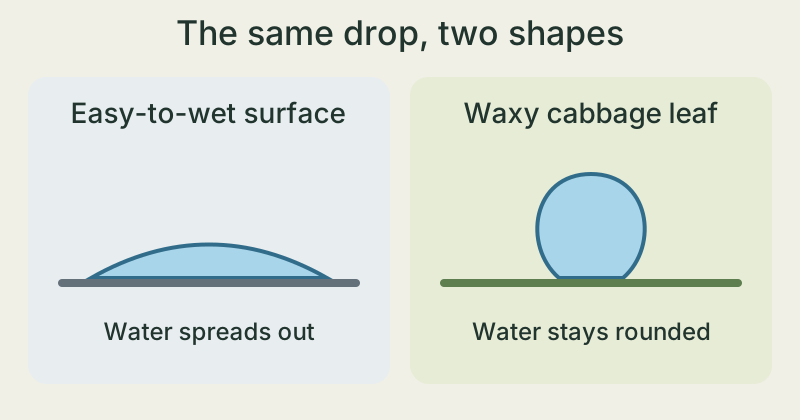
When the drop touches something, its shape also depends on how easily water spreads on that surface. On a surface that water wets easily, the drop spreads wider. On the waxy surface of many cabbage leaves, the water tends to stay together in a rounder drop.
Tiny bumps leave room for air
A cabbage leaf can look smooth. Magnify the surface enough and you can see tiny wax crystals on some leaves. They make the surface uneven. If the drop rests on their tips, air can stay in the gaps beneath it.
The water then touches only a small part of the surface. With less to grip, the drop can roll off more easily when the leaf tilts. How easily it moves depends on the leaf and where the drop lands. A leaf vein, for instance, can stop it.
A rolling drop can pick up dust
This behaviour is especially striking on the leaves of the lotus plant. A drop rolling off can pick up loose dust and carry it away. This kind of self-cleaning is called the lotus effect.
A single drop on a cabbage leaf lets you see how much the surface matters. The same water can spread out on one leaf and form a small bead on another.
Compare a cabbage leaf and a lettuce leaf
- Put a dry piece of outer cabbage leaf and a piece of lettuce leaf on a tray, with their top sides facing up. On each leaf, choose a fairly flat spot between the veins.
- Use the same dropper to put an equally sized drop of water on each spot. Look from the side. Which drop is taller and rounder? How much space does it cover?
- Lift one side of the tray slowly. If the leaves slide, hold them by their dry edges. See whether the drops start moving at the same angle. Try a second spot on each leaf if you need to.
Use tap water and wipe up any spills.
The takeaway
On a waxy cabbage leaf, a drop can rest on tiny raised points. With less of its surface touching the leaf, the drop tends to stay round and can roll off more easily.
What can stay in the gaps between the tiny bumps under a drop?
Sources & further reading
Botanischer Garten der TU Dresden · Self-cleaning surfaces: the lotus effect ↗Science Museum of Minnesota / NISE Network · Bump and Roll ↗Our stories explain the main idea in our own words. Pictures and models simplify reality and are not drawn to scale.