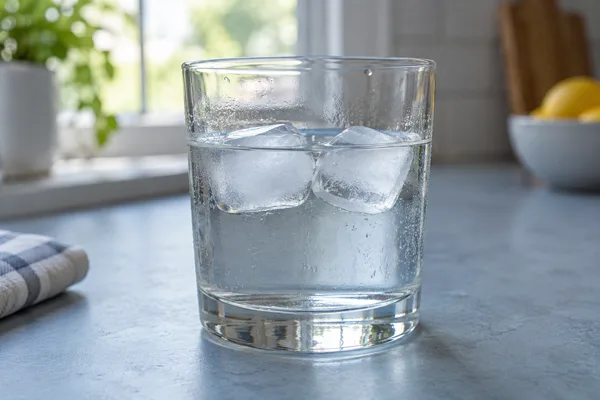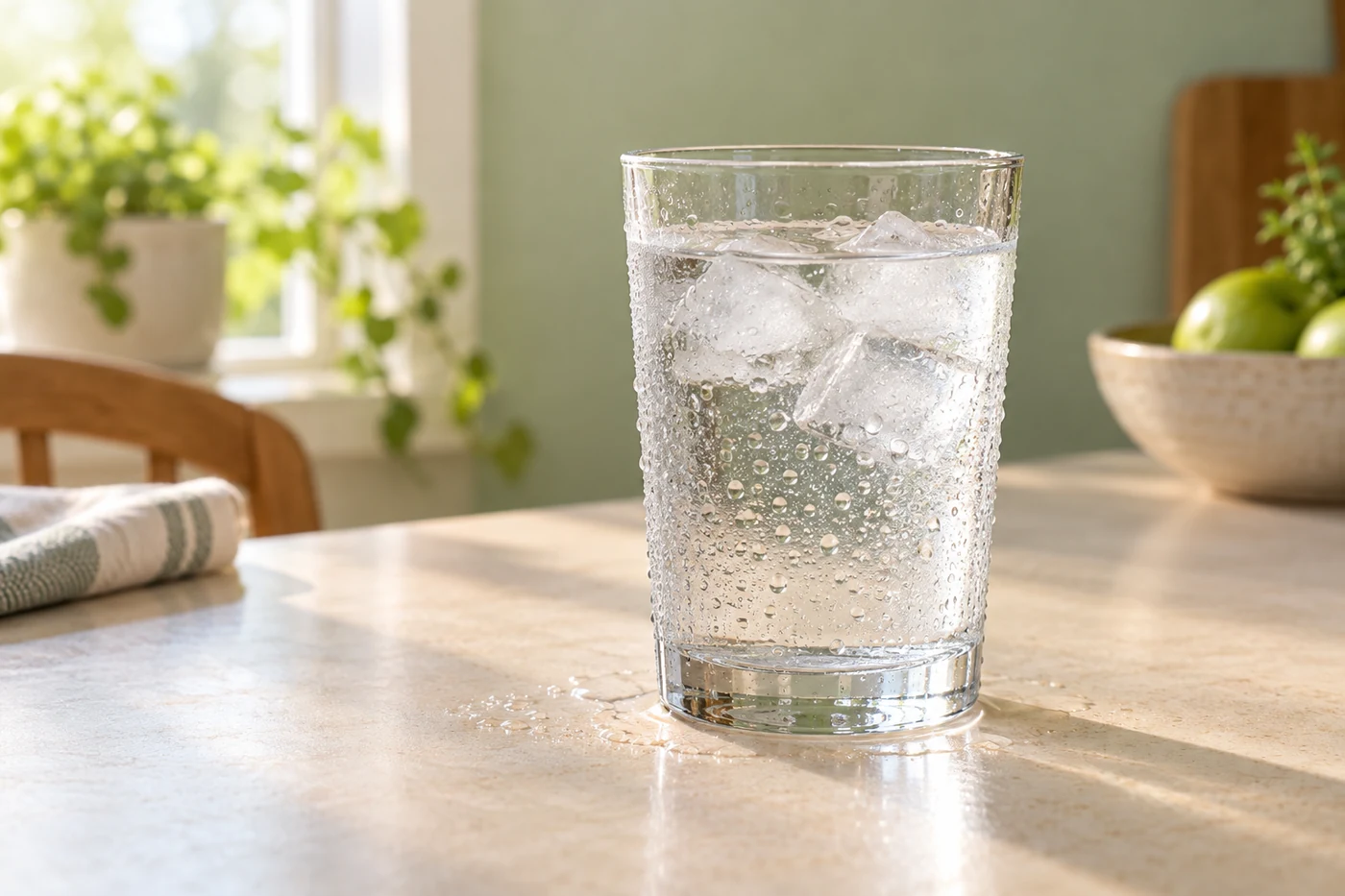
Air contains invisible water vapour. The cold glass cools the air next to it. If the surface is cold enough, some water vapour turns into liquid droplets. This is called condensation.
Put a glass of ice water on the table. Its outside starts off dry. Soon it sparkles with beads of water, even though you haven't spilled anything. An intact glass does not let the drink seep through its wall: the droplets form on the outside.
Invisible water in the air
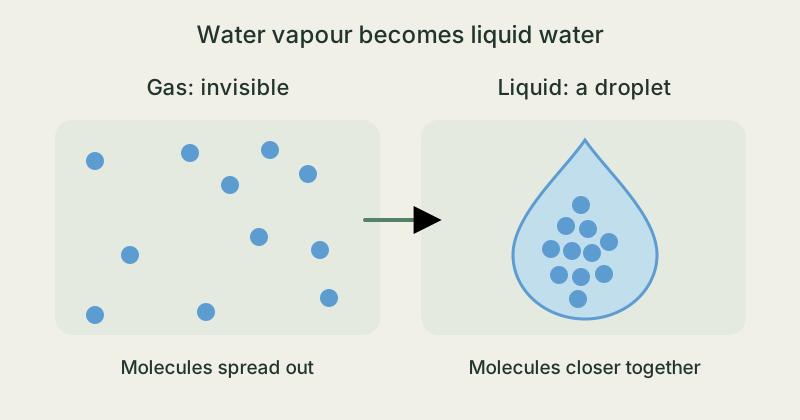
Water can be liquid, solid or a gas. Water in its gas state is called water vapour. Its tiny molecules move among the other particles in the air. You cannot see them.
Liquid water evaporates, supplying water vapour. Condensation changes it back into liquid. A visible misty coating consists of tiny droplets; water vapour itself is invisible.
Cold enough: the dew point
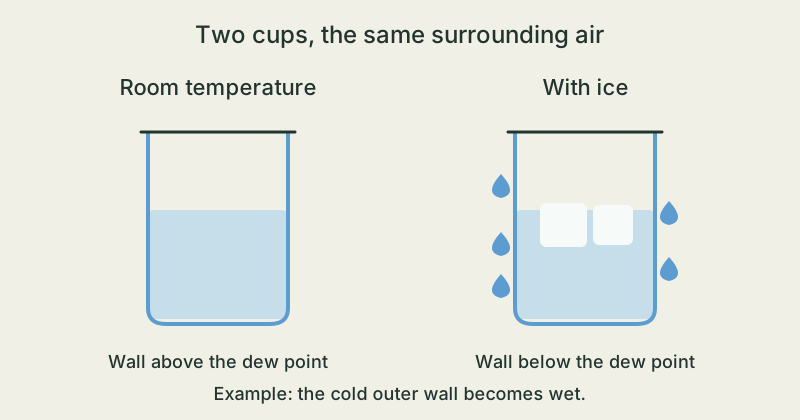
Ice water cools the glass wall, which cools the air right beside it. Whether droplets form depends on the temperature and the moisture in the air.
The dew point is the temperature at which cooling air becomes saturated while its water vapour content stays the same. Below that temperature, water vapour can condense on the glass surface. A cold glass can therefore stay dry in very dry air. The dew point is not a fixed temperature such as 0 °C.
The same idea on windows and grass
Moist indoor air can leave water on a cold windowpane. Outside, dew forms on grass that has cooled enough. In both cases, invisible water vapour becomes visible liquid water.
As the glass warms, its droplets can evaporate again. The water changes state; no new water is created.
Compare two cups
- Place two identical clear cups on a tray. Fill one with room-temperature water and the other with ice water. Cover both cups and dry their outsides.
- Leave both in the same place. After five to ten minutes, look for droplets on the outside. Which cup is wetter?
- Dry the cold cup again and keep watching. No droplets? The air may be very dry, or the cup may not yet be cold enough.
Keep the tray stable and away from electrical devices. Wipe up spills. This observation does not need hot water.
The takeaway
The water beads come from water vapour in the surrounding air. A sufficiently cold surface turns it into liquid droplets.
Where does the water on the outside of an intact cold glass come from?
Sources & further reading
USGS Water Science School · Water Cycle for Kids: Condensation ↗NOAA National Weather Service · What is Dewpoint? ↗Met Office · Understanding humidity ↗Our stories explain the main idea in our own words. Pictures and models simplify reality and are not drawn to scale.