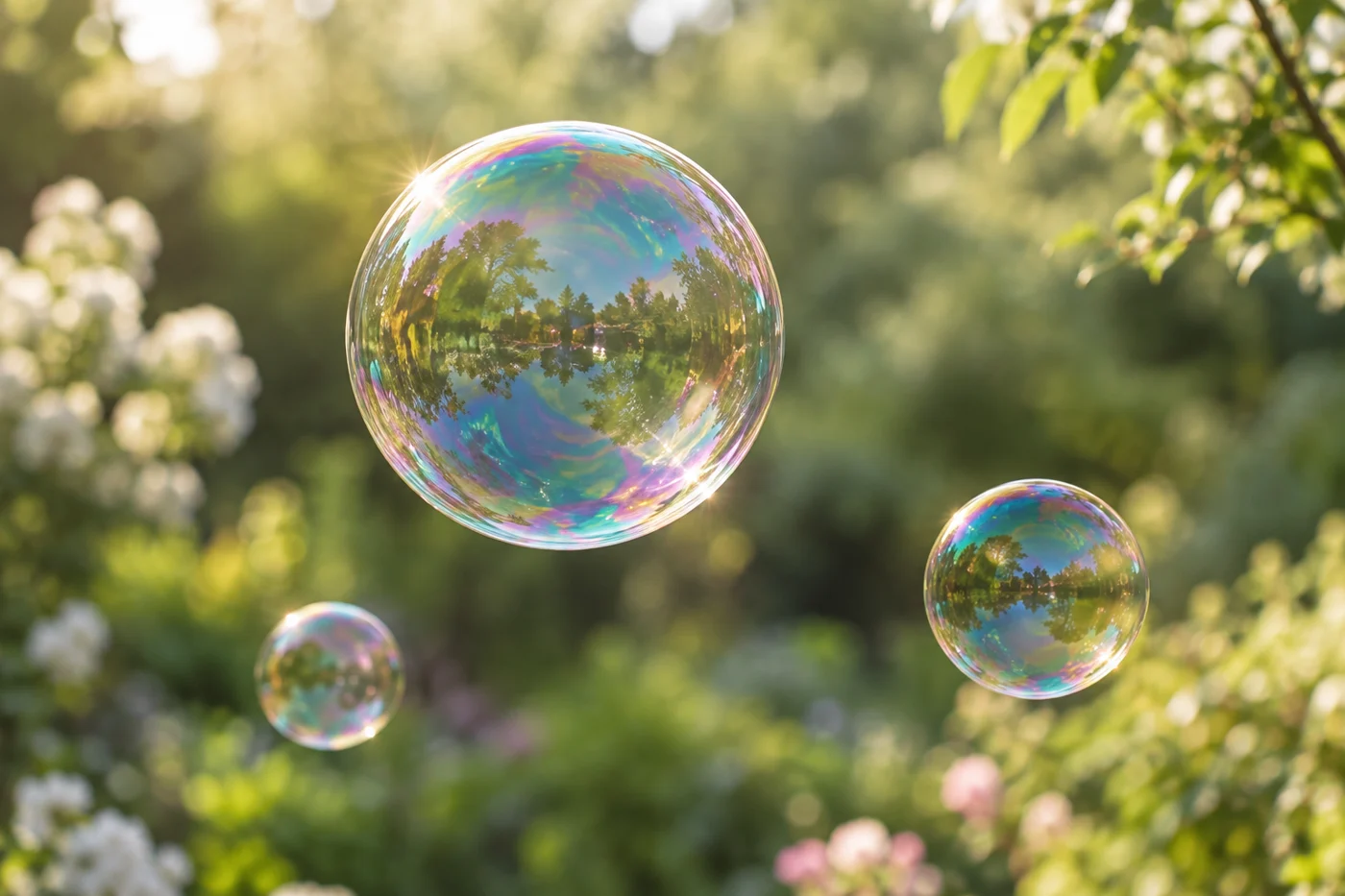
A bubble's surface pulls itself inward. A sphere encloses the trapped air with the smallest possible surface area, so a free bubble becomes round.
Blow through a wand and a long, wobbling shape forms. It breaks free and becomes almost perfectly round. Its skin is extremely thin, yet it can trap a pocket of air. How does it manage that?
A skin made of water and soap
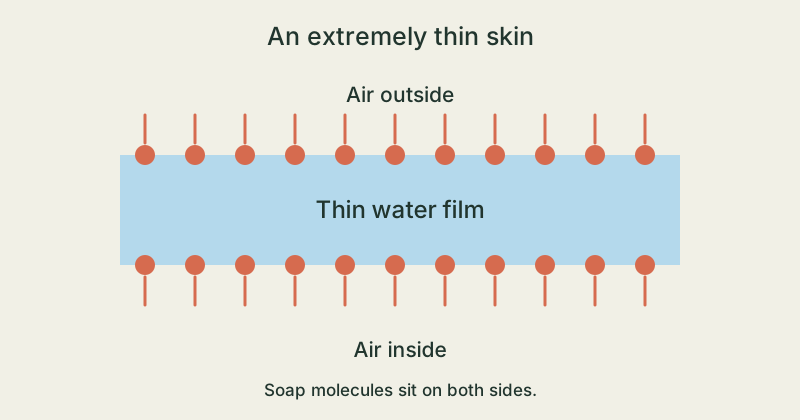
A soap bubble's wall is a very thin film of water. Soap molecules sit on both its inside and outside surfaces. One part of each molecule is attracted to water, while another part avoids it. This helps them arrange themselves at the film's surfaces.
Soap lowers water's surface tension and helps stabilize a thin film. It does not increase that tension. Blowing through pure water usually does not produce a long-lasting, freely floating bubble.
A sphere uses less surface
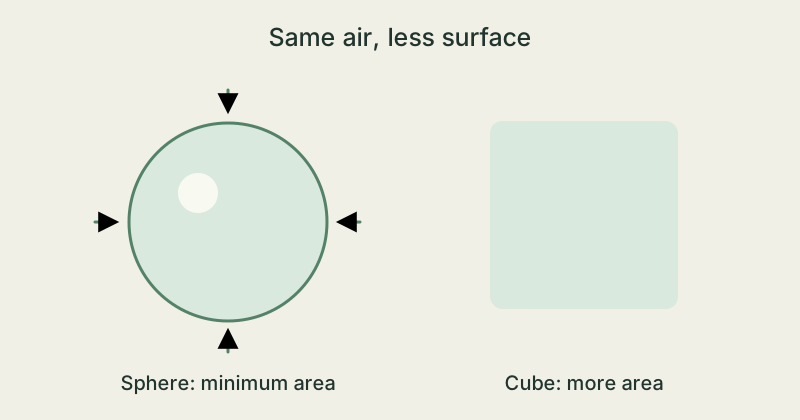
A liquid film's surface is under tension and tends to shrink its area. For a fixed amount of enclosed air, a sphere has the smallest surface area. Corners and edges would need more film.
That is why a free bubble in still air becomes roughly spherical. It is not thinking or trying to save anything. Calling it economical is simply our way of describing a state with as little surface energy as possible.
Why does it shimmer?
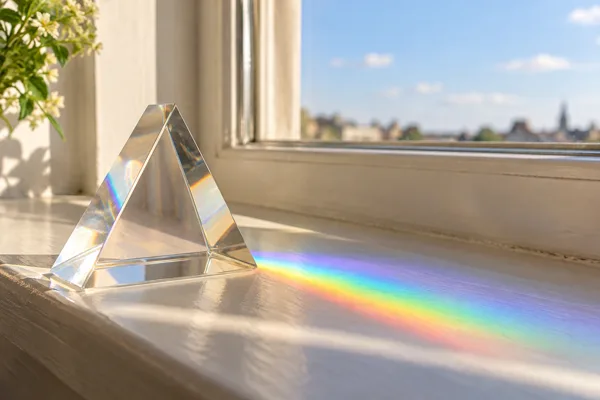
Light reflects from both sides of the thin film. Those reflected waves can reinforce or weaken each other. Depending on the skin's thickness and your viewing angle, different colours stand out. This is called interference.
The skin keeps changing as water drains downward and evaporates, so the colourful patterns move. If the film becomes too thin or is disturbed, it tears and the bubble bursts. When several bubbles touch, their shared surfaces can also be very different from a sphere.
Watch a bubble find its shape
- Use ready-made bubble solution and a large wand.
- Blow slowly and watch a bubble just after it separates.
- Notice its changing colours. Compare one free bubble with two touching bubbles.
Do not drink bubble solution or get it in your eyes. Wipe up spills.
The takeaway
A free bubble becomes round because a sphere encloses the same air with the smallest surface area.
Which shape encloses the same air using the least surface?
Sources & further reading
Exploratorium · The Shape of Bubbles ↗Exploratorium · Soap and Surface Tension ↗Exploratorium · See Colors in Bubbles ↗Our stories explain the main idea in our own words. Pictures and models simplify reality and are not drawn to scale.