Freezing arranges water molecules into an open pattern. The same amount of water takes up more space. Ice is less dense than liquid water, so it floats.
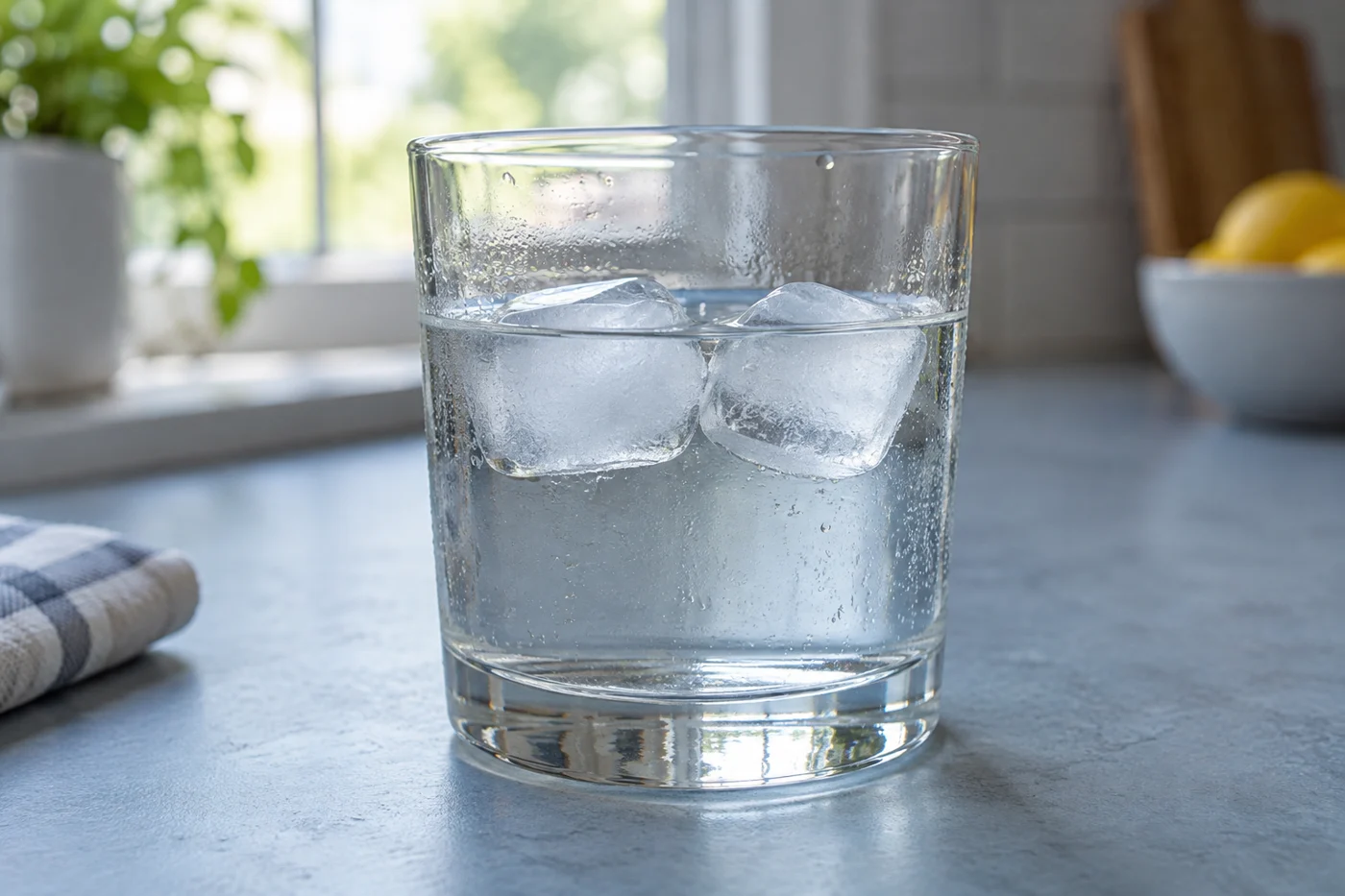
Drop an ice cube into a glass of water. It dips in, bobs back up and rests at the surface. The cube is made of the same substance as the liquid below. What changes is how its tiny building blocks are arranged.
Density: how much is packed in?
Picture two boxes of the same size. One is packed with building blocks and the other holds only a few. The packed box contains more mass in the same space. Density describes exactly that relationship: mass per volume.
Whether something floats in water depends in part on its average density. A material less dense than water can float. Solid does not automatically mean it sinks, and being heavy is not a complete explanation on its own.
Freezing leaves more gaps
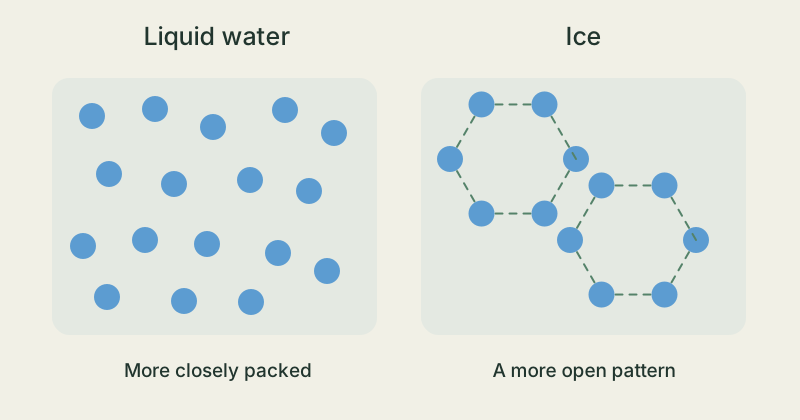
In liquid water, molecules move around and keep changing neighbours. As water freezes, hydrogen bonds arrange them in an ordered, relatively open pattern. These bonds are attractions between molecules, not extra rigid sticks.
In ordinary ice, the molecules are farther apart on average than in liquid water. The same mass occupies more space. Its density decreases, allowing ice to stay at the surface. Many other substances become denser when they solidify.
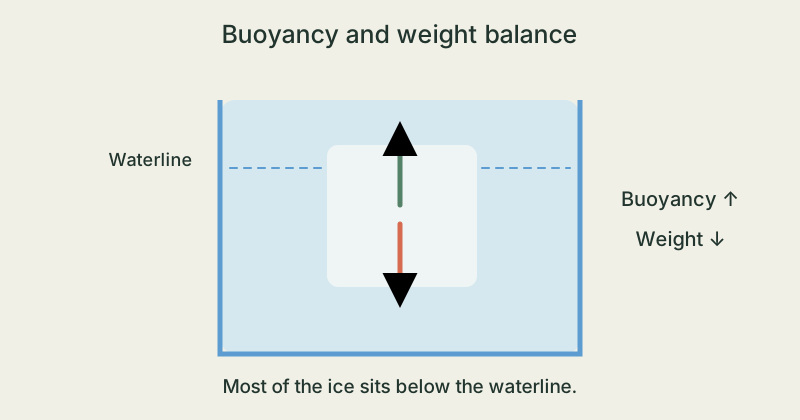
Why is so little above the surface?
Water pushes upward on an immersed object. That force is called buoyancy. A floating ice cube settles until the upward force balances its weight. Because ice and water have fairly similar densities, most of the cube sits below the waterline.
Floating ice also matters for lakes in winter: they normally freeze from the top. Liquid water can remain below the icy lid. This small difference between ice and liquid water helps shape entire habitats.
An ice cube in a glass
- Fill a clear glass with tap water.
- Add an ice cube and look at the waterline from the side.
- Compare how much ice sits above and below the surface. Watch it as it melts.
Freeze water only in suitable open ice trays. Never freeze a sealed glass bottle: expanding water can break it.
The takeaway
Ice spreads the same mass over more space. Its lower density lets it float on liquid water.
What happens to the space water needs as it freezes?
Sources & further reading
USGS Water Science School · Water Density ↗OpenStax Biology 2e · Water ↗OpenStax University Physics · Archimedes’ Principle and Buoyancy ↗Our stories explain the main idea in our own words. Pictures and models simplify reality and are not drawn to scale.