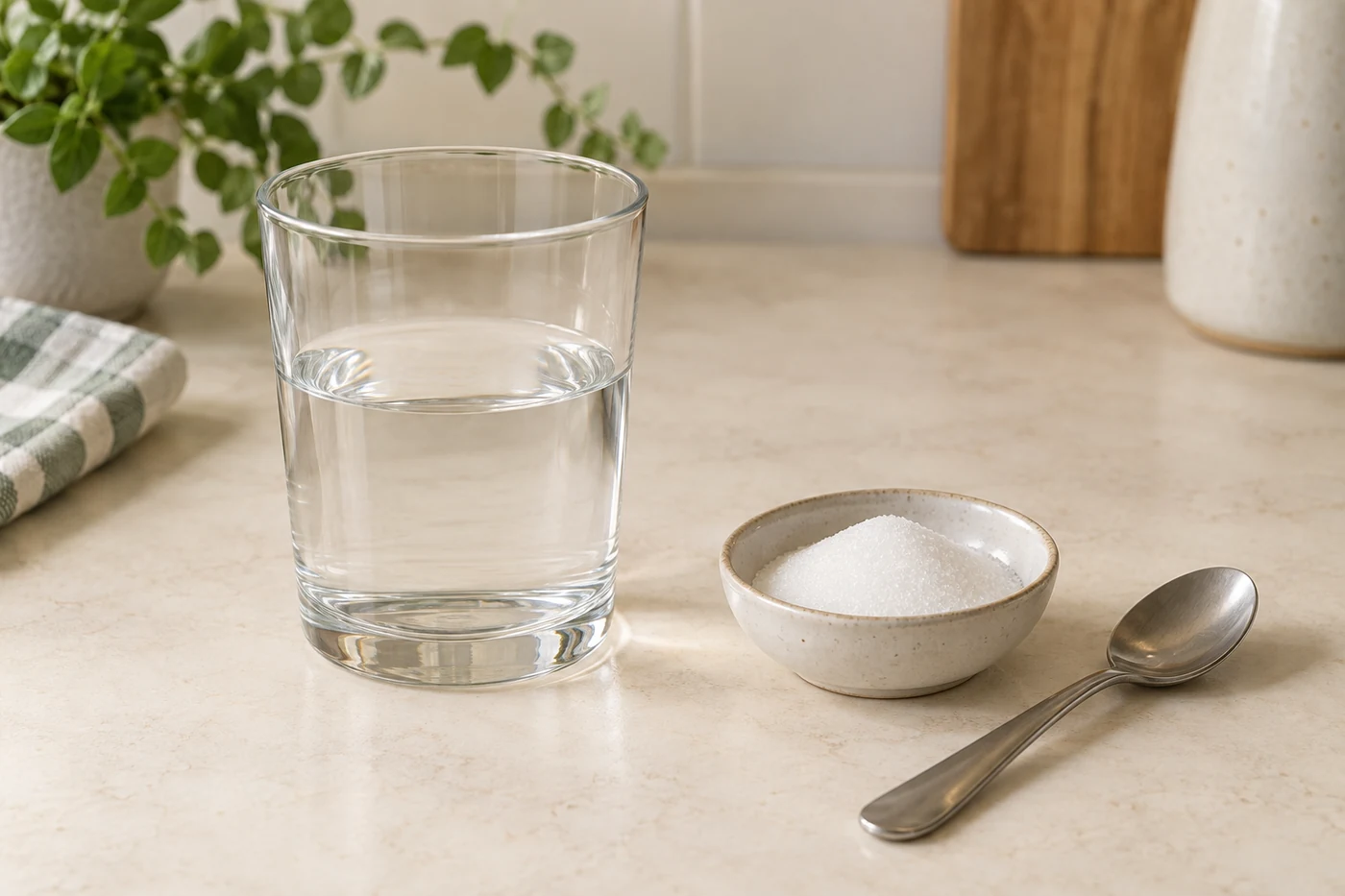
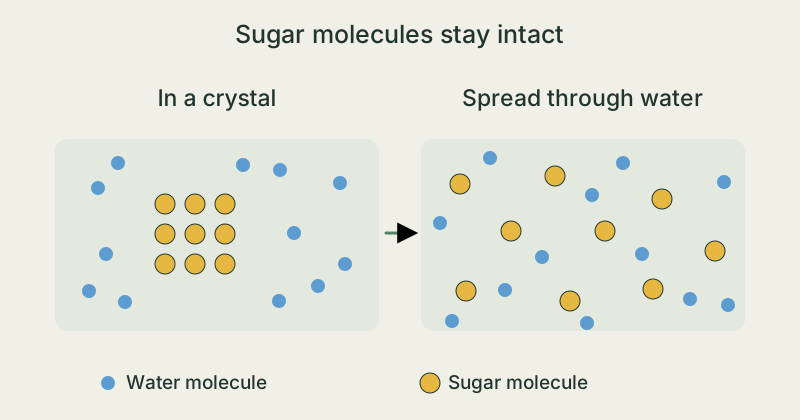
The sugar stays in the water. Its crystals separate into individual sugar molecules that spread through the water. These molecules are too small to see with the naked eye.
Clear water can contain dissolved sugar. Stirring has neither destroyed the sugar nor turned it into water. What has changed is how its tiny building blocks are arranged.
From a crystal to separate molecules
Table sugar consists of molecules called sucrose. Many are arranged together in a crystal. Water can separate individual sugar molecules from this group. The atoms within each sugar molecule stay together.
Water and sugar molecules have regions with slightly positive or negative electrical charge. These regions attract one another, helping water dissolve sugar. Dissolving is different from melting through heat.
The scale keeps count
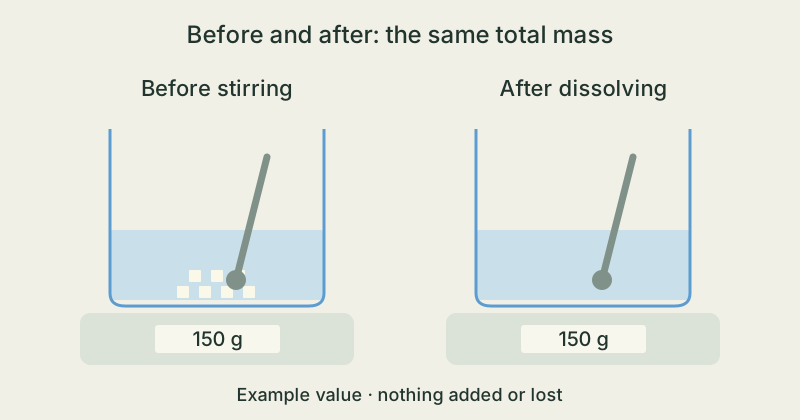
The sugar molecules are still there and still contribute to the mass. If nothing is added or lost, the total mass stays the same before and after dissolving.
Small differences on a kitchen scale can come from its precision. Spills, evaporation or liquid on a spoon removed from the cup can also change the result. Looking clear alone does not tell you whether the water contains sugar.
Stirring has limits
Stirring brings water with less dissolved sugar to the crystal surfaces. This can speed up dissolving.
At a given temperature, a particular amount of water can dissolve only a limited amount of sugar. If there is too much, some crystals remain. More stirring does not remove this limit.
Grains gone, mass still there
- Put about 100 milliliters of room-temperature water in a clear plastic cup. Add one level teaspoon of table sugar. Weigh the cup, water, sugar and the spoon standing inside it together. Record the value.
- Stir gently until you can no longer see grains. Avoid spills. Immediately weigh the same items again, with the same spoon inside the cup.
- Compare the values. They should agree within your scale's precision. The grains are no longer visible, but the mass remains. Without a scale, you can observe dissolving, but cannot use this observation to check the mass.
Use only sugar and room-temperature water. Keep water away from electrical devices. Do not drink the sample. Young children should observe with an adult.
The takeaway
Dissolved means spread out, not vanished: sugar molecules stay in the water, and their mass remains.
What happens to table sugar when it dissolves in water?
Sources & further reading
American Chemical Society · Why Does Water Dissolve Sugar? ↗American Chemical Society · Conservation of Mass ↗American Chemical Society · Using Dissolving to Identify an Unknown ↗USGS Water Science School · Why is water the universal solvent? ↗Our stories explain the main idea in our own words. Pictures and models simplify reality and are not drawn to scale.