
Earth’s axis is tilted. In winter, our hemisphere tilts away from the Sun. In Germany, sunlight then strikes the ground at a shallower angle and spreads over a larger area. Days are also shorter. Less solar energy reaches each area over the day, making winter colder on average.
We compare winter and summer in a place such as Berlin. The cover illustrates a winter walk; it is not a measurement. This explains the seasonal difference, rather than predicting the weather on every individual day.
Earth spins on a tilt
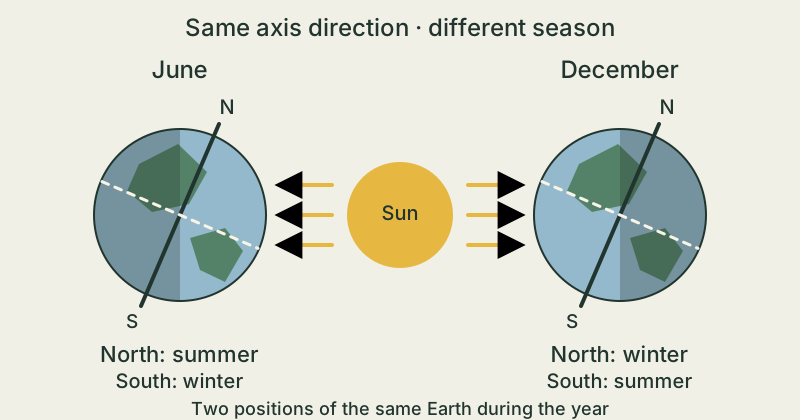
Imagine an invisible rod through the North and South Poles. Our planet spins around this axis. It tilts by about 23.5 degrees from a line perpendicular to the plane of Earth’s orbit.
During one trip around the Sun, the axis keeps pointing in roughly the same direction in space. In June the Northern Hemisphere leans towards the Sun; in December it leans away. Seasons are reversed in the Southern Hemisphere.
The same light over more ground
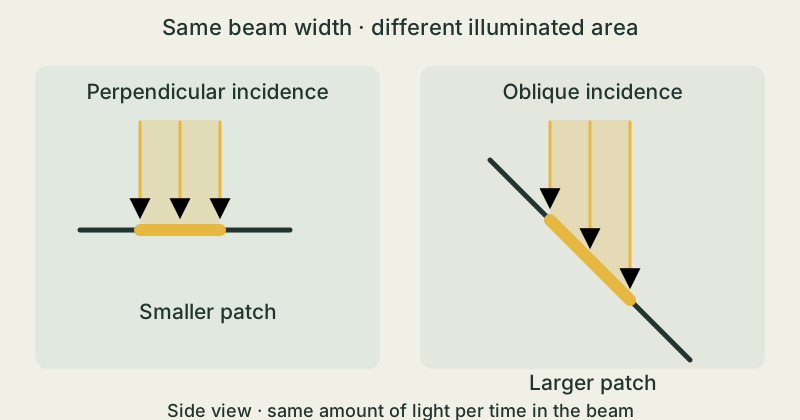
When the Sun is lower above the horizon, sunlight strikes a horizontal surface more obliquely. A beam of the same width then spreads its energy over a larger patch of ground.
Picture a spot of light being stretched out. Each little piece of ground receives less energy. The Sun does not need to become dimmer for this to happen.
Fewer hours of warming
The tilt also changes the length of daylight. In Berlin, the Sun spends fewer hours above the horizon in winter than in summer. The ground receives sunlight for less time.
Shallower sunlight and shorter days work together. How cold any particular day becomes also depends on clouds, wind and other weather conditions. Winter does not automatically mean snow.
Is distance from the Sun the reason?
Earth’s orbit is slightly oval. The whole Earth is actually closest to the Sun in early January, during northern winter and southern summer.
Distance alone therefore cannot explain these opposite seasons. Earth’s tilted axis is the key to our winter. Near the equator and in polar regions, daylight and seasons differ from those in Berlin.
Tilt a patch of light
- With an adult, set an ordinary small LED torch firmly on a table and aim it horizontally at white card. Mark the centre of the light spot with a small pencil dot. First hold the card perpendicular to the beam. Keep the torch, brightness and distance to the centre fixed.
- Slowly turn the card around a vertical line through the marked centre, keeping that centre in the same place. Watch the light spot: does it become longer in one direction? Sketch the first and tilted positions on another sheet. Compare shapes without treating brightness as a precise measurement.
- Turn the card back and repeat the comparison three times. A real torch beam spreads out, so this activity only shows the basic idea of distributing light over an area. It measures no warming and does not show shorter winter days. Compare the two explanatory diagrams as well.
Work with an adult and an ordinary small LED torch. Look only at the spot on the card; do not shine the torch at anyone’s face. Use no sunlight, magnifying glasses, lasers or heat lamps. A clear, safe table is enough; no observation of the Sun is needed.
The takeaway
Earth’s tilted axis makes winter days shorter and the midday Sun lower in Germany. Sunlight spreads over more ground and arrives for fewer hours, reducing the daily solar energy received by each area.
Why does the ground in Berlin usually receive less solar energy per day in winter?
Sources & further reading
NASA Space Place · What Causes the Seasons? ↗NASA Science · Facts About Earth: Orbit and Rotation ↗NOAA / National Weather Service · Why Do We Have Seasons? ↗Met Office · Winter: the coldest season ↗Our stories explain the main idea in our own words. Pictures and models simplify reality and are not drawn to scale.