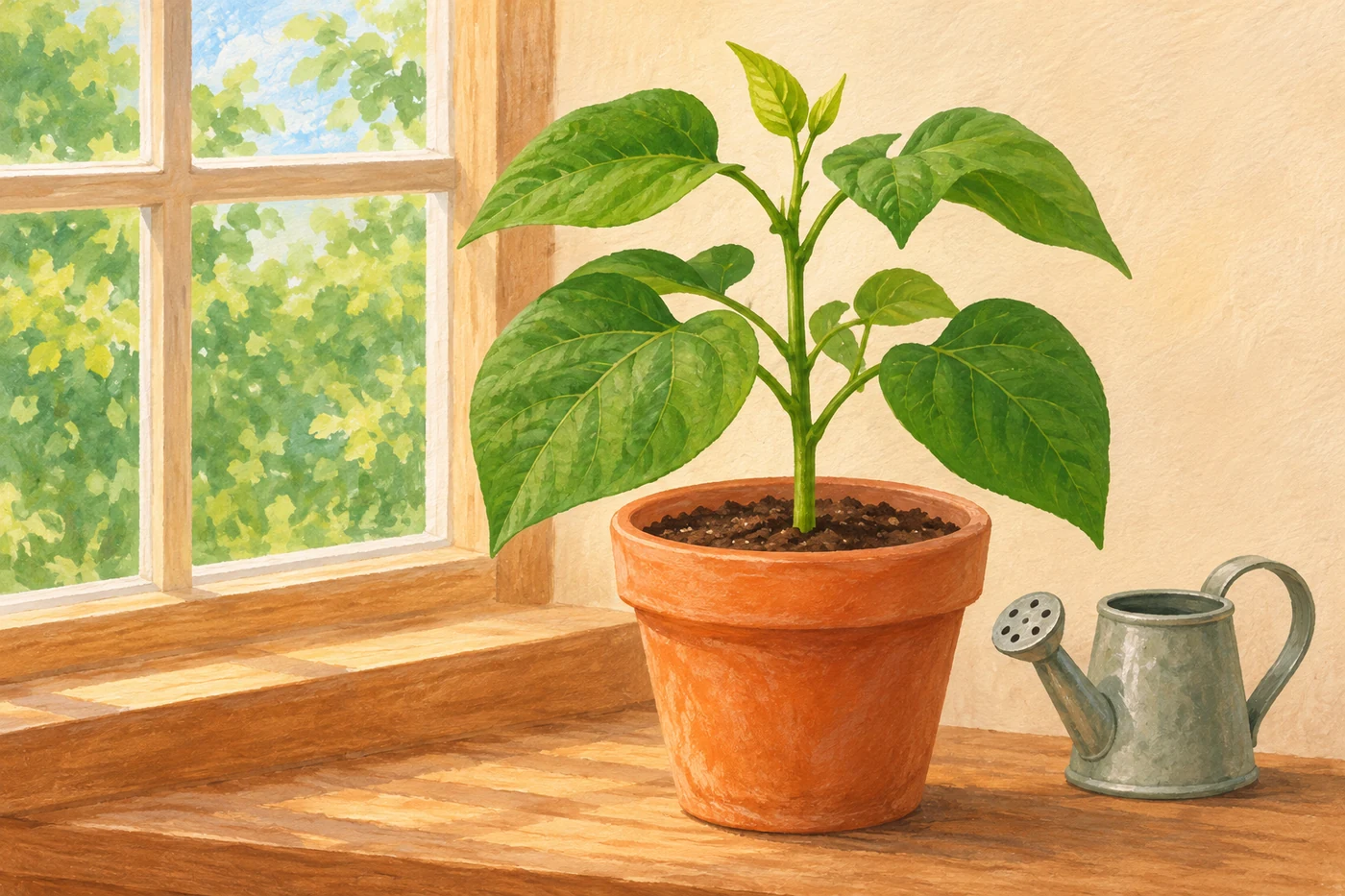
Green houseplants make sugar by photosynthesis. They use water and carbon dioxide from the air. Light supplies the energy for this building process. Soil provides important minerals, rather than ready-made sugar.
The cover is an illustration. The diagrams show simplified connections, rather than individual reaction steps or measured amounts of substances.
Light supplies energy
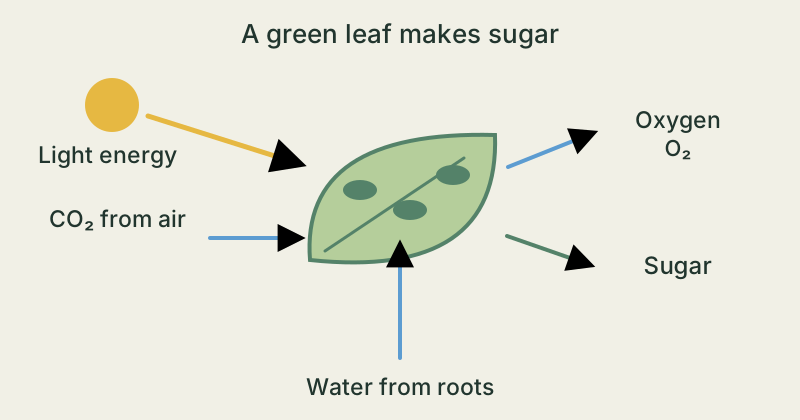
Green plant cells contain tiny chloroplasts. Their green pigment, chlorophyll, absorbs light energy. This enables the plant to build sugar from other substances. Light is an energy source, rather than a piece of building material.
Water and an invisible gas
Roots take up water. Carbon dioxide, or CO₂, enters through tiny openings in leaves. Its carbon becomes part of the sugar. Photosynthesis also produces oxygen. In a simplified summary: carbon dioxide + water become sugar + oxygen, using light energy.
Sugar has several jobs
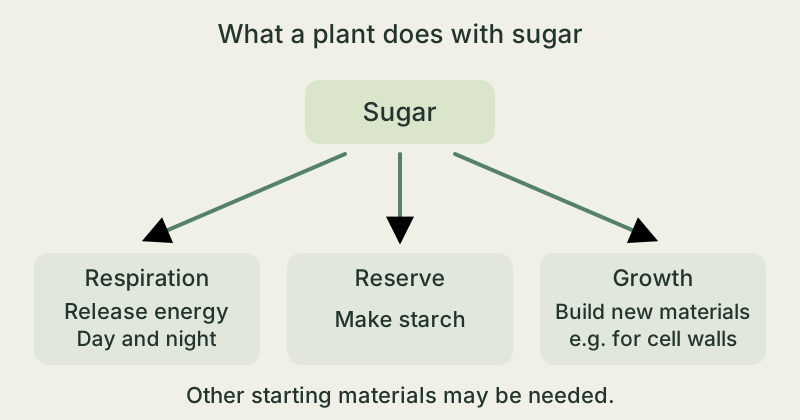
A plant can use sugar to build new materials for growth or make starch as a reserve. Cellular respiration releases energy from sugar. Respiration takes place during the day and at night; photosynthesis needs light.
Why soil and fertiliser still matter
Roots also take up dissolved minerals with water, such as compounds containing nitrogen. These are needed for growth too. Fertiliser supplies such nutrients. It cannot replace sugar production or light.
Watch a leaf grow
- With an adult, choose a healthy houseplant you already have. Keep it in its usual suitable, bright spot and care for it as normal. Find a young leaf without picking it.
- Draw or photograph that leaf each day for a week at roughly the same time. Hold a ruler beside it for scale, without squeezing the leaf. Record days when you see no change too.
- Compare the pictures. On paper, draw arrows for light reaching the leaf, CO₂ from the air and water from the roots. You may see growth, but this observation alone does not demonstrate sugar production. Season and care also affect growth.
Do not taste leaves, soil or fertiliser. Keep leaves uncovered, continue normal watering and add no extra substances. This observation needs no chemicals or magnifying glass in sunlight.
The takeaway
In photosynthesis, light provides energy while water and CO₂ provide starting materials for sugar. Minerals are needed too. Sugar provides reserves, materials for growth and energy through cellular respiration.
What does light do when a plant makes sugar?
Sources & further reading
Arizona State University · Ask A Biologist: Snacking on Sunlight ↗NC State Extension · Extension Gardener Handbook: Botany · Photosynthesis and respiration ↗Oregon State University Extension: Plant growth and development · Photosynthesis and respiration ↗University of Illinois Extension · The Great Plant Escape: Nutrients from the Soil ↗Our stories explain the main idea in our own words. Pictures and models simplify reality and are not drawn to scale.