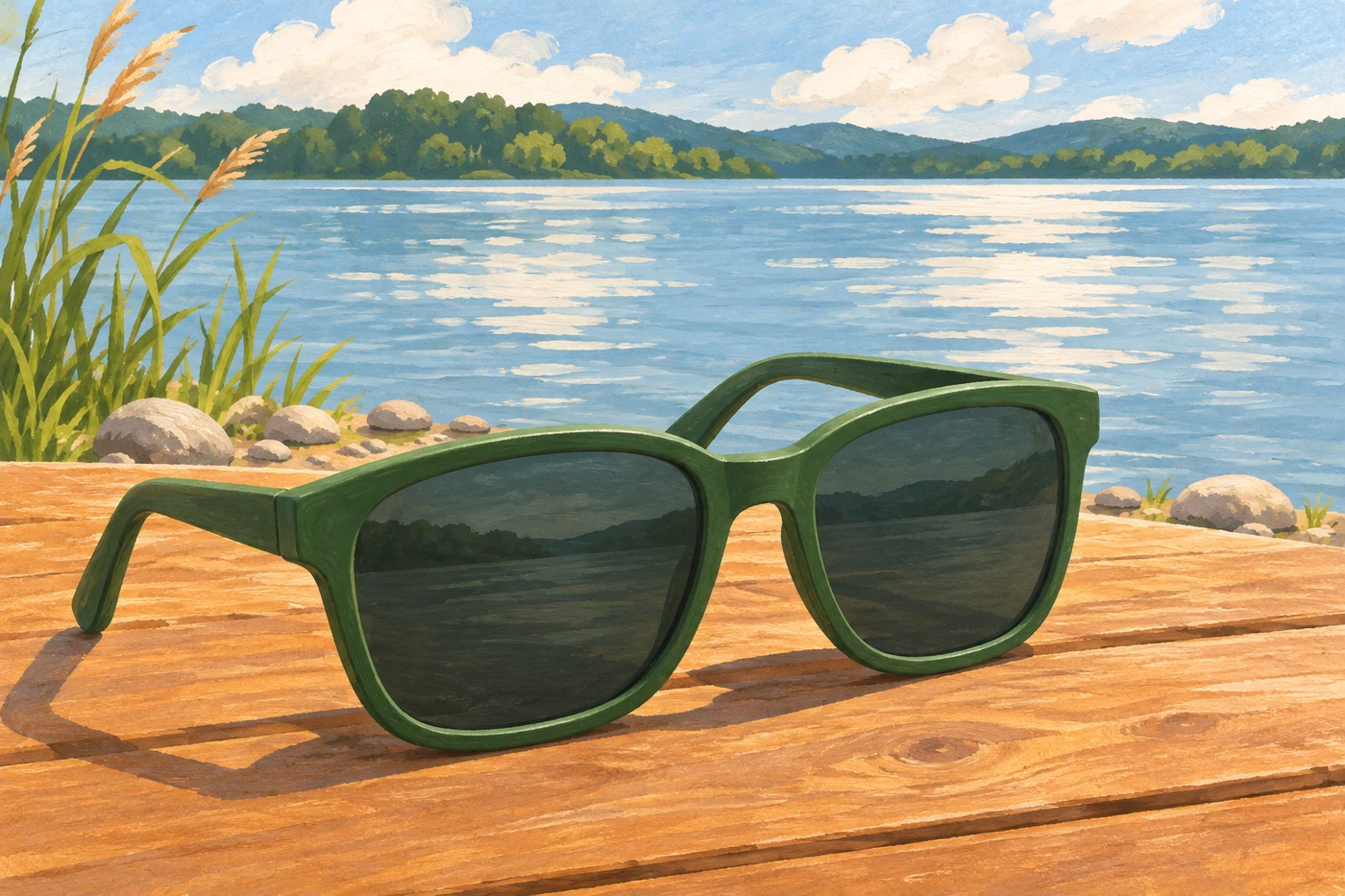
Light reflected from a horizontal water surface often has a stronger horizontal vibration. Polarised sunglasses usually transmit the vertical direction of vibration and absorb the horizontal one. Less of this reflected light then reaches the eye.
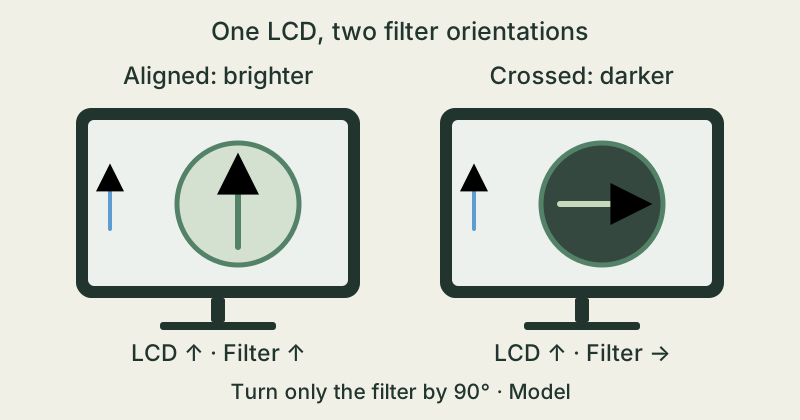
The cover is an illustration. The diagrams explain a simplified model; they do not show measured brightness levels.
Vibrating is different from travelling
Light is an electromagnetic wave. Its electric field vibrates across the direction of travel. Polarisation describes that direction of vibration. Horizontally polarised light does not have to travel horizontally.
A surface changes the mix of light
Ordinary light contains many directions of vibration. Water reflects these to different degrees. Depending on the viewing angle, the reflected light can have a stronger vibration parallel to the water's surface.
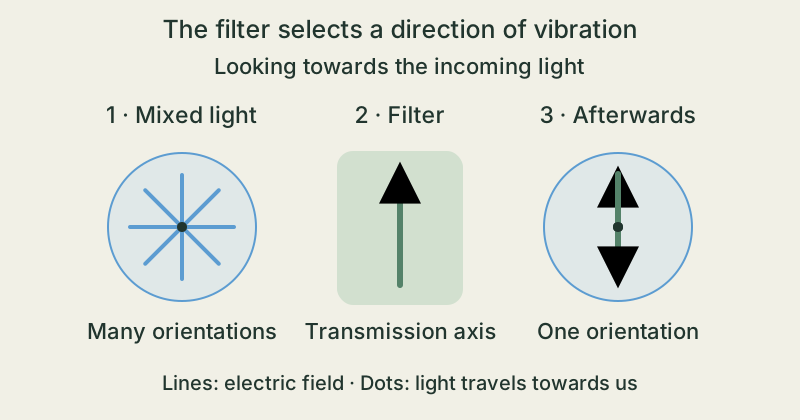
The filter selects by direction
A polarising filter sits inside the lens. It absorbs one direction of vibration particularly strongly. The direction at right angles to it passes more easily. A dark tint alone does not sort light this way. The filter's orientation matters too.
Why a screen darkens when you turn the glasses
Light from many LCD screens is already polarised. More passes through when its direction matches the filter. A quarter-turn can let much less through. The effect varies between screens. Reflections do not disappear completely at every angle either.
Try a quarter-turn in front of a screen
- With an adult, place an LCD screen on a table. Display a bright, still area at a comfortable brightness. Keep the room light on. Use a pair of polarised sunglasses you already have.
- Hold one lens in front of an eye and look through it at the screen. Slowly turn the whole pair of glasses by about 90 degrees, keeping the screen and your head in roughly the same orientation.
- Draw the brightest and darkest positions. Turn back and compare. If there is little change, the screen's construction may matter; this observation alone cannot reliably identify the type of glasses. It does not test UV protection either.
Observe while seated with an adult. Do not take apart the screen or glasses. Never look through sunglasses at the Sun, lasers or bright lamps.
The takeaway
A polarising filter selects by the direction of vibration. Reflected light from water often favours one direction, so a suitably oriented filter can greatly reduce it.
Which property does a polarising filter use?
Sources & further reading
University of Alaska Fairbanks · Geophysical Institute: Polarized Light ↗University of Waterloo · Institute for Quantum Computing: Light polarization ↗American Academy of Ophthalmology: What Are Polarized Lenses? · Polarization and UV protection ↗University of Memphis · Physics: Polariscope ↗Our stories explain the main idea in our own words. Pictures and models simplify reality and are not drawn to scale.