A cloud is not one solid lump of water. Its tiny droplets fall very slowly in still air because air resistance slows them strongly. Rising air can also carry them along. Gravity keeps acting throughout.
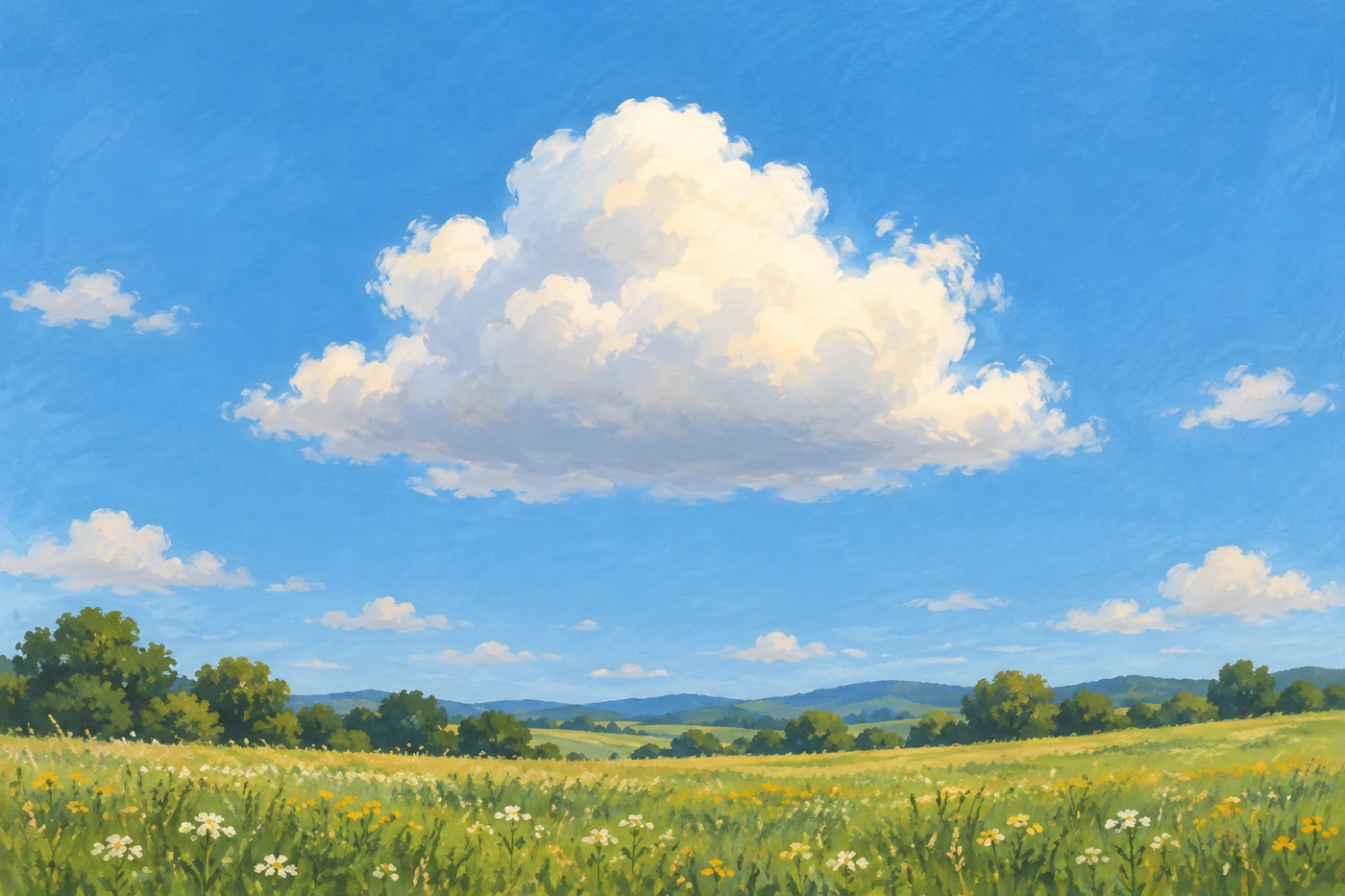
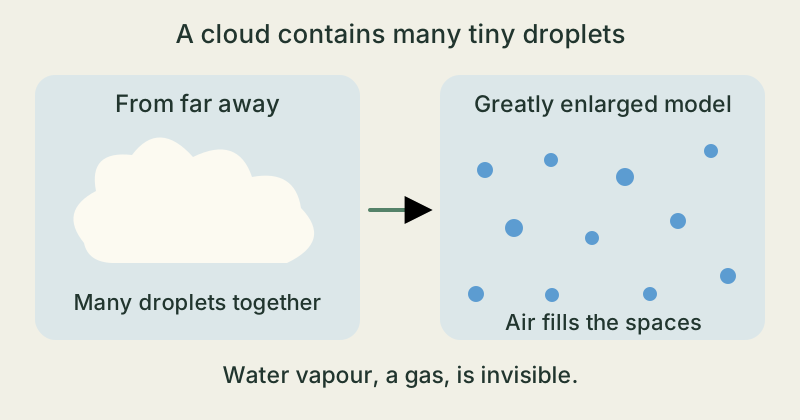
The cover is an illustration. Both diagrams are simplified models; droplets and spaces are greatly enlarged and not drawn to scale.
What we see is not water vapour
Water vapour is an invisible gas. Visible clouds contain huge numbers of little water droplets, ice crystals, or both, with air between them. Droplets in a low water cloud can be about a hundredth of a millimetre across. Many droplets together make the cloud visible.
Tiny droplets are pulled down too
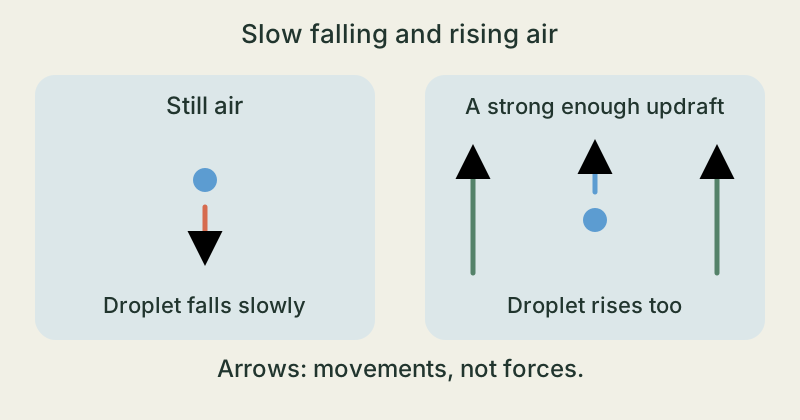
Water is denser than air. Yet a tiny droplet does not rush to the ground like a stone: the air slows its motion. This slowing effect is especially large compared with its weight. It therefore sinks very slowly in still air. A larger raindrop falls much faster.
The air itself can rise
Air also moves upwards, for example above sun-warmed ground. This rising air, called an updraft, can balance a small droplet's slow fall or carry it upwards. A cloud needs no solid floor. When droplets grow through collisions, they can fall out as rain. Whether rain reaches the ground also depends on whether it evaporates on the way down.
The cloud keeps being renewed
When moist air rises and cools enough, water vapour can become droplets on tiny airborne particles. Meanwhile, other droplets evaporate, especially when drier air mixes in. A cloud is therefore always changing. Its edges can grow or disappear while wind carries it along.
Watch a cloud change
- In calm weather, choose a single cloud from a closed window or a safe spot. Pick a fixed reference point, such as a treetop, and sketch the cloud with the time.
- Draw it again after two minutes and after five minutes. Compare two things separately: has the whole cloud moved relative to the tree? Have individual edges or gaps changed?
- Write down only what you actually see. Your sketches show motion and changes in shape; you cannot see individual droplets or measure their falling speed from this distance. Compare your observations with the models.
Do not look at the Sun. Do not climb onto windowsills or stand in the road. During a thunderstorm, observe only from indoors.
The takeaway
Tiny cloud droplets fall slowly, air currents carry them, and droplets keep forming and evaporating. Gravity has not switched off.
Why doesn't a cloud fall like a bucketful of water?
Sources & further reading
NASA Science · How Do Clouds Form? ↗NOAA JetStream · How Clouds Form ↗National Weather Service · Cloud Development: droplets, air resistance and rising air ↗Met Office · Clouds ↗Our stories explain the main idea in our own words. Pictures and models simplify reality and are not drawn to scale.