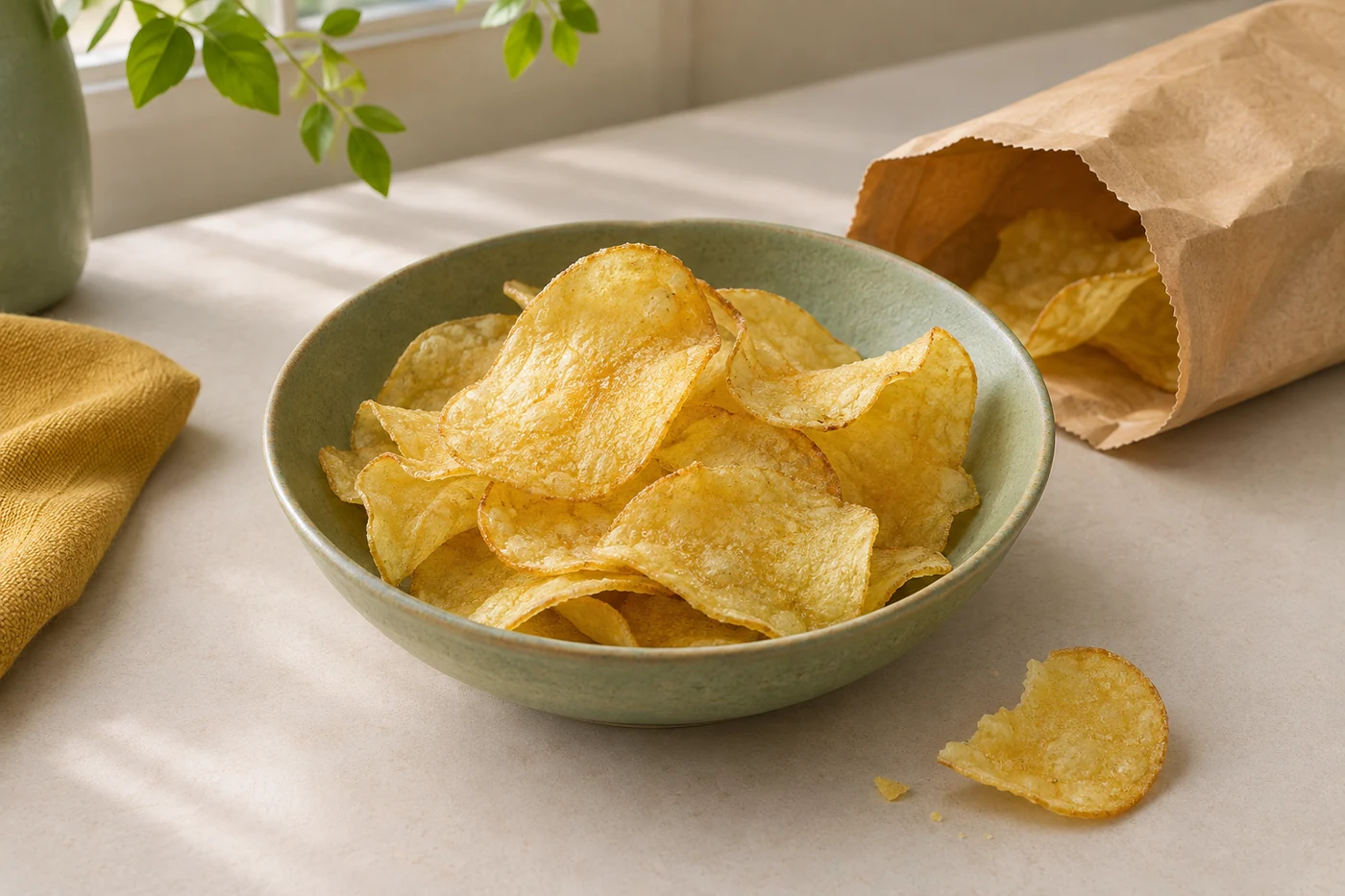
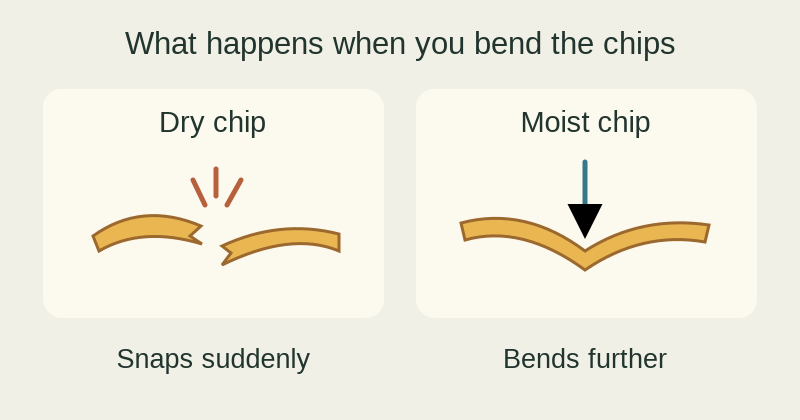
Fresh potato chips contain very little water. In humid air, they gradually take up water from their surroundings. That makes their rigid structure give way more easily. They break less suddenly when bent and often make a quieter snap.
A fresh chip snaps with a small bend. One from a bag that has been open for a long time may bend further before it breaks. What makes the difference?
A dry chip snaps easily
Frying drives much of the water out of a potato slice. What’s left is a thin, dry chip. Bend it and its brittle structure can crack quickly. That’s the snap you hear.
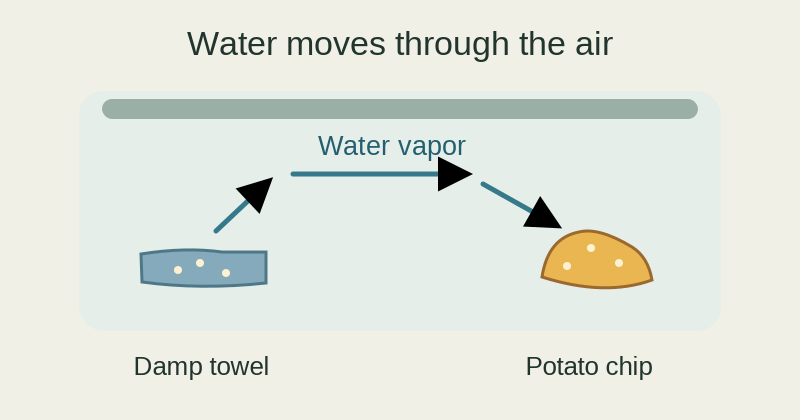
The water comes from the air
Even clear air contains water as invisible water vapor. A dry chip can take up some of it without ever touching a drop.
Once the chip has taken up enough water, its structure changes shape more easily. It gives more when you bend it. How quickly you notice the difference depends in part on how humid the air is and how thick the chip is.
You can compare how crisp chips are
Researchers kept potato chips in air at different humidity levels and compared how crisp they were afterward. In the study, chips with more water were generally judged less crisp.
A closed bag limits how much humid air reaches the chips. Sealing it well after opening helps the chips stay crisp for longer.
Compare chips from the same bag
- Put two chips of similar thickness on each of two small, dry plates. Put the plates in two clean containers of the same size, each with a lid.
- Put a damp, wrung-out piece of paper towel beside the plate in one container. Keep the chips and their plate dry. Put a dry piece of paper towel of the same size in the other container.
- Close both lids and leave the containers side by side at room temperature for a few hours. Then open them and gently bend one chip from each. Compare how far they bend and how loudly they snap.
- If you can barely tell the difference, close the containers again and give the remaining chips more time.
Keep the damp towel separate from the chips. Use your fingers and ears to compare them and throw them away after the activity.
The takeaway
Dry chips snap when they break. When they take up water vapor from humid air, they bend more easily.
What can make a chip go soft in an open bag?
Sources & further reading
Katz & Labuza · Effect of Water Activity on the Sensory Crispness and Mechanical Deformation of Snack Food Products ↗Kwak et al. · Prediction of Sensory Crispness of Potato Chips Using a Reference-Calibration Method ↗Our stories explain the main idea in our own words. Pictures and models simplify reality and are not drawn to scale.