
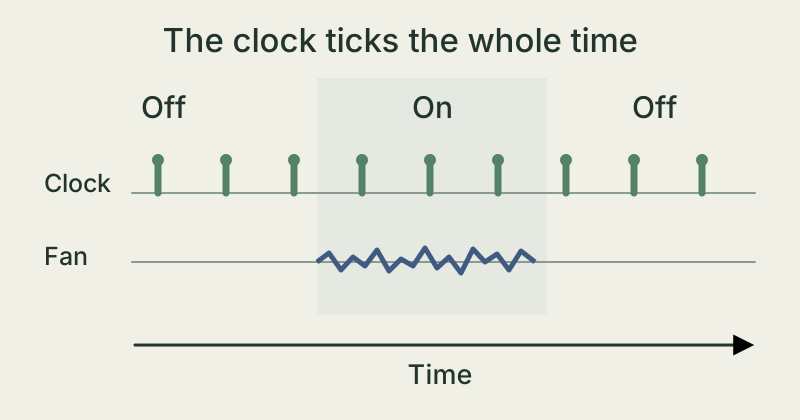
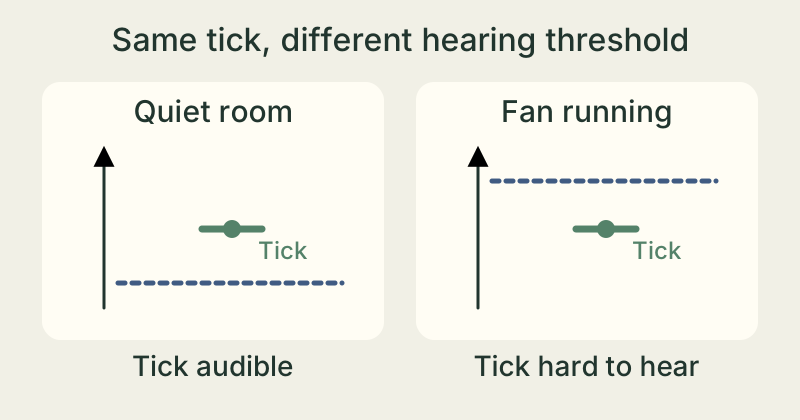
The clock keeps ticking at the same level. While the fan is running, its whir and the ticking reach your ears at the same time. The whir can cover up the soft ticking. Once the fan stops, the individual ticks are easier to hear.
You’re reading beside a clock. As soon as the fan stops, you hear it. Tick, tick, tick. The clock has been ticking the whole time. Why are you only noticing it now?
Ticks can get lost in the whir
A clock makes short ticks with gaps in between. A fan makes a fairly steady whir. While it runs, your ears hear a mixture of the two sounds. A soft tick can be hard to pick out of that mixture.
When one sound makes another harder to hear, it’s called masking. Once the whir fades, each tick stands out more clearly.
Sounds close in pitch can mask each other more
A sound can contain a mix of low and high pitches. Some of those pitches matter more than others when you try to recognize a tick. If the fan makes a lot of noise around those pitches, it can more easily mask the ticking.
Picture two whistled notes. If they’re close in pitch, a strong note can cover up a faint one. When they’re farther apart, the faint note is often easier to hear.
You can hear more in a short gap
A background sound doesn’t have to stop altogether. Sometimes a brief gap is enough. On a street you might hear a bird in the gap between two passing cars. When the next car goes by, the bird’s call is harder to hear again.
How closely you listen matters too. For a fair comparison, stay in the same spot and listen carefully for the clock both times.
Listen to the same clock with and without a fan
- Put a ticking clock on a table. Sit far enough away that you can just about hear the ticks clearly in a quiet room.
- Run a table fan nearby on its lowest setting. Wait for it to settle into a steady whir. Stay seated and listen for the clock again for a few seconds.
- Turn the fan off or ask someone to do it for you. Listen from the same spot. Compare when you can pick out the individual ticks most easily.
- If you don’t notice a difference, move the fan a little and try again. Some sounds cover up the ticking more than others.
Use a low fan setting. Keep the guard in place and keep your fingers away from it.
The takeaway
Background sound can cover up a quiet tick. When the background gets quieter, the very same tick is easier to hear.
Why can you hear the clock more clearly when the fan stops?
Sources & further reading
U.S. National Park Service · Young Sound Seekers: Masking Mayhem ↗The Open University · Perceptual encoding and frequency masking ↗Our stories explain the main idea in our own words. Pictures and models simplify reality and are not drawn to scale.