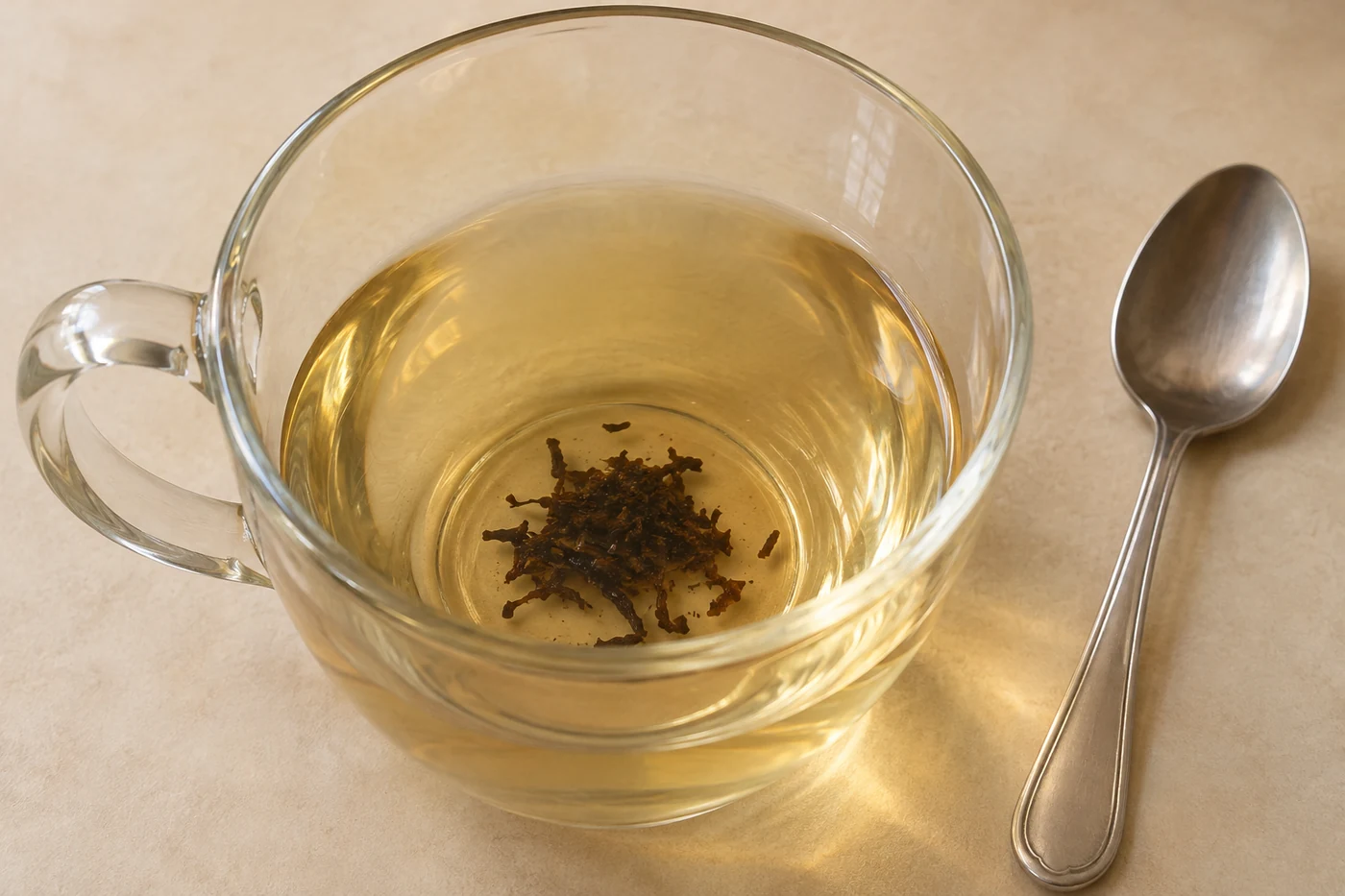
Stirring makes the tea spin. The base of the cup slows down the liquid just above it. There, a current flows inward from the edge and carries the sunken leaves with it.
Some loose tea leaves are resting at the bottom of a cup. Stir the tea and lift the spoon out. Something surprising happens. Many of the leaves glide inward and form a little pile.
The tea spins and the base slows it down
When you stir in circles, the tea starts to spin. You can see the surface dip a little in the middle. The cup itself stays still.
Friction near the base slows the liquid. The tea near the bottom spins more slowly than the tea higher up.
Tea near the bottom flows inward
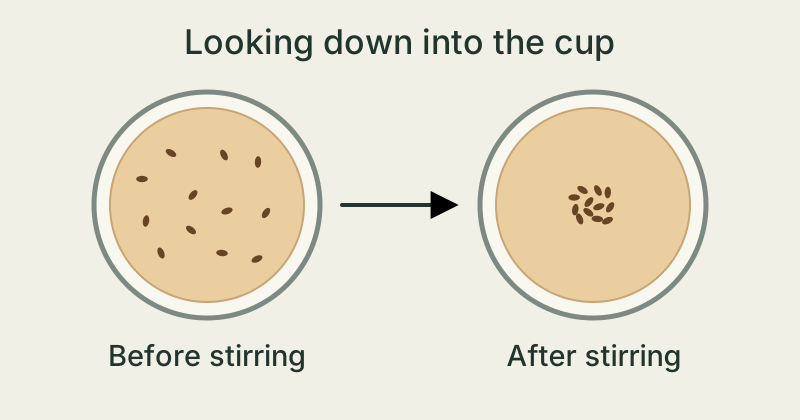
In the spinning tea, the pressure is higher at the edge than in the middle. Pressure here means how strongly the liquid pushes on its surroundings. That difference pushes the slow-moving tea at the bottom inward.
Some of the liquid rises in the middle. Near the top it flows back toward the edge, where it sinks. This extra motion is called a secondary flow. The tea keeps spinning as it flows this way.
The leaves show where the tea flows
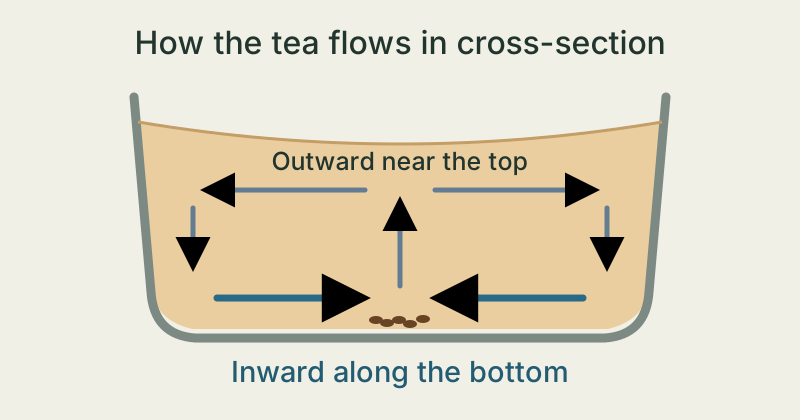
Soaked leaves that have sunk are right where the tea flows inward. Some slide along the bottom and others lift briefly. Many end up near the middle.
How clearly you see a pile depends partly on the shape of the cup’s base and how you stir. A round container with a flat bottom makes the movement easy to watch.
Watch the leaves in a glass
- Set a round, clear glass with a flat bottom on a sheet of white paper. Fill it halfway with room-temperature water. Add a small pinch of loose tea leaves that have already soaked in water.
- Wait for some pieces to sink. Look down from above and see where they lie.
- Stir in a few steady circles and lift out the spoon. Leave the glass in place. Watch the pieces on the bottom as the water slows down.
- Compare the positions before and after stirring. If many pieces float, give them time to soak and watch the ones that sink.
Use room-temperature water and set the glass on a flat, sturdy surface.
The takeaway
The cup slows the spinning tea near its base. The resulting inward current can sweep sunken leaves into a pile in the middle.
Which movement carries sunken tea leaves toward the middle?
Sources & further reading
Tandon & Marshall · Einstein’s Tea Leaves and Pressure Systems in the Atmosphere ↗Japan Society of Mechanical Engineers · Collecting Tea Leaves ↗Kolesnik et al. · Thomson–Einstein’s Tea Leaf Paradox Revisited ↗Our stories explain the main idea in our own words. Pictures and models simplify reality and are not drawn to scale.