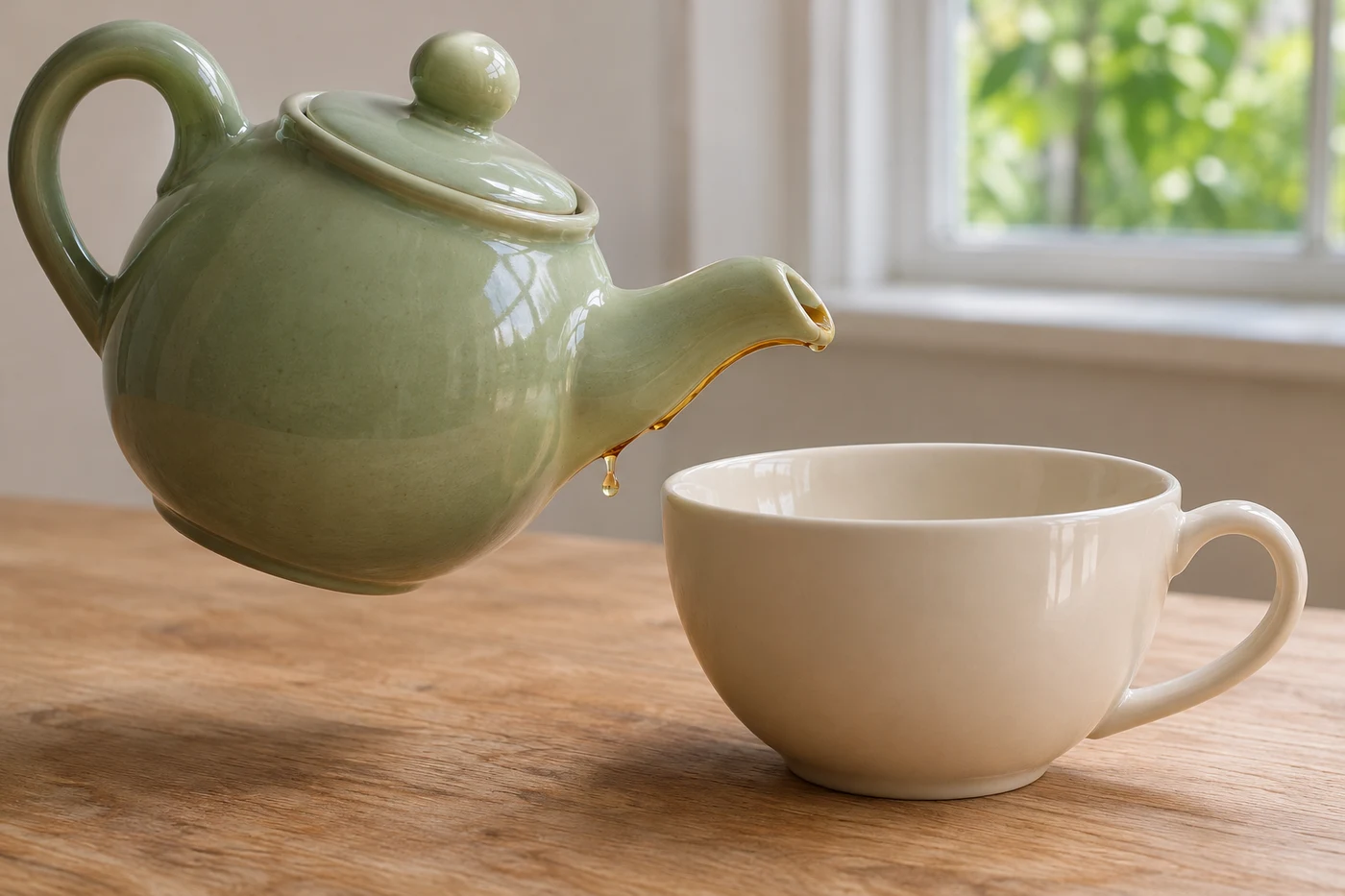
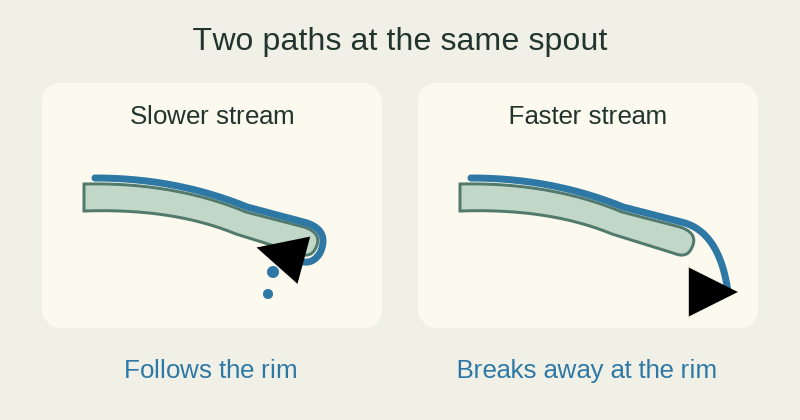
A tiny patch on the underside of the spout can stay wet. When you pour slowly, the stream can follow that wet patch around the edge and run down the outside of the pot. A faster stream often breaks away from the edge more easily.
You pour a cup of tea. The cup is right below the spout, yet a drop still lands on the table. Next time, use cold water and watch the spout from the side. Where does the water leave the pot?
The stream can turn around the edge
A stream of water tends to keep moving in the direction it was already going. That’s inertia. Once the stream is free of the spout, gravity pulls it down.
At the spout the water can change direction before it falls. On some pots a tiny drop hangs under the rim. If the stream is slow enough, water can follow the rim around to that wet spot and drip from farther back.
The shape and surface of the rim matter
Water spreads easily over some surfaces. We say it wets those surfaces well. A thin layer of water can stay on the underside of that kind of spout more easily. Surface tension plays a part here. It also helps water form little drops.
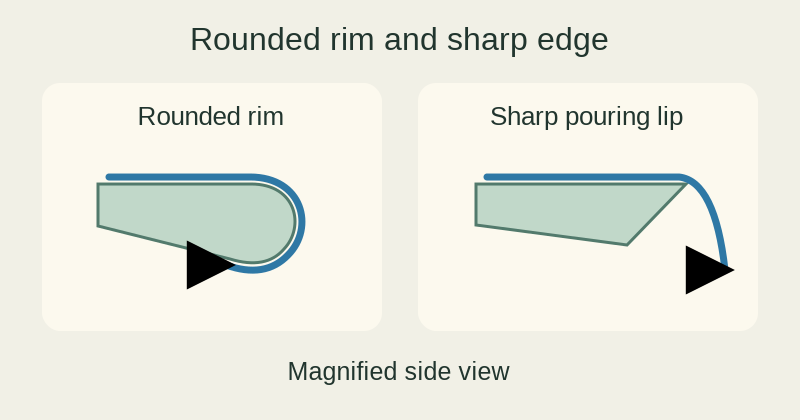
A rounded rim often lets the stream curl around the edge more easily. A sharply shaped lip can help the stream break away. How well it works also depends on how easily the surface gets wet and how you hold the pot.
The drip often comes at the end
As you tip the pot upright again, the stream slows. The last bit of water can run along the underside, even if the rest of the stream went right into the cup.
Researchers call this the teapot effect. In experiments they’ve studied the shape of the edge, how easily water wets the surface, and the speed of the flow. All three can change where the liquid breaks away.
Compare two pouring speeds
- Fill a small pitcher with cold water and hold it over the sink. If it has a loose lid, take it off first.
- Pour a thin, slow stream. Watch the spout from the side. Does the stream leave from the tip, or can you see water along the underside?
- Dry the spout and refill the pitcher to about the same level. Pour a little faster this time. Watch where the stream leaves the spout.
- In both trials, watch the last drop as you tip the pitcher upright. The difference can be small with some pitchers. If so, try another one.
Use cold water and a light, shatterproof pitcher. Pour directly over the sink.
The takeaway
At a wet rim, a slow stream can run down the outside. Pouring speed, rim shape, and the surface all affect where the water breaks away.
Where does the water on the outside of the pot come from?
Sources & further reading
TU Wien · Warum Teekannen immer tropfen ↗Duez et al. · Wetting controls separation of inertial flows from solid surfaces ↗Kistler & Scriven · The teapot effect ↗Our stories explain the main idea in our own words. Pictures and models simplify reality and are not drawn to scale.