Paper is made of many connected fibers. A gently bent sheet usually springs back when you let go. In a sharp fold, the fibers and their connections change shape within a narrow strip. Some of that change stays, leaving a visible crease.
Bend a sheet of paper into a wide curve and let go. It becomes almost flat again. Now fold the same sheet sharply in half and open it. This time a line remains. What’s different?
A gentle bend spreads out
A sheet of paper contains many short fibers lying across one another. They connect in many places, forming a thin network.
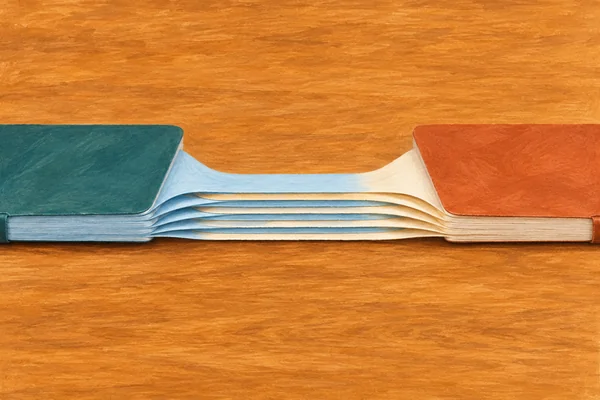
If you bend the sheet into a wide curve, the bend spreads across a large area. Let go and the paper returns almost to its old shape. This is called elastic deformation.
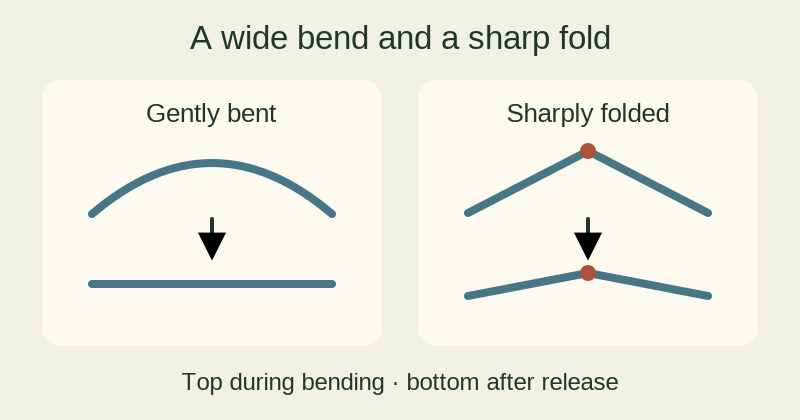
A sharp fold changes the network of fibers
At a sharp fold, nearly all the bending happens in a narrow strip. The paper stretches on the outside of the bend and gets squeezed on the inside.
Some fibers can stay changed, and some connections between them can give way. When a material keeps part of its new shape after you let go, that’s called plastic deformation.
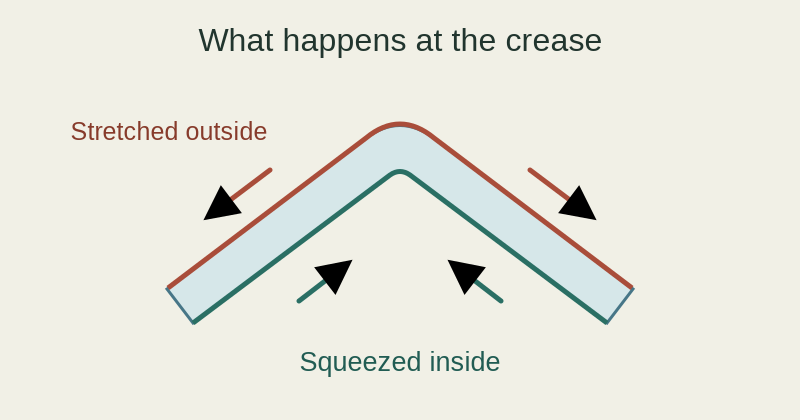
The line stays visible when you open the sheet
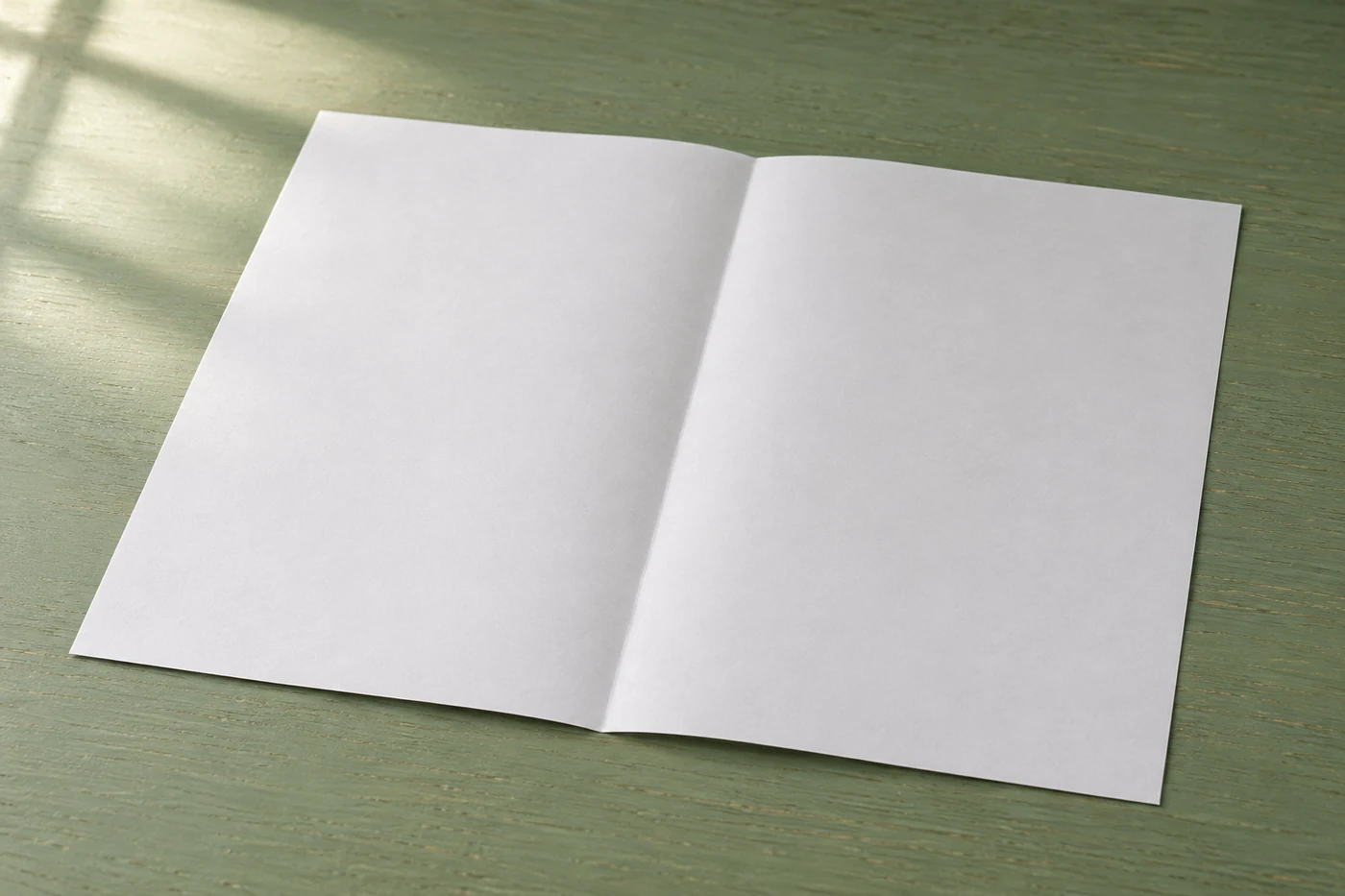
The sheet may spring back a little when you release it. Even after you open it out, the paper along the crease has changed. You can usually fold the sheet along that line more easily a second time.
Researchers have examined single folds in thin sheets. In their tests a fold opened quickly at first, then kept changing slowly. A fold can open farther and still leave a visible crease.
Compare a wide bend with a sharp fold
- Take two sheets of copy paper of the same size. Hold the short edges of the first sheet and bring them together until the paper forms a wide curve. Let go without pressing the middle.
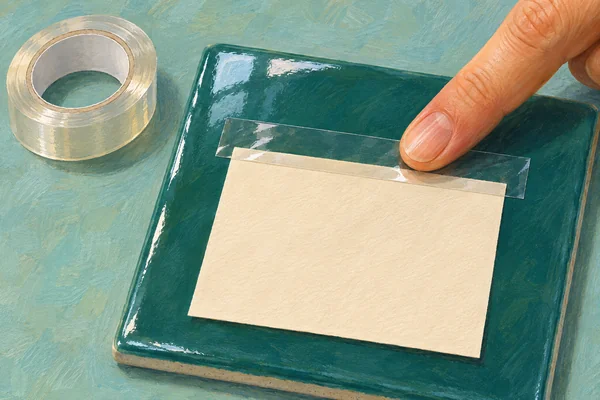
- Bring the same edges of the second sheet together. Lay it on the table and run one finger along the fold to press it down. Open the sheet again.
- Put the sheets side by side in the light. Which one has a narrow shadow along its middle? Look at the sheets from the side, too.
- With very little force, bend both sheets in the same place again. Which one folds more easily along a line?
Use ordinary copy paper and press the fold flat against a table. You don’t need any tools.
The takeaway
A gentle bend spreads across the sheet. A sharp fold changes the structure of the fibers in a narrow strip. That strip stays visible as a crease.
Why does the crease stay visible after you open the sheet?
Sources & further reading
MIT Libraries · Fold Mechanics of Natural and Synthetic Origami Papers ↗Thiria & Adda-Bedia · Relaxation Mechanisms in the Unfolding of Thin Sheets ↗Japan Society of Mechanical Engineers · Automated folding and creasing of paper ↗Our stories explain the main idea in our own words. Pictures and models simplify reality and are not drawn to scale.