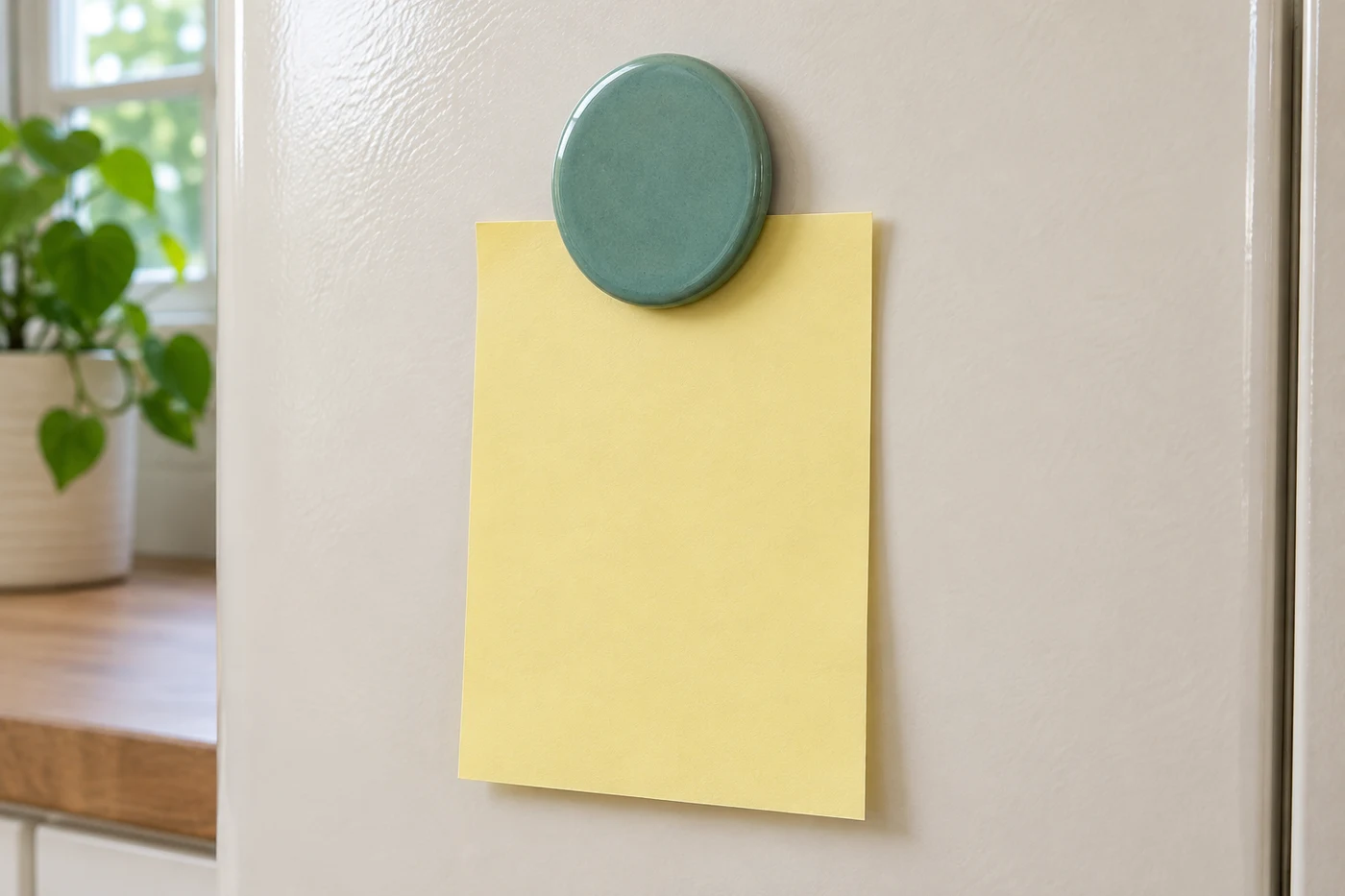
Magnetic attraction pulls the magnet against the steel door. Gravity pulls it down. Static friction acts upward where the magnet touches the door and holds it in place as long as it can balance the magnet’s weight.
Put a magnet on the fridge and let go. It stays at exactly the same height. The attraction pulls it toward the door, though. What keeps the magnet from sliding down?
The magnet is pulled toward the door
The magnet’s field realigns some magnetic regions in the steel. That makes the steel and the magnet attract each other. On a flat, upright part of the door, this attraction pulls the magnet mainly toward the door.
Once the magnet touches the door, the door pushes back against it. The magnet stays in contact with the surface. A fridge magnet barely holds, if at all, on plastic and some types of stainless steel.
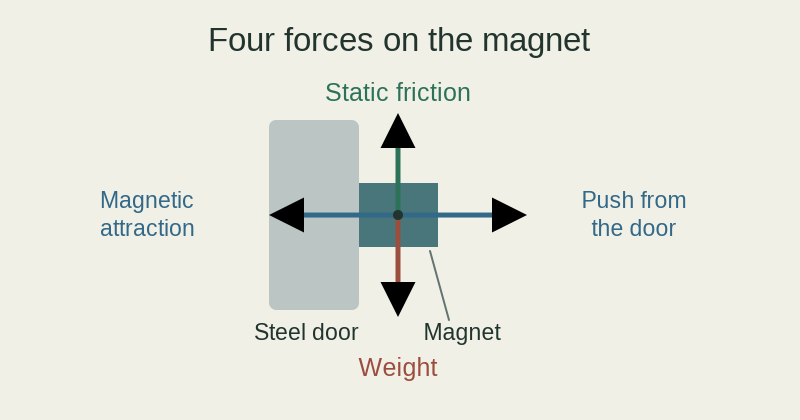
Static friction keeps it at the same height
Earth pulls the magnet down, so it would slide along the door if there were no friction. Where the surfaces touch, an upward force holds it in place. We call that force static friction while the surfaces stay still relative to each other.
When the magnet hangs still, downward gravity and upward friction are equal in size. Static friction has a limit, though. With the same two surfaces, pressing the magnet harder against the door lets friction balance a larger downward force.
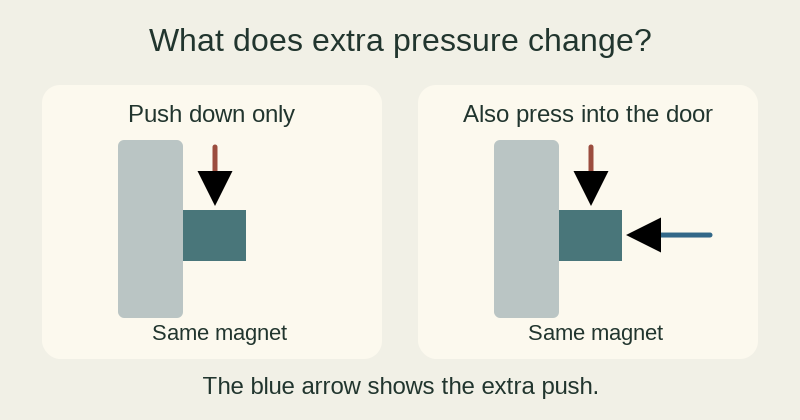
A downward push can exceed that limit
Push the magnet down very gently and static friction can balance both your push and gravity. Push harder with the same contact pressure, and eventually the magnet starts to slide.
The materials touching each other also matter. A grippy backing can hold better on the same door than a smooth one. Two magnets that are pulled toward the door equally strongly can therefore take different amounts of force to slide.
Try sliding the magnet with and without extra pressure
- Pick a broad, flat fridge magnet and remove any note. Put it on a clean spot on the door where it holds securely. Place a folded towel below it in case it slips.
- Use one finger to push the magnet very slowly down from the top. Notice roughly how much force it takes before the magnet moves.
- Lift the magnet off and put it back in the same spot. Use one finger to press it straight against the door. With a finger on your other hand, try pushing it down as before.
- Carefully repeat both trials. When was it easier to get the magnet moving?
Use an ordinary fridge magnet with a smooth backing. Slide it only a short distance and keep it from falling. Skip small or powerful magnets for this activity.
The takeaway
Magnetic attraction holds the magnet against the door. Upward static friction keeps it from slipping.
Which force balances the weight of the magnet while it hangs still?
Sources & further reading
OpenStax · University Physics, 6.2 Friction ↗University of Alabama · General Physics II, Abschnitt 7.4.3 ↗Rensselaer Polytechnic Institute · Refrigerator Magnets ↗Our stories explain the main idea in our own words. Pictures and models simplify reality and are not drawn to scale.