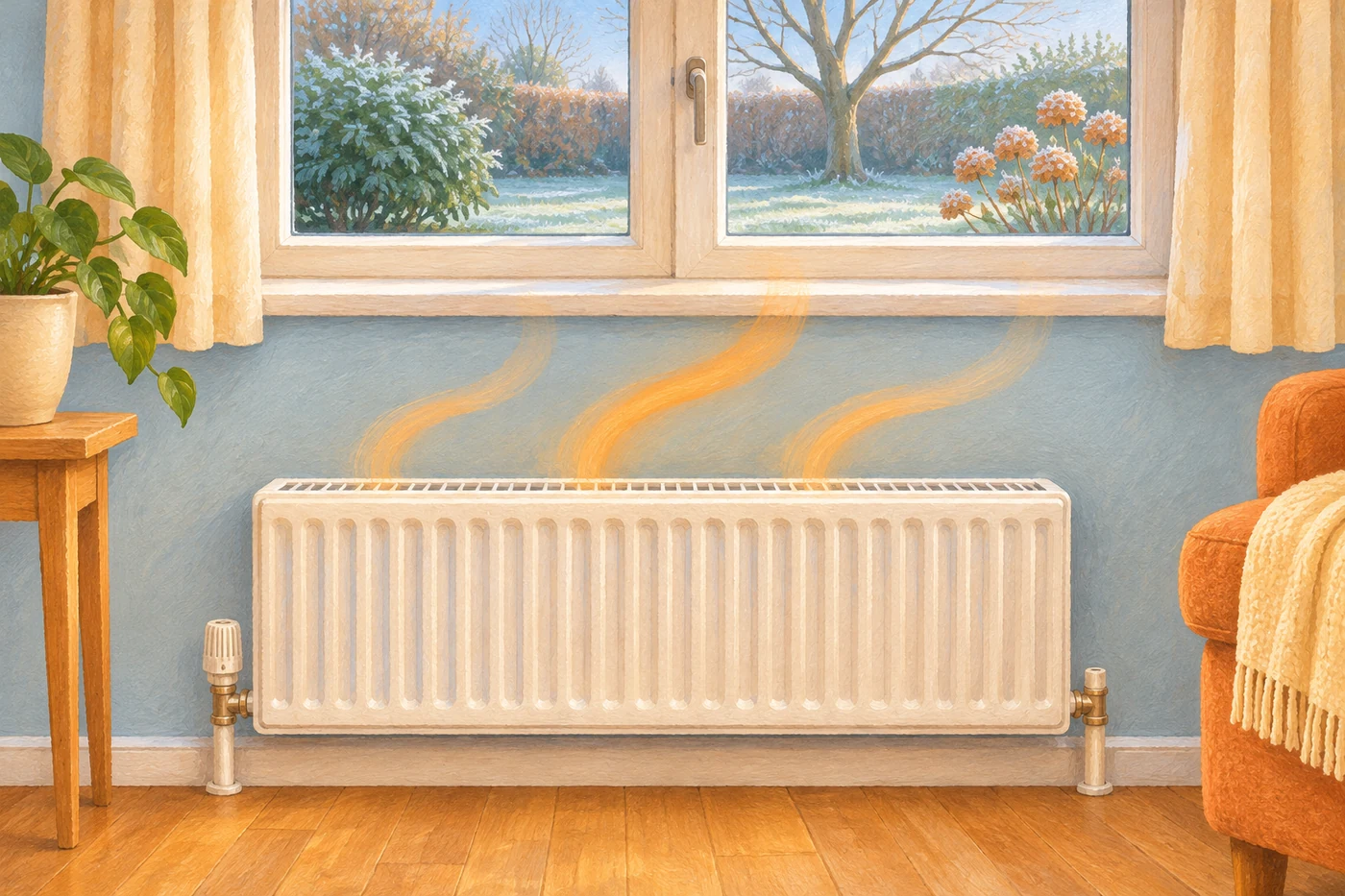
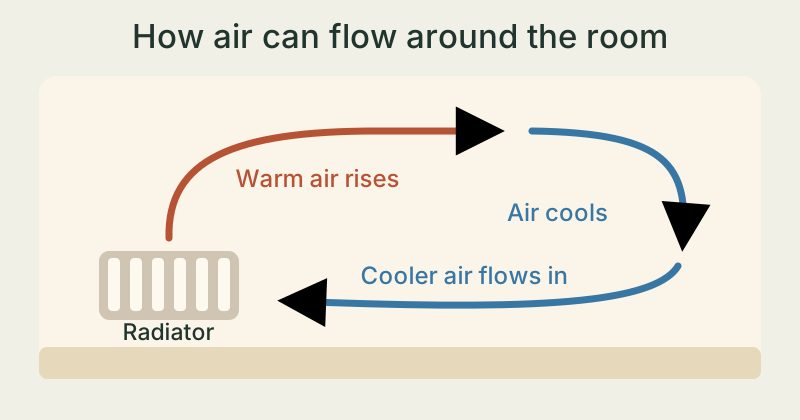
The radiator warms the air right around it. The air expands and becomes less dense than the cooler air nearby. The warmer air rises, and cooler air flows in to take its place. This movement carries heat around the room.
A radiator often sits low on the wall, yet it warms the air higher up in the room too. An air current starts right above it. You can make that movement visible with a light strip of paper.
Warm air takes up more space
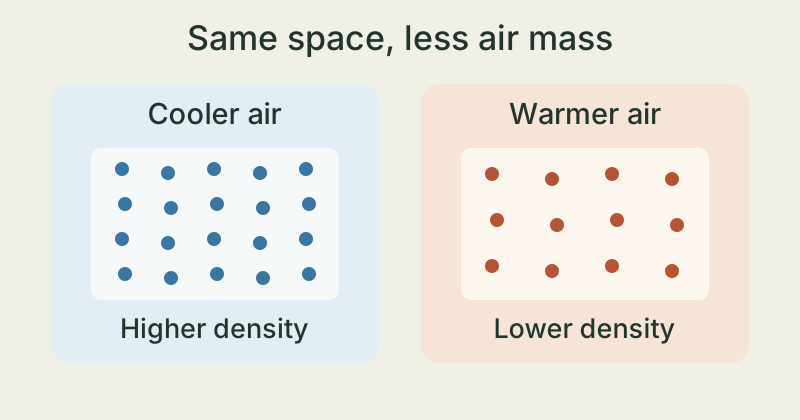
Air is made of tiny particles that are always moving. When air near the radiator warms up, its particles move faster. In the open room, the warmed air can expand. The same amount of air now takes up more space.
Imagine two cubes of air the same size, one warm and one cool. On average, the warm cube contains fewer particles. It has less mass even though it takes up just as much space. We say the warm air is less dense.
Cooler air flows in
In the cooler surroundings, the warmer air experiences buoyancy. This upward force helps it rise. Cooler air flows towards the radiator from below and from the side. It can warm up there too.
As the warm air moves through the room, it mixes with the air already there. Near cooler surfaces, air can cool and sink again. The flow depends on the room: a window, furniture or a draught can change its path.
Moving air carries heat
When moving air carries heat with it, we call it convection. Near the radiator, the temperature difference alone can set the air moving. That's called natural convection.
The radiator also gives off thermal radiation. That can warm your hand when you hold it in front of the radiator, for example. The paper strip in the activity responds to the moving air.
Make the moving air visible with paper
- Cut a narrow strip from a single layer of a paper tissue. Close the windows and doors to reduce draughts.
- Hold the strip firmly by one end. Start beside a warm hot-water radiator, around the height of its top edge. Then move the strip directly above the radiator, keeping a gap. Pause at each spot until your hand is still. Where does the loose end lift or flutter more?
- Compare the two spots again after the radiator has cooled completely. Is the difference smaller? If the strip flutters about the same everywhere, there may be a draught.
Do the activity with an adult and use a hot-water radiator. Keep hold of the paper and leave at least a hand's width of space. Do not touch or cover the radiator during the activity.
The takeaway
Warmed air expands. It rises because it is less dense than the cooler air nearby. This flow spreads heat around the room.
What happens to the air's density as it warms up and expands near the radiator?
Sources & further reading
OpenStax · University Physics: Mechanisms of Heat Transfer ↗Oregon State University · Conduction, Convection, and Radiation: Fundamentals ↗Our stories explain the main idea in our own words. Pictures and models simplify reality and are not drawn to scale.